(Next post on Wednesday:
Famous, forgotten, well-known, and obscure visual artists of Chinese descent in the United States
Showing posts with label New York. Show all posts
Monday, December 25, 2023
Friday, August 18, 2017
Dong Kingman in Life Magazine
May 14, 1951
“Dong Kingman’s U.S.A.”
New York Chinatown
(Next post on Fruday: Ko Kei-Fung in Chinese Digest)
“Dong Kingman’s U.S.A.”
New York Chinatown
Related Posts
Thursday, November 28, 2013
Yun Gee in Theatre Arts Magazine
September 1949
Yun Gee, the painter currently constructing a tunnel to the moon starting from the rear garden of his small apartment in Greenwich Village, finds the future in tomorrow, rather than in the past as Roberts does. As an artist Yun Gee has attracted some attention. An impressionist with a fine sense of color and an extravagant imagination, he has been honored with a one-man exhibit in Newark. He also invented a four-handed checker game.
But his tunnel to the moon is his chef d'oeuvre. It was conceived in the spring of 1946, and might now be in the first stages of construction had not some vile thief stolen Yun Gee’s elaborate set of blueprints later that year. That mishap may have delayed the fulfillment of Yun Gee’s dreams, but it has not discouraged him. While less inspired New Yorkers were wasting time trying to cool off at nearby beaches during the drought this summer, Yun Gee was working up a new set of plans and concocting a brochure which he feels sure will result in the initial capital necessary to launch his gigantic project. Nine million dollars will get things underway. That amount is not, of course, a drop in Yun’s total lunar bucket. The tunnel can be built, without extras, estimates Yun, for 150 billion dollars, considerably less than the total cost of World War Two. “And who will say,” says Yun, “that it will not bring more happiness to the world?”
Nothing makes Yun more unhappy than careless reporters who refer to his project as a “bridge” to the moon. “Scientifically,” he has told me repeatedly, “a bridge to the moon is preposterous. You would never get it beyond the atmosphere. It must be a tunnel so that it can be filled with atmosphere.” For the mechanically inclined Yun Gee’s tunnel will be constructed of aluminum tubing, ten blocks in diameter (Yun is a true New Yorker, measuring small distances in blocks rather than miles or fractions thereof) for the first thirty miles. From then on—that is, for the next 221,006 miles, more or less—it will be possible to construct the walls of the tunnel of bamboo and canvas. The project will employ a million men, and Yun Gee sees it as a giant insurance policy against unemployment in event of an extended business recession. Yun Gee is not enthusiastic, however, at the thought of government financing of the tunnel. “A thing of this nature, involving a certain element of risk, should be undertaken by risk capital. It is all very well, on the surface, for the government to step in and provide material and funds; but frankly, that is not how the American West was won. You cannot open up new frontiers by decree. When this thing is done it will be done by men of vision and daring.” Thus far no men of vision and daring have stepped forth with funds. A neighbor of Yun's applied for the soft drink concession for the tunnel; he offered to pay $100000 for the privilege, if and when completed, but as Yun observed, “It is not the kind of money you can use.”
Like Henry C. Roberts the book dealer, Yun Gee, the artist is not discouraged by temporary setbacks. For he has dreams.
Yun Gee, the painter currently constructing a tunnel to the moon starting from the rear garden of his small apartment in Greenwich Village, finds the future in tomorrow, rather than in the past as Roberts does. As an artist Yun Gee has attracted some attention. An impressionist with a fine sense of color and an extravagant imagination, he has been honored with a one-man exhibit in Newark. He also invented a four-handed checker game.
But his tunnel to the moon is his chef d'oeuvre. It was conceived in the spring of 1946, and might now be in the first stages of construction had not some vile thief stolen Yun Gee’s elaborate set of blueprints later that year. That mishap may have delayed the fulfillment of Yun Gee’s dreams, but it has not discouraged him. While less inspired New Yorkers were wasting time trying to cool off at nearby beaches during the drought this summer, Yun Gee was working up a new set of plans and concocting a brochure which he feels sure will result in the initial capital necessary to launch his gigantic project. Nine million dollars will get things underway. That amount is not, of course, a drop in Yun’s total lunar bucket. The tunnel can be built, without extras, estimates Yun, for 150 billion dollars, considerably less than the total cost of World War Two. “And who will say,” says Yun, “that it will not bring more happiness to the world?”
Nothing makes Yun more unhappy than careless reporters who refer to his project as a “bridge” to the moon. “Scientifically,” he has told me repeatedly, “a bridge to the moon is preposterous. You would never get it beyond the atmosphere. It must be a tunnel so that it can be filled with atmosphere.” For the mechanically inclined Yun Gee’s tunnel will be constructed of aluminum tubing, ten blocks in diameter (Yun is a true New Yorker, measuring small distances in blocks rather than miles or fractions thereof) for the first thirty miles. From then on—that is, for the next 221,006 miles, more or less—it will be possible to construct the walls of the tunnel of bamboo and canvas. The project will employ a million men, and Yun Gee sees it as a giant insurance policy against unemployment in event of an extended business recession. Yun Gee is not enthusiastic, however, at the thought of government financing of the tunnel. “A thing of this nature, involving a certain element of risk, should be undertaken by risk capital. It is all very well, on the surface, for the government to step in and provide material and funds; but frankly, that is not how the American West was won. You cannot open up new frontiers by decree. When this thing is done it will be done by men of vision and daring.” Thus far no men of vision and daring have stepped forth with funds. A neighbor of Yun's applied for the soft drink concession for the tunnel; he offered to pay $100000 for the privilege, if and when completed, but as Yun observed, “It is not the kind of money you can use.”
Like Henry C. Roberts the book dealer, Yun Gee, the artist is not discouraged by temporary setbacks. For he has dreams.
Related Posts
(Tomorrow: Yun Gee’s Patent)
Thursday, October 31, 2013
Masquerading as a Chinese Artist
The Evening Telegram
(New York)
September 19, 1894
“Tammany” cartoon
“CG Bush” is in the panel on the lower-left corner.
(click images to enlarge)
The New York Herald
December 15, 1894
advertisement
December 16, 1894
“At Ye Shrine of Ye Sugar Stork” cartoon
“CG Bush” is in the panel on the lower-right corner.
About Charles G. Bush
The Call
(San Francisco, California)
June 18, 1911
Magazine Section
“1911” and “Stoner” are in the vertical boxes
June 11, 1911
About Harry Stoner
(Next post November 8: Seong Moy in Life Magazine)
The Call
(San Francisco, California)
June 18, 1911
Magazine Section
“1911” and “Stoner” are in the vertical boxes
June 11, 1911
About Harry Stoner
(Next post November 8: Seong Moy in Life Magazine)
Friday, August 30, 2013
Chung Wun, Portrait Painter
The Sun
(New York)
July 29, 1881
A CHEERY CHINESE ARTIST.
The First of His School to Venture to New York.
A Visit to His Studio—Portraits and Sketches
that Adorn the Walls—Not Appreciated,
He Fled to Gotham, and Going to Leave Us.
Fourth avenue, near, thirty-fourth street, has the distinction of harboring the first Chinese artist who ever plied palette and brush in this city. The representative of Chinese art is quartered upon the second floor of a newly-painted and neatly kept flat. Stained glass panes in the lower sashes of the front windows serve as a pleasing contrast to the plain glass in the windows of the other tenants, and temper the light to the shorn and queued artist within. Under the windows is a modest sign, “Chung Wun. Portrait Painter.” A smaller sign of the same purport is on the outer door of the artist’s rooms. In a little obelisk-like column, on either side of the Roman letters of the inscription are the Chinese equivalent.
Thursday, August 22, 2013
Kwei Teng Exhibitions in New York
Seattle Daily Times
(Washington)
October 17, 1929
(click images to enlarge)
New York Evening Post
October 19, 1929
Thursday, August 8, 2013
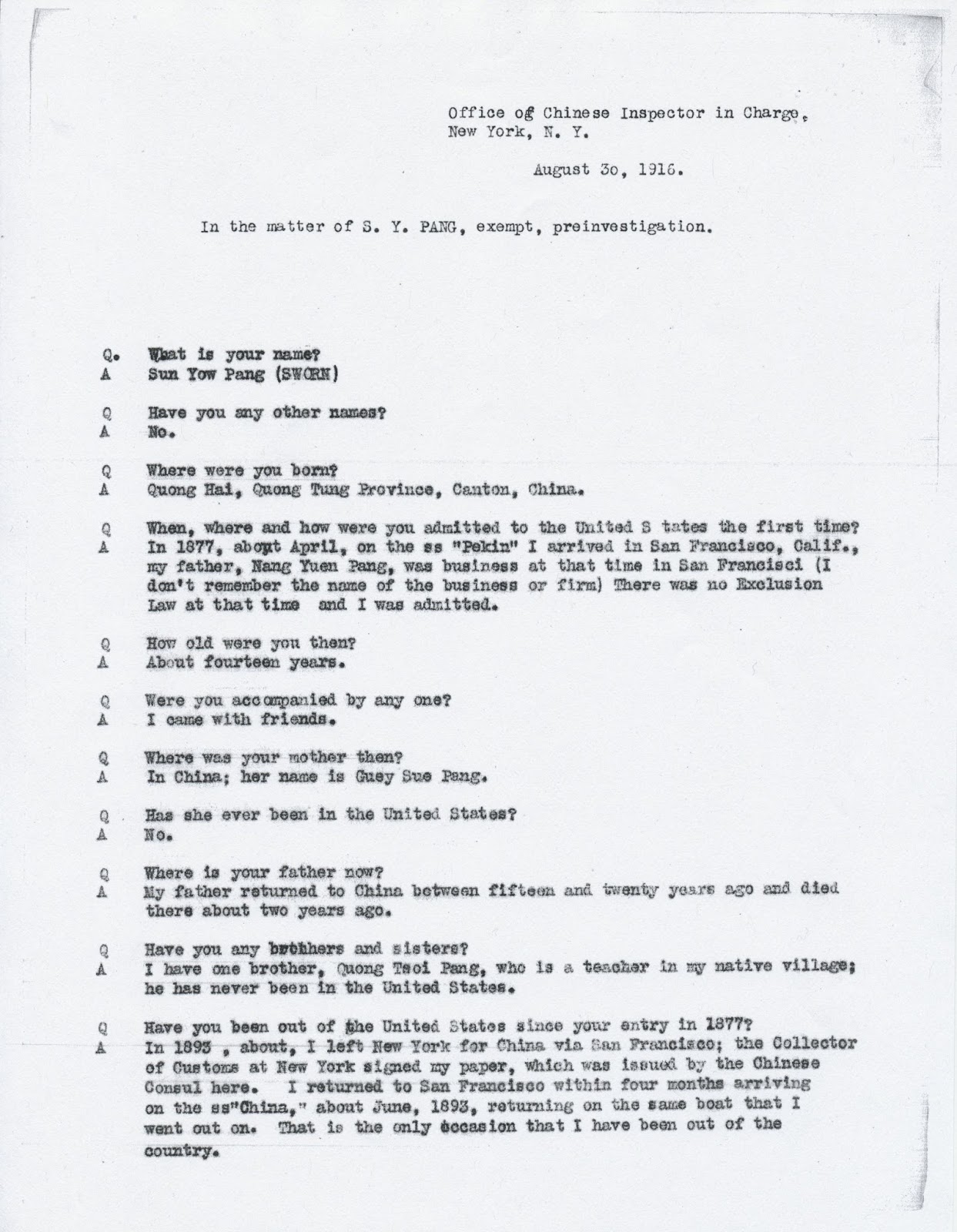
Sun Yow Pang’s Travel Documents
Form 431
1916
Form 431 and Chinese Exclusion Act interview
located at the National Archives, New York City
(Tomorrow: Sun Yow Pang’s The Red Cord)
Monday, August 5, 2013
Sun Yow Pang and the Chinese Weekly Herald
Evening Telegram
(New York)
February 18, 1901
(click image to enlarge)
(Tomorrow: Sun Yow Pang in The Forum)
Sunday, August 4, 2013
Sun Yow Pang on the Emperor, Boxers and a Prince
New York Herald
June 3, 1900
As an American Chinaman Views Situation.
by Sun Yow Pang
China’s present situation maybe best shown by defining the warring parties in China. They are the Ye Ho Chuan, a society commonly known to English speaking nations as the “Boxers,” and the reform party, the Bow Wong Wui. The reformers are the ardent supporters of the young Emperor, Kwang Hsu. They stand for civilization and for progress.
The “Boxers” stand secretly behind the Empress Dowager, Gno La She, and it is believed she sympathizes with their atrocities. They hate the young Emperor and all foreigners, especially Christians, with a bitter hatred. They are fighting tooth and nail against the spread of Christianity in China.
The Empress, who is now about sixty-six years old, is afraid of losing her power. She represents the very essence of the old regime and knows little of the outside world. She fears most of all the partitioning of China by the European Powers. The young Emperor and his supporters feel confident that if they were allowed to govern China its old power would return and it would soon be regarded as a first class Power. They believe if Kwang Hsu were in power the other nations would keep their hands off China.
Although the Empress selected the present Emperor to succeed to the throne, she has become jealous of his growing power and has violently opposed every movement for progress which he has encouraged. It has even been charged, and is generally believed, that she plotted to bring about the murder of her nephew, Kwang Hsu, the present Emperor.
The enlightened Chinese, almost to a man, favor the young Emperor and the reformers. Kwang Hsu’s chief adviser, the leader of the reform party, Kwang Yu Wai, has done more for China and the common people than any other man of the present generation.
During the six months of the young Emperor’s unhampered reign all movements for social and political advancement were encouraged and not a single outrage was committed on the Christian missions. The common people had the hitherto unheard of privilege of appealing to the Emperor in person and stating their grievances.
But the Empress soon tired of this and interfered. She instructed all high officials to disregard her nephew’s orders and promised to protect and promote them in the government service. Then she ordered the execution of six of Kwang Hsu’s leading supporters.
Two of these, who are now spreading the propaganda of the reformers, escaped. They are Kwang Yu Wai and Liung Kai Chu, his principal lieutenant. Kwang Yu Wai escaped from Shanghai to Hong Kong and thence to Japan by means of a British man-of-war, and Liung Kai Chu was spared the sword through the Japanese Legation’s sheltering doors.
Tom Tse Tong, one of the reform leaders beheaded, might have escaped also. But it had been said that the reason reform did not prosper in China was that no blood had been shed in its cause. The other party boasted that none of the Emperor’s supporters was patriot enough to lay down his life in the cause of liberty. So Tom Tse Tong said:—
“Let my head go for China. My blood shall be shed for progress, and thousands will then rise up and fight for Kwang Hsu and the right.”
So he remained and became a victim of the headsman’s swords. He was a Christian, and many of the reform party are of that faith.
The old Empress, restored to power, quietly reinstated the old officials and the old conditions obtained. All movements looking toward progress and civilization, toward social and political advancement and the freedom of thought and speech were effectively checked for the time, and outrages on the Christian missionaries were allowed to pass unpunished.
Then the “Boxers” organized their secret society. They circulated posters through Chilli and Shang Tung provinces, saying:—
“We are for the Manchurian dynasty and would expel every foreigner.”
With fire and sword they waged secret warfare on the missionaries, burned down the mission houses and cut off the heads of the Chinese converts to Christianity and destroyed whole villages. The English nickname “Boxers” was applied to them simply because they were pugilistic—fighting men. The names of the leaders and, in fact, of all the members were carefully guarded, and even now are not known. Their number is comparatively small, but as the government takes no steps to suppress them they are naturally increasing their membership.
Meanwhile Kwang Hsu Wai had gone to Hong Kong o a British war ship, and finding that he was not safe there, had journeyed to Japan. In yokohama he established a periodical, in which he described the Empress as a would be murderess. He advocated the cause of the young Emperor and called him the best of all China’s rulers.
He carried the propaganda of the reformers to British Columbia, and thousands of the Chinese residents there hailed him as “the savior of China” and flocked to his standard. He started there a branch of the Bow Wong Wui, the reform society, and several thousand members are now enrolled on its books. In fact, the majority of the Chinese in British Columbia are members of that organization. He then returned to Japan, and from there went to Hong Kong. But the old Empress, stung to the quick by the vituperative language Kwang Hsu Wai had used toward her in his Japanese periodical, and frenzied at the activity of his Bow Wong Wui campaign abroad, set a price of $160,000 upon his head.
So Kwang Yu Wai realized that he was no longer safe in Hong Kong and went to Singapore, where a large number of the reform party had sought sanctuary. He is now in Siam, where many recruits have been received for the reform ranks.
The Chinese reformers throughout the world are no engaged in purchasing modern weapons of war, preparatory to an uprising in Kwang Hsu’s behalf in the event of his imprisonment or death.
An active branch of the reform party exists in San Francisco, and Liung Kai Chu, the other reform leader, who is now in Hawaii, intends to to visit San Francisco in the near future. The American members of the Chinese Diplomatic Corps are using every influence they can command to keep the Chinese residents in America from joining the reform party, and will prevent, if they can, the landing of Liung Kai Chu on American shores.
He is not afraid of death, however, and declares that he will sail for San Francisco as soon as Honolulu is free from the bubonic plague. A price of $60,000 has been set upon his head by the Empress. But despite the warnings of the Empress emissaries in America, thousands of the Chinese residents have openly attended meetings in favor of the Bow Wong Wui and are wearing the ribbon badge of the reform society
Labels:
1900,
1902,
Boxers,
Emperor,
New York,
New York Herald,
Sun Yow Pang
Friday, August 2, 2013
Sun Yow Pang in The World
The World
(New York)
January 6, 1897
(click images to enlarge)
January 16, 1898
“A Chinese Artist Draws an American Comic.”
Drawn by Sim You Tang [sic] for the Sunday World Comic Weekly.
(Tomorrow: Instruction for Chinese Women and Girls)
Labels:
1897,
1898,
Cartoonist,
New York,
Sun Yow Pang,
The World
Thursday, August 1, 2013
Sun Yow Pang, Student and Artist
The Twenty-Ninth Annual Report
of the Trustees of the Cooper Union
for the Advancement of Science and Art
May 26, 1888
Ornamental Drawing.
Third Year.
P. Sun Yow
(click images to enlarge)
Newton Register
(New York)
April 17, 1890
The Brooklyn Daily Eagle
(New York)
September 21, 1890
“Chinese Christians”
March 3, 1891
“Two Sunday Schools Celebrate with Supper and Song.”
The Sun
(New York)
December 30, 1891
“Chinese Morality”
Daily Standard-Union
(Brooklyn, New York)
January 6, 1892
“Left the Hall”
(Next post August 9: Sun Yow Pang in The World)
Sunday, May 5, 2013
Dong Kingman by James Wong Howe
Photo from The Water Colors of Dong Kingman
James Wong Howe filmed Kingman
painting in New York’s Chinatown.
See the film at the Internet Archive.
Related Posts
Exhibitors Herald-World, January–March 1929
James Wong Howe, International Photographer
James Wong Howe, Cinematographer
The Man Who ‘Shot’ Lincoln
James Wong Howe in Look Magazine
James Wong Howe’s Stars
James Wong Howe in The New Movie Magazine
Exhibitors Herald-World, January–March 1929
James Wong Howe, International Photographer
James Wong Howe, Cinematographer
The Man Who ‘Shot’ Lincoln
James Wong Howe in Look Magazine
James Wong Howe’s Stars
James Wong Howe in The New Movie Magazine
Friday, April 5, 2013
Woo Ching Fow
The New York Evening Journal
January 18, 1898
(click image to enlarge)
Impressions of Woo Ching Fow, the Chinese Artist, of the New Joss House.
His sketch was [illegible] for the Evening Journal [illegible] Joss house was [illegible] in Chinatown [illegible] Pell street. Fow as an artist is well known in
Friday, March 22, 2013
Chin Yin a.k.a. Chin Jin
1910 U.S. Federal Census
Manhattan, New York, New York
3 Doyers Street
Line 22: Chin Yin, Artist
(click images to enlarge)
The Call
(San Francisco, California)
August 31, 1913
“4 Bridal Feasts for Ms. Chin Chee”
drawing by Chin Jin
drawing by Chin Jin
(Next post March 29: Charles Leong, Painter)
Friday, February 22, 2013
John Zane’s Identity and Travel Documents
Form 430
1921
(click images to enlarge)
Passport Application
1921
Chinese Exclusion Act Interview
New York, 1924
Form 430 and interview photocopies at
the National Archives in New York City.
Passport application at Ancestry.com.
(Tomorrow: John Zane in Shanghai)
the National Archives in New York City.
Passport application at Ancestry.com.
Related Posts
Thursday, February 21, 2013
John Zane to the Rescue
New York Evening Post
October 11, 1924
The New York Times
October 11, 1924
(excerpt)
When the first engines arrived flames were shooting through the superstructure and about 200 coolies of the crew, asleep below, had been confused by smoke and were shouting for help. Watchmen, firemen and policemen helped them off after they had been quieted by John Zane, a Chinese cartoonist on the China Press of Shanghai, who is working his way around the world as a member of the crew. A few Chinese jumped into the water and were fished out. They gathered with the rest on the pier, which also was aflame for a time, and cheered Zane for having saved them from panic and its consequences.
Friday, February 8, 2013
Wong Kai Wee a.k.a.
Wong Kai Kee was also known as Wee Kai Wee.
The World
(New York)
July 19, 1900
(click images to enlarge)
(Tomorrow: Charlie Low, the Lightning Chinese Artist)
Thursday, February 7, 2013
Wong Kai Kee in Jail
Subscribe to:
Posts (Atom)


+p1+0480.jpg)


+p07.jpg)
+p16.jpg)

.jpg)
.jpg)
.jpg)
.jpg)


.jpg)


.jpg)

.jpg)
.jpg)
.jpg)


.jpg.jpg)


.jpg)

.jpg)

.jpg)