Showing posts with label Architect. Show all posts

Wednesday, March 29, 2023

Shinn-hong Howard Jee, Civil Engineer and Architect


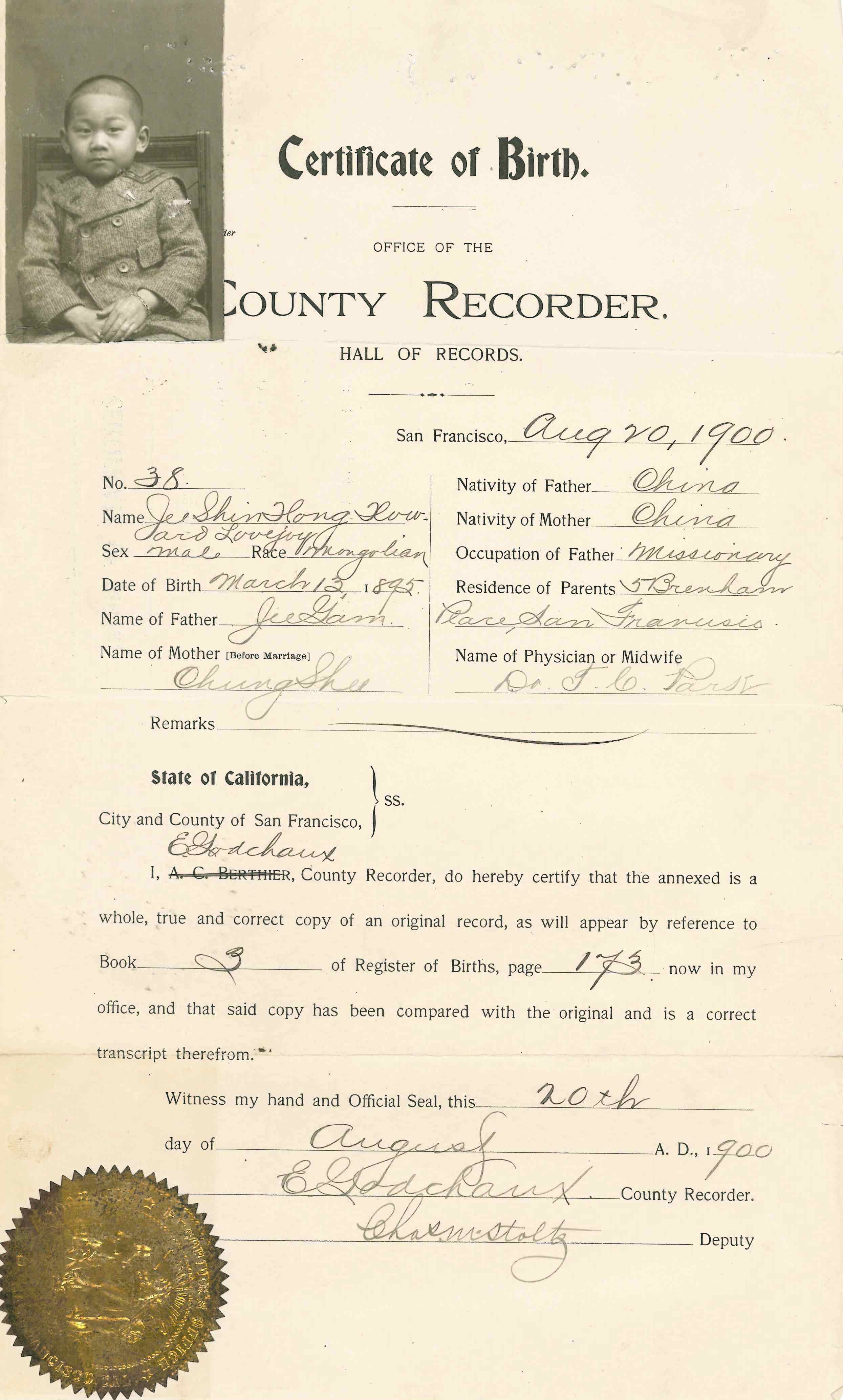
Shinn-Hong Howard Jee was born Jee Shin Hong Howard Lovejoy (朱神康 Zhu Shenkang) on March 13, 1895 in San Francisco, California. Jee’s birth certificate is in his Chinese Exclusion Act case file at the San Bruno branch of the National Archives. 


The New York Times, December 3, 1899, interviewed Jee’s father, Jee Gam (朱金 Zhu Jin), who explained how he named his children; below is an excerpt about Jee. 
When the seventh child came, it was a boy, too, and that was just at the time of the war between China and Japan. I wanted very much to have peace, so I said I will call my boy God’s Peace. Then there was that good man Gen. Howard, and there was Mr. Lovejoy, who was a friend of Dr. Pond. I must name one of my boys after him, so I called my last boy Shin Hong Howard Lovejoy.
The St. Paul Globe (Minnesota), November 19, 1899, said Jee Gam was a native of the Hoi Ping district (Kaiping in Mandarin). 

In the 1900 United States Census, Jee was the youngest of seven children. His father was minister of the Congregational Church. The family lived in San Francisco, California at 7 Brenham Place. 


The Marysville Appeal (California), May 10, 1904, reported the twenty-fourth anniversary of the Marysville Chinese Mission. Jee and his brother, Jee Shin Min Benton, sang a song in Chinese, “America”. Jee’s father spoke about “The New China”. 

On April 18, 1906, an earthquake and fire devastated sections of San Francisco, especially Chinatown. The church housing the Jee family was severely damaged but the family survived.

The 1910 census was enumerated in April. Jee was fifteen years old. The family’s address was 21 Brenham Place in San Francisco. 


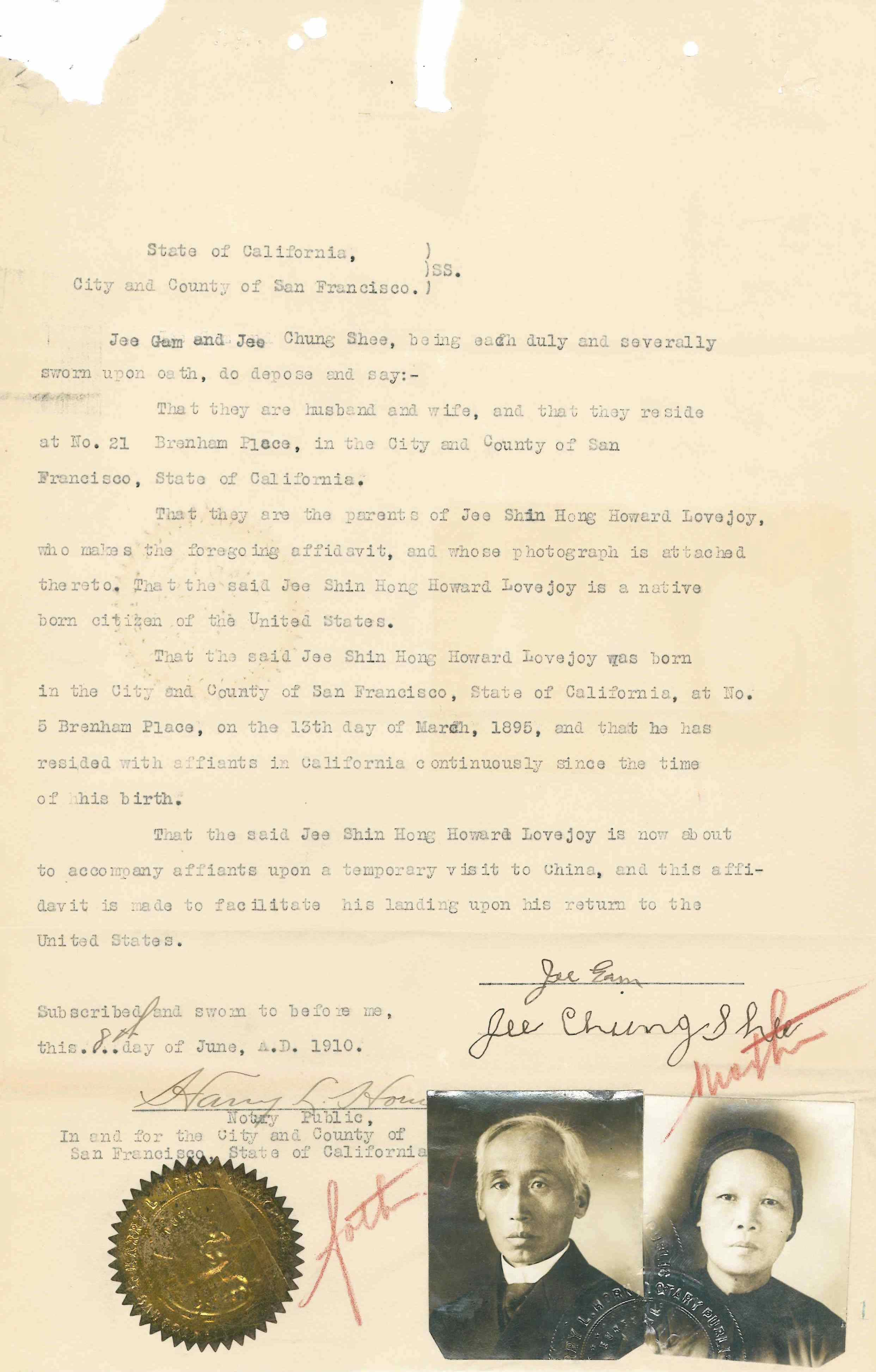
In June 1910, Jee Gam, his wife and four children made plans to travel to China. They were interviewed on June 16, 1910. 


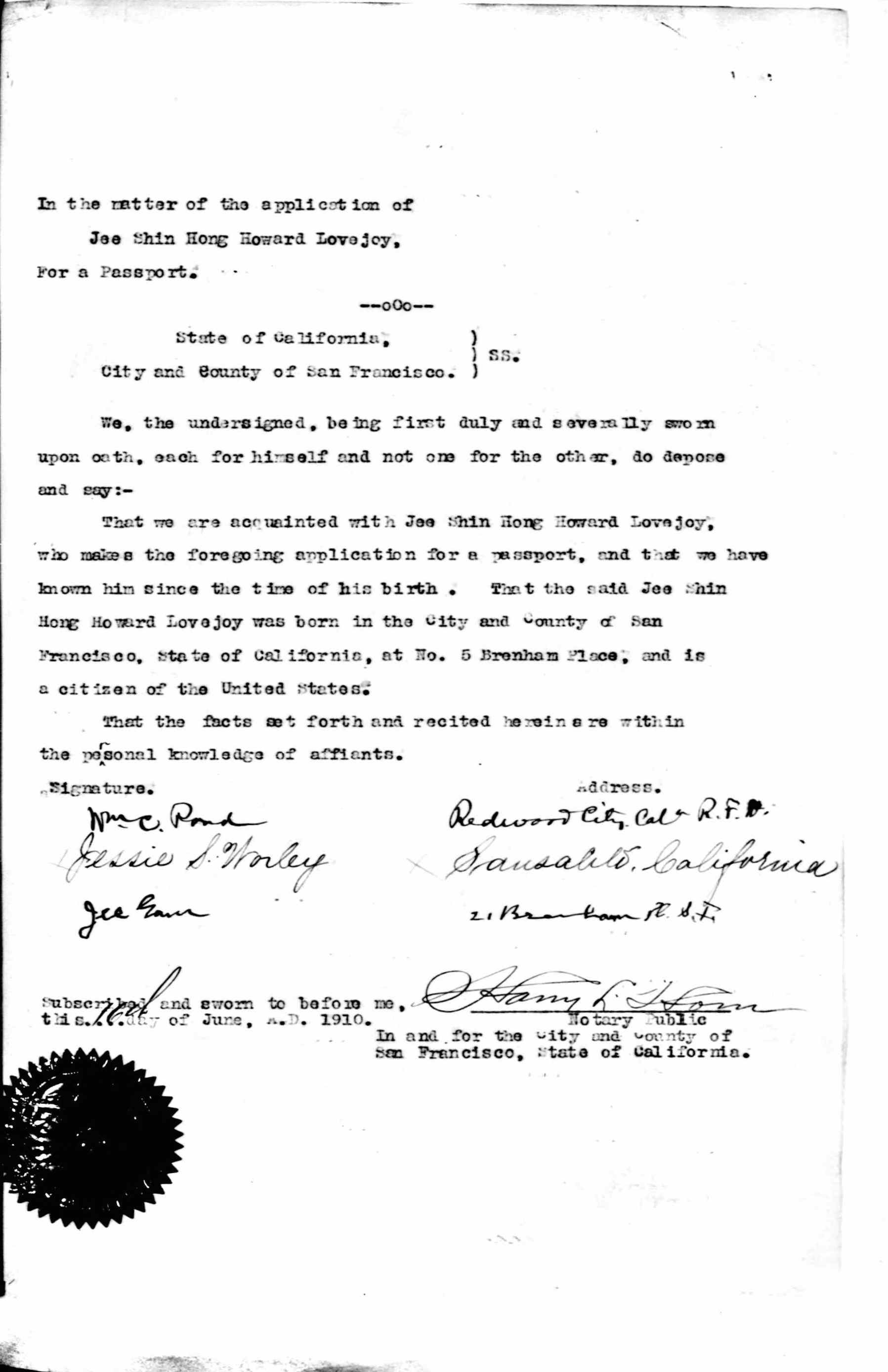
Jee’s parents vouched for him. 


In a separate interview, Jee Gam said he was 62 years old and born in “See Gow Chun village, H P D [Hoi Ping District]”.


Form 430 was issued to each Jee member.


A record at Ancestry.com said a passport was issued to Jee on June 27, 1910. Below are pages of the application. 


The San Francisco Call, July 7, 1910, said the Jee family and others had departed July 6 on the Pacific Mail steamship China. The Jees’ final destination was Shanghai. 

Before the ship reached its first stop in Honolulu, Hawaii, Jee Gam died. News of his death was reported on July 21 in the Oakland Tribune and San Francisco Call. (The family name Jee was also spelled Gee in some publications.)

Already in China were Jee Gam’s eldest sons, Jee Shin Wong (location unknown), Jee Shin Fwe Pond Mooar in Tientsin (Tianjin), and Jee Shin Yien Luther McLean in Tangshan. After the children and their mother arrived in Shanghai, Jee traveled to Tientsin and continued his education. 

Jee had a Certificate of Registration of American Citizen from the American consulate in Tientsin. Dated March 19, 1912, it said he was a student at the Tangshan Engineering College. His mother was in Tientsin at 17 Rue de Paris. 


The American Missionary, January 1914, published an article and photograph of the Jee family in Tangshan. 

Left to right: Mabel Kau Jee (wife of Pond Mooar Jee), 
Pond Mooar Jee, Howard Jee, Chung Shee, Luther 
McLean Jee, Mae Jee, and Benton Jee


On September 17 1919, Jee obtained an emergency passport to return to the United States. From 1910 to 1915, he was in Tangshan, and from 1915 to 1919 in Tientsin.


Aboard the steamship Nile, Kee departed Shanghai on October 19, 1919. He arrived in San Francisco on November 11 and answered several immigration questions.


Six days later, Jee applied for his Certificate of Identity. 


Jee had returned to continue his engineering education. In Seattle, he enrolled at the University of Washington. The following year he was listed in the 1920–1921 catalog. The 1921 school yearbook, Tyee, said Jee was in the American Society of Civil Engineers and Chinese Students Club (His name was misspelled Chinn). 


In Seattle, Jee was involved with the Chinese Students’ Christian Association in North America. 

Later in 1921, Jee transferred to the University of Michigan and enrolled in the College of Architecture. The 1922 yearbook, Michiganensian, listed Jee as a member of the Chinese Students Club. Jee graduated in 1923. He earned a Bachelor of Science in architectural engineering. 


The Michigan Alumnus, October 11, 1923, said 
Shinn-hong H. Jee, ’20–’22, who was formerly in Ann Arbor, may now be addressed at 6138 University Ave., Chicago, Ill.
The Michigan Alumnus, March 7, 1924, said 
Shinn-hong H. Jee, ’23e, is draftsman with the office of William Neil Smith, Architect, New York City. He may be addressed at Apartment 34, 195 Claremont Ave., New York City. 
In July 1924, Jee returned to China. The exact date was not known according to two immigration letters. 


The Annuary 1925–1926 of the American Institute of Architects listed Jee as junior member. 
Jee, Shinn-hong Howard.....1923
100 Rue Petain, Tientsin, China
The Michigan Alumnus, June 5, 1926, said 
S. Howard Jee, ’23 arch, has recently opened an architectural office at 100 Rue Petain, Tientsin, China. 
In February 1925, Jee’s brother, Shin Fwe Pond Mooar, passed away. According to the death certificate he died at 100 Rue Petain, Tientsin, China. Shin Fwe Pond Mooar and his family and brothers, Benton and Jee, lived in Tientsin at 10 Falkland Villas. 


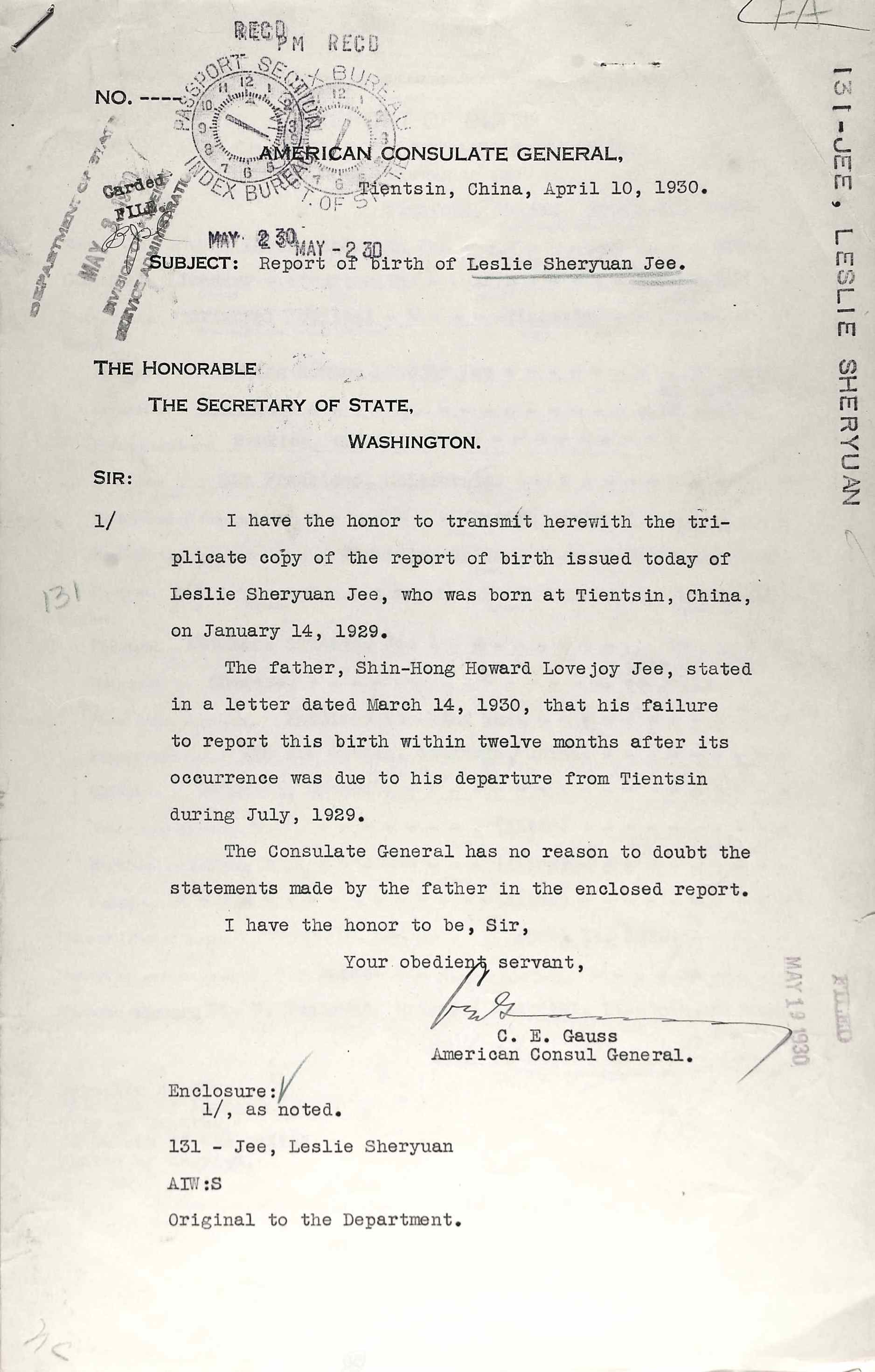
On January 15, 1929, Jee’s son, Leslie Sheryuan, was born in Tientsin. The mother was Kathleen Siu-Ming Sun, a Tangshan native, whom Jee married on April 14, 1928. When Jee moved in July 1929, he forgot to report his son’s birth to the American consulate. Jee was in Nanking (Nanjing) when the report was filed on April 10, 1930. 


While in Nanking, Jee had collaborated with Yook Yee Wong, in 1929, on the Capital Plan. Their names are on the drawing in the lower right hand corner.


100 Rue Petain Tel 30784
Jee, S. Howard
Architect
What became of Jee is not known. There is no record of Jee’s return to the United States. Presumably Jee lived out his life in China.


Sidebar: The Jee Family
1. Jee Gam, died July 1910
San Francisco Call, September 20, 1895, Jee Gam’s Ordination 
Leslie’s Weekly, April 7, 1900, Jee Gam photograph
San Francisco Call, November 9, 1905, Chinese Interpreter Abandons Queue 

2. Chung Shee, probably died in China

3. Jee Shin Wong Linforth, status unknown

4. Jee Shin Fwe Pond Mooar, died February 22, 1925


5. Jee Shin Yien Luther McLean, died November 29, 1960
partially named after Rev. John Knox McLean


6. Jee Shin Mae Felt Blodgett, status unknown
partially named after Rev. Henry Blodget
photograph in the Overland Monthly, January 1894

7. Jee Shin Quong Henshaw, died June 24, 1939
photograph in the Overland Monthly, January 1894


wife, Anna Jee arrived in San Francisco January 1947; passed away May 15, 1993 in New York City
daughter, Ellison Jee arrived in San Francisco in September 1940; married and passed away October 27, 2001 in New York City

8. Jee Shin Min Benton, status unknown


Further Reading
Peter G. Rowe, Seng Kuan
MIT Press, 2004
Pages 73–74 
... The planning office first attempted to arrive at an acceptable proposal for the new capital’s administrative center on Purple Mountain through a design competition. The first-ranked submission, by Huang Yuyu (an engineer in the planning office) and Zhu Shenkang, was noteworthy for combining modern Beaux-Arts axial planning and, in places, a traditional Chinese unfolding of major urban spaces, as well as for its unified architectural proposals. ... 
Jeffrey W. Cody, Nancy S. Steinhardt, Tony Atkin, Editors
University of Hawaii Press, 2011
Page 69
... The period of relative prosperity, however chaotic, of the 1920s lasted only until the Japanese invasion, beginning in 1934. Among the many projects begun in the 1920s, the most ambitious was the establishment and planning of a new national capital by Chiang Kai-shek and the Goumingdong in Nanjing, designed by Huang Yuyu and Zhu Shenkang in 1928 [sic]. The plan laid out a modern city with different administrative districts and an axial relationship to Sun Yat-sen’s mausoleum. ... 
Charles Musgrove
University of Hawai’i Press, 2013
Pages 98–99
... The design that earned the most praise was the work of Chinese architects Huang Yuyu (an engineer in the city planning office) and Zhu Shenkang. (figs. 3.3 and 3.4) The judges specifically praised the patriotic flavor of the building designs: “[The plan] follows the Chinese ancient style in that all the buildings project a feeling of magnificence and enchantment.” The layout also reflected the spirit of the new China: “The arrangement is very systematic, in order to express freedom and equality in the Chinese republic.” To the judges, the plans evoked confidence in the GMD-led government, which would “represent” a “people’s nation,” with the “appearance and stability of a mountain rock” (Shoudu zhongyang zhengzhi qu” 1929, jihua 1). 

Friday, May 13, 2022

Two Accounts of Yook Yee Wong’s Death at Baoshan

1902–1942

Eighty years ago this month, Yook Yee Wong was killed during the bombing of Baoshan in May 1942. Below are two accounts of his death.

  廖寿柏(1911 年出生,培正中学退休老师,抗战前负责学校总务,1953 年后任 地理老师)
口述日期:2015 年 2 月 26 日、4 月 16 日(两次综合)
口述地点:廖寿柏家中
采访及文字整理:新快报记者 莫冠婷 实习生 张文慧 注:红字标注的时间是查资料所得,因廖寿柏记不起日期。其他时间均是他口述。
(日期参考:http://www.cssn.cn/lsx/lskj/201407/t20140713_1251415.shtml) [dead link]

1937 年 8 月末,日军轰炸广州,我当时在培正中学当老师,负责总务。那 时候刚开学,学生看见轰炸都不敢报到,所以培正中学就搬去了鹤山。我后来也 就调去了香港。但因为香港又没有亲人在,别人就介绍我去飞机厂工作。1939 年,我就去了云南缅甸交界的中央雷允飞机制造厂,在会计室做闲职,管理飞机 厂医院的日常开支,以及清点飞机厂合作社的物资。

我去了那边没有多久,黄玉瑜就来了,当时我不认识他。后来知道,黄玉瑜 是台山人,我也是台山人。他是搞工程的弄设计的,主要就是管理厂的建筑。我 记得他去买竹,用竹子就搭起了一座电影院,好像一个礼堂一样,但没有顶遮盖 的,用来每个星期放电影。我住的宿舍窗口就对着他,他每晚都煲咖啡,都叫我 去喝一杯,顺便聊天。我和他说喝咖啡晚上睡不着的,他说不是喝很多不怕。后 来,我就每晚都去他那边喝咖啡,聊天。

  当时飞机厂的宿舍是张鸿设计,他是广东恩平人。

1942 年,日本军队打入缅甸,我所在的飞机厂希望搬迁,就派了黄玉瑜去 保山找地盘去侦察,重新建设。他比我早十几天去的,我就委托个司机帮我将行 李送去给黄玉瑜那边。后来,我们就去了保山和黄玉瑜旅馆那边住,黄玉瑜当时 就和我们说没什么地方住一齐只能睡地板,我们说也没什么所谓,就和另一个同 事陈兆强一起住在他旅馆房间。第二天早上,有个广州人就找了间房子,那间房 子新建成的,两层楼,我们就租了,搬了进去。黄玉瑜看见我们去了,他就跟着 我们去住,那就不用睡旅馆。有个姓黄的会计也一起搬了来睡地板。

1942 年 5 月 4 日,我、陈兆强早上就去吃早餐,黄玉瑜没有去。后来,我 回到房子里,黄玉瑜就叫我一起去吃午餐,我说我刚吃饱,就不出去了。黄玉瑜 就和黄会计一齐出去。我就在房里继续睡觉。到中午时,就听到飞机的声响,我 们赶紧跑下楼,分别跑到不同的巷子,我们趴在地上,看到那些炸弹就一轮轮地 放。后来我们就跳进了一个山坟里面躲避。到了四点钟左右,我就看见黄玉瑜被 人用帆布床送去医疗营。我们厂就立即下命令连夜撤走,搬去了离保山几公里的 一个村。我们的厂临时办事处就找了几间屋子,安排职工暂住。
 
 我和陈兆强就睡在农村的石路上,原来旁边都是死尸,一阵恶臭,我们不睡 了,坐在那边等消息,后来看见很多乡民紧张地离开。刚好,有个英国人的红十 字会车队经过,司机是广东人,我就问他情况,他说日本人已经烧到功果桥。我 们趁洋人队长一走开,就钻进了货车的帐篷里面,准备跟车离开。到第二天早上 7 点,我们的车也未离开保山。

第二日早上 8 点左右,日本军队又再一次轰炸,当时我们全部人都来不及逃 命撤离,剩下黄玉瑜在医疗营那里,没有人抬他离开,黄玉瑜就在那时候牺牲了。

Liao Shoubai (born in 1911, retired teacher of Peizheng Middle School, in charge of the general affairs of the school before the Anti-Japanese War, and a geography teacher after 1953)

Oral Dates: 26 February, 16 April 2015 (two rounds)
Oral location: Liao Shoubai's home
Interview and text arrangement: New Express reporter Mo Guanting Intern Zhang Wenhui Note: The time marked in red is obtained from the data search, because Liao Shoubai cannot remember the date. The rest of the time is his dictation.
(Date reference: http://www.cssn.cn/lsx/lskj/201407/t20140713_1251415.shtml) [dead link]

At the end of August 1937, when the Japanese bombed Guangzhou, I was a teacher at Peizheng Middle School and was in charge of general affairs. At the beginning of the school year, the students did not dare to report to see the bombing, so Peizheng Middle School moved to Heshan. I later moved to Hong Kong. But because I didn’t have any relatives in Hong Kong, I was introduced to work in an aircraft factory. In 1939, I went to the Central Leiyun Aircraft Factory on the border of Yunnan and Burma, where I took a spare job in the account- ing office, managed the daily expenses of the aircraft factory hospital, and counted the materials of the aircraft factory cooperative.

Not long after I went there, Huang Yuyu came. I didn’t know him at the time. Later I learned that Huang Yuyu was from Taishan, and I was also from Taishan. He was engaged in engineering design, mainly to manage the building of the factory. I remember he went to buy bamboo and built a movie theater out of bamboo, like an auditorium, but without a roof, to show movies every week. The window of the dormitory where I lived was facing him. He made coffee every night and asked me to have a drink and chat by the way. I told him that I couldn’t sleep at night when I drink coffee, and he said I’m not afraid of drinking a lot. After that, I went to his place every night to have coffee and chat.

At that time, the dormitory of the aircraft factory was designed by Zhang Hong, a native of Enping, Guangdong.

In 1942, the Japanese army invaded Burma, and the aircraft factory I was in wanted to relocate, so I sent Huang Yuyu to Baoshan to find a site for reconnaissance and rebuilding. He went ten days earlier than me, so I asked a driver to help me deliver my luggage to Huang Yuyu. Later, we went to stay at a Baoshan hotel. Huang Yuyu told us at the time that there was no place to live together and could only sleep on the floor. The next morning, a man from Guangzhou found a house. The house was newly built with two floors. We rented it and moved in. When Huang Yuyu saw us go, he stayed with us, so there was no need to sleep in a hotel. An accountant surnamed Huang also moved in to sleep on the floor.

On May 4, 1942, Chen Zhaoqiang and I went to have breakfast in the morning, but Huang Yuyu did not go. Later, when I returned to the house, Huang Yuyu asked me to have lunch. I said that I would not go out soon as I was full. Huang Yuyu went out with accountant Huang. I continued to sleep in my room. At noon, we heard the sound of the plane. We hurried downstairs and ran to different alleys. We lay on the ground and the bombs dropped one after another when we saw them. Then we jumped into a mountain tomb to escape. At about four o’clock, I saw Huang Yuyu being taken to the medical camp on a cot. Our factory was immediately ordered to evacuate overnight and move to a village a few kilometers away from Baoshan. Our temporary factory office found a few rooms and arranged for the employees to live temporarily.
 
Chen Zhaoqiang and I slept on the stone road in the countryside. It turned out that there were dead corpses next to us, and there was a stench. We stopped sleeping and sat there waiting for news. Later, we saw many villagers leave nervously. It just so happened that a British Red Cross convoy passed by, and the driver was from Canton. I asked him about the situation, and he said that the Japanese had already set fire to Gongguo Bridge. As soon as the foreign captain left, we got into the tent of the truck and prepared to leave with the truck. Our car did not leave Baoshan by 7 am the next morning.

At about 8:00 the next morning, the Japanese army bombed again. At that time, we all had no time to escape, leaving Huang Yuyu in the medical camp. No one carried him away, and Huang Yuyu died at that time.


谭立威的博客
寻找黄玉瑜

下面我们来看看叶肇坦先生在空军医院看到的情况,“医院里也是一片惨状。我一进大门,就听见院子里一片向我大呼救命声,十分凄惨。当时天黑,没有电灯(炸后停电),根本看不出是谁,只能大声安慰他们,请他们暂时忍耐。走进屋内,走廊里又传来许多呼救声。这里有几只烛光,隐约可以见人,于是走去看望。在我看到而认识的重伤人员中,我竟发现随我同来保山的王工程师(Y.Y.Wang,美籍华侨)也在其中,他的两臂被炸断,躺在担架上哼声不绝,旁边有几位广东同事守护,我非常伤心,忙俯身和他说话,安慰他。他大概因流血过多,已不能说话,但仍能听出微弱的回答声,更令我心酸欲泪。”这里有一个细节,守护在Y.Y.Wang身边的是几位广东同事。垒允厂里职工以江浙人和广东人为主,往往以地域关系集合在一起,从这个细节中可以推断,这位美籍华侨的“Y.Y.Wang”很有可能是广东人。

叶肇坦先生在医院与院方交涉,请医护人员抢救垒允厂的伤员之后,于午夜两三点回到保山饭店,向负责人曾桐汇报情况,第二天,也就5月25日,就发生了保山全城大撤退,在一片兵荒马乱中,叶肇坦先生受命联系车辆撤退垒允厂职工家属,因此也就再没能去空军医院。但是,叶先生在回忆录中很清楚地写下了他所了解到的那位“王工程师”后来的情况,“上面谈到的王工程师,据后来确知,他在跟着发生的保山全城大撤退时,竟因无人照顾,在空军医院中饿死。一个从万里外为了抗日而回国的爱国华侨竟无端遭此横祸,实在令人十分痛惜!”

Tan Liwei's Blog
Looking for Huang Yuyu

Let’s take a look at what Mr. Ye Zhaotan saw in the Air Force Hospital, “The hospital was also in a tragic situation. As soon as I entered the gate, I heard a scream for help from the yard, which was very miserable. It was dark and there was no electric light (exploding). After the power outage), I couldn't tell who it was, so I could only comfort them loudly and ask them to bear it for a while. When I walked into the house, there were many calls for help in the corridor. There were a few candles here, and people could be vaguely seen, so I went to visit Among the seriously injured people I saw and knew, I found that engineer Wang (Y.Y. Wang, Chinese American) who came to Baoshan with me was also among them. His arms were blown off and he was lying on a stretcher humming. Absolutely, there were several Guangdong colleagues guarding me. I was very sad, so I hurriedly leaned over to talk to him and comfort him. He was probably unable to speak due to excessive bleeding, but he could still hear a faint reply, which made me even more sad. Tears.” Here is a detail, guarding YY Wang’s side are several Guangdong colleagues. The employees in Leiyun Factory are mainly from Jiangsu, Zhejiang and Cantonese, and they are often grouped together by geographical relationship. From this detail, it can be inferred that the “Y.Y.Wang” of this American overseas Chinese is likely to be Cantonese.

Mr. Ye Zhaotan negotiated with the hospital at the hospital. After asking the medical staff to rescue the wounded in Leiyun Factory, he returned to the Baoshan Hotel at two or three midnight and reported the situation to Zeng Tong, the person in charge. The next day, on May 25, the There was a massive evacuation of the entire city of Baoshan. In the chaos of the army, Mr. Ye Zhaotan was ordered to contact the families of the employees of the Yunchang factory to evacuate the vehicles, so he was unable to go to the Air Force Hospital again. However, Mr. Ye clearly wrote in his memoirs what he had learned about the “Engineer Wang” later. “The engineer Wang mentioned above, it was later confirmed that he was in the ensuing evacuation of the entire city of Baoshan. At that time, he starved to death in the Air Force Hospital because he was not taken care of. It is very sad that a patriotic overseas Chinese who returned to China from thousands of miles away to fight against Japan should suffer such a calamity for no reason!”


Related Posts
 

(Next post on Friday: Howard Low, Artist and Illustrator)

Friday, July 30, 2021

Poy Gum Lee (Li Jinpei) in Shanghai Directories

The Shanghai Directory 1929
page 175: Li-jin-pei-cheng-jui-shih
29 Szechuen Road Tel 14849

Lee, Poy G., Registered Architect
Architects and Engineers
Chang, K. P., architect
Ling, J. K., civil engineer
King, Y. Y., civil engineer
Chen, Gee K., secretary
Li, T. K., clerk of works


page 460: Szechuen Road—E
29 Sheng Building—
Poy G. Lee


The Shanghai Directory 1930
page 175: Li-king-pai-chi-tso-sze
29 Szechuen Road Tel 14849
P.O. Box 1467 Tel Add: Genyue

Lee, Poy G.
Architects and Engineers

Lee, Poy G., Registered Architect, architect
Wong, T.P., business manager
Chang, K.P., architect
Ling, J.K., civil engineer, engineer
Chen, S.Y., secretary
Chong, Y.C., draughtsman
Kew, S., draughtsman
Wong, Z.C., draughtsman
Chen, B.F., draughtsman
Loo, Y.T., draughtsman
Lee, Y.T, draughtsman
Zee, C.W., superintendent
Chuck, M.Y., superintendent
Tsuy, W.F., superintendent
Sung, S.U., clerk of works
Lee, T.K., clerk of works


page 475: Szechuen Road—C
29 Sheng Building—
G. Lee Pay [sic]


page 524: Lee, Poy G. & Mrs—88 Fong Loh Lee


The Shanghai Directory 1931
page 182: Li-king-pai-chi-tso-sze
29 Szechuen Road Tel 14849
P.O. Box 1467 Tel Add: Genyue

Lee, Poy G., Registered Architect
Architects and Engineers

Lee, Poy G., Registered Architect, architect
Wong, T. P., business manager
Chang, K. P., architect
Lee, Y. O., M. Arch., architect
Ling, J.K., Civil Engineer, engineer
Chen, S.Y., secretary
Sung, S. U., draughtsman
Zee, C. T., draughtsman
Wong, Z. C., draughtsman
Chen, B. F., draughtsman
Lee, Y. T, draughtsman
Zee, C. W., superintendent
Chuck, M. Y., superintendent
Tsuy, W. F., superintendent
Loo, Y. T., clerk of works
Lee, T. K., clerk of works
Jen, C. W., clerk of works


page 506: Szechuen Road—C
29 Szechuen Building—
G. Lee Poy


page 562: Lee, Poy G. & Mrs—Y 1052 C North Szechuen Road


The Shanghai Directory 1941
page 192: Lee, Poy G.
Architects and Engineers
353 Kiangse-rd
Tel 14849
TA 1237
PO Box 1467

Lee, Poy G., Registered Architect, M.S.C.A.
Chu, Basun, Civil Engineer
Chen, B. F., draughtsman
Chow, Y. N., draughtsman
Lam, S. N., draughtsman
Jen, Y. C., clerk-of-works
Hsiang, F. H., clerk-of-works


page 405: Shanghai Who’s Who
Lee, Poy G.—Poy G. Lee


page 510: Kiangse Road
353 
Poy G. Lee


Related Posts