Showing posts with label Li Ling Ai. Show all posts

Wednesday, June 24, 2026

Rey Scott the “Kukan” Cameraman

Reynolds Gilmore “Rey” Scott was born on January 9, 1905 in St. Louis, Missouri according to the Missouri Birth Register and his World War II draft card, both at Ancestry.com. Scott’s parents were Raymond Gilmore Scott (1872–1936) and May Reynolds (1882–1906) who married in St. Louis on October 5, 1903.

On June 13, 1906, Scott’s mother died shortly after the birth of his sister, May (1907*–1972). Later, Scott and May were placed in the care of their paternal grandparents, Clark (1846–1916) and Catherine Scott (1844–1941). The 1910 United States Census counted Scott, his sister, grandparents, two aunts, an uncle, a servant and four lodgers on Main Street in Buffalo, West Virginia. Scott’s grandfather operated a general store.

The Cleveland Plain Dealer (Ohio), February 12, 1913, published the first prize essay on Abraham Lincoln by eight-year-old Scott who lived at 1854 East 93rd Street in Cleveland.


Scott’s father signed his World War I draft card on September 12, 1918. He lived in St. Louis at 5105 Delmar Street.

According to the 1920 census, Scott and his sister lived with their paternal grandmother (a widow), an uncle and aunt in Cleveland at 1854 East 93rd Street. 
 
Cleveland Plain Dealer, 
November 12, 1925
 
After graduating high school, Scott enrolled at Bethany College in West Virginia. He was published in the 1925 yearbook, Bethanian. In Scott’s sophomore year,  he was a member of the fraternity, Beta Theta Pi. (Scott’s father was also in Beta Theta Pi. In 1942, Scott returned to Bethany and lectured on China.)

 
The 1927 Bulletin of the University of Wisconsin listed Scott as a Summer session undergraduate. Scott graduated from Butler University (Indianapolis, Indiana) on June 16, 1928.

The St. Louis Post-Dispatch, July 20, 1928, reported the marriage of Scott’s sister. The newspaper said “The bride entered on the arm of her brother, Reynolds Scott, who gave his sister in marriage.”

Scott’s marriage to Thirma Lockart was reported in the St. Louis Post-Dispatch, July 31, 1931. The marriage ended in divorce.

 
In Gamblers with Fate (1945), Doug Allan profiled Scott. As a reporter on a St. Louis paper, Scott interviewed Julian Bryan who was a roving photographer. Scott decided to become a photographer and see the world. He traveled to Europe in 1936. Scott was aboard the ship Normandie when it departed Le Havre, France on June 10, 1936. Scott arrived at the Port of New York on June 15. His address on the manifest was 800 Chestnut Street, St. Louis, Missouri.

Scott’s father passed away on June 15, 1936. His estate consisted of two items for his son and daughter.

Thirty-two year-old Scott went to Los Angeles, California where he boarded the ship Lurline which departed on April 3, 1937. Eight days later he arrived in Honolulu, Hawaii. Gamblers with Fate said Scott found work at the Honolulu Advertiser. He was assigned to interview Li Ling-ai who convinced him to witness and film the devastation in China by the Japanese. Four months later on August 28, Scott sailed on the ship Taiyo Maru from Honolulu bound for Kobe, Japan. Scott sailed to either Shanghai or Hong Kong. Two-and-a-half months later, Scott was aboard the same ship when it left Yokohama, Japan. He arrived in Honolulu on November 26, 1937. The manifest listed his address as 2216 Kalia Road, Honolulu.

Aboard the Taiyo Maru, Scott returned to Yokohama. The sailing time was from September 14 to 25, 1938. From there, Scott made his way to China. The Hongkong Telegraph, November 12, 1938, published Scott’s photographs of destruction in Canton here and here.

At Hong Kong, Scott boarded the ship Empress of Japan on November 11, 1938. The ship arrived at Honolulu November 24. Scott’s return to the Mainland began December 9, 1938 on the ship Matsonia. Five days later he was in Los Angeles.

The December 5, 1938 issue of Life published Scott’s photograph as its Picture of the Week. A similar image by Scott was published by the St. Louis Post-Dispatch on April 2, 1939.

Scott’s five-day return trip, aboard the Lurline, to Honolulu began on July 7, 1939. His next ship, the Empress of Canada, launched on July 14. Scott disembarked at Hong Kong on July 28, 1939. The Motion Picture Herald, July 15, 1939, said
RKO Pathe News has dispatched ... Rey Scott to Rangoon, following the new military and supply road through French Indo-China to Chungking, provisional capital of the Chinese government for the purpose of filming the present situation in the Orient. ...
Scott was profiled in the Hong Kong Sunday Herald, October 29, 1939.
Three Japanese aeroplanes, flying in formation, were heading south in the direction of Hong Kong. Two young men, lounging in a sampan, watched them and wondered idly where they were going. A single plane might have caused them apprehension, but three or four, flying together, were certain to have a specific objective. Suddenly the planes wheeled, spiralled downwards, and began to drop bombs at the ribbon of water below. The first exploded harmlessly in a rice-field. The second flattened out a corrugated-iron shed. Their aim improved and little fountains spurted up from the river as the shots came nearer to the sampan in which two young men were now crouching. They lay inert as the planes swooped down, released the remainder of their bombs all around them, then mounted into the sky and sped north again. Newsreel Scott and Epstein of United Press breathed with relief and pulled them selves together.

This was but one of Scott’s adventures in his effort to smuggle out of Canton the first and only complete newsreel picture of the evacuation, burning and occupation of the Kwangtung capital. He stayed there whilst the streets were beset by snipers, looters, marauders and a fleeing, panic-stricken population, taking colour pictures of the devastation. As he clicked his camera, whole districts went up in flames and explosions threw massive buildings into the sky and chopped them, in a million fragments, back into the city. The subject of one of his best pictures was a Chinese coolie, who, with fire and death raging around him, sat on a doorstep nonchalantly eating a bowl of rice. It was given a double page in “Life” [December 5, 1938] and now first prize in a ballot for the best picture of the China War. He had another effective, unique of its kind, of the blowing-up of Canton’s ammunition dump, minded by the Chinese, but exploded by the Japanese.

With the roads full of Japanese and the countryside filled with armed and disorganised militia bandits and guerrillas, no one could be found to accompany him on his dash to Hong Kong until he met Epstein. Together they set out. After days of sleeping in ditches, evading outposts and sentries, walking incredible distances across country and being bombed, they were forced to return to the city. Scott had the finest newsreel ever made of the China War. It was in colour, it held the only complete story of the fall of Canton, and it was red-hot news. But it was valueless unless he could get it out. So a day or two later he headed south again, this time accompanied only by a coolie, who carried his kit on a bamboo pole.

The secret of his getaway was that his precious film was in the hollow of the pole. Twice he was arrested and both he and the coolie were searched. His cameras were examined and found empty of spools. Once he found himself in the middle of a skirmish, with Japanese tanks and armoured cars blazing from the roads and guerrillas sniping from the fields. But he reached Hong Kong in safety, with the first newsreel to get out of Canton. He sent it by air for the Pathe News Reel in America. Together with stills for Life and the New York Times. [Black-and-white footage by A.T. Hull, of British Pathe, is here]

Newsreel Scott has been on the move all his life. While still at the University of Wisconsin, he had tramped through almost every state in America, had ridden thousands of miles in freight trains in company with professional hoboes and had spent months picking peaches in Georgia. When he graduated he tried for a cadetship in the U.S. Air Force, but a defective ear disqualified him. After a few months picking beets in Colorado, he walked into the office of the “St. Louis Star Times” and asked for a job as a reporter. Turned down, he offered to work for a fortnight for nothing. This stunt had not then reached its height, but even at that time every newspaper office, radio station and film studio was besieged by out-of-work college graduates, offering to work for nothing. His offer was treated with greater derision than had he asked for a $1,000 a month. So he went out into St. Louis with his camera, brought back unusual stories illustrated with his own photographs and handed them to the city editor. After three days they put him on the salary list. Meanwhile, he went on making pictures, always taking three times as many as he needed and offering for sale only the best of them. Soon he found he could make twice as much money with his camera than he could as a reporter.

Confident in his new found ability, he went to France, landing in Paris with his camera, 24 plates and 12 dollars. He took a garret in Montmartre, slept on the floor, grew his hair long and made friends with poets, painters, and revolutionaries. These friendships gave him a knowledge of the city which enabled him to make an intimate series of pictures of Parisian life.

Then to Hawaii, for a new and profitable profession. He went to join the staff of the “Honolulu Advertiser” and stayed with it till he came to China. [Scott also sold photographs to the St. Louis Post-Dispatch.] On the side, however, he worked as a beach photographer. There were already several people “working” Waikiki, all making the poorest of livings. Deciding they used the wrong technique, he evolved a new one. Having inspected the hotel registers, he would go up to a visitor from, say, London and tell him he was making pictures for the “Times” or “Express.” It would be pleasant if they included the photograph of a distinguished Londoner. Would he mind? Generally the visitor was delighted, especially after he was assured that there was nothing to pay. Scott then made 20 or thirty photographs, destroying all but 5 or 6 of the best. Meeting his “victim” by accident next day, he would take the pictures out of his pocket, and, after much argument, would allow himself to be persuaded to sell them. In 9 months he made U.S.$2,500, which he used to buy the best newsreel cameras he could find.

One night, when working in the office of the “Honolulu Advertiser,” came news of the appalling carnage at Shanghai. Next afternoon he was on his way to China, met Pembroke Stevens, who gave him a job with the London “Daily Telegraph,” and at the same time, he made colour films of the war in Shanghai. Soon afterwards Matsui issued his famous edict, in which he threatened to bomb Nanking until every building had been razed to the ground, and every living thing blown off it. Pembroke Stevens sent Scott to film the event. Every inch of the railway was bombed continuously. Scott had to travel 450 miles across country to cover the 90 miles which separate the two cities. He stayed for several weeks during one of the world’s worst bombardments. He was standing on a roof when a bomb, missing him by a few yards, knocked him off his feet and, crashing into the next building, demolished it. Among his best pictures of Nanking are some of Madame Chiang, dressed in beach pyjamas, and W. H. Donald, in his shirt sleeves, directing the rescue of the wounded.

After his adventures in Canton, he toured U.S. for ten months, showing his films and lecturing on the China War. So successful was his tour that he was induced to come East again to make a picture record of China’s effort to re-build her national life in the free areas, and this is the reason for his presence in Hong Kong. He has just come back from Chungking, after taking some hundreds of photographs and color films of the Chinese Red Cross, the new industries which are springing up in the west and south, and the Chinese Industrial Co-operatives. He has some interesting pictures of the new but little publicised “side-door of China,” the road from Haiphong which joins the Chinese road systems at Kweiyung, and of the Miaos, “the shy people,” natives of South-west China concerning whom so little is known.
A record of Scott’s return has not yet been found. In November 1939, photographs of Scott and a panda appeared in numerous newspapers including the Redwood City Tribune (California), November 7, Times Herald (Washington DC), November 14, and Shelby County Democrat (Columbiana, Alabama), November 16.

Scott visited several cities where he lectured and showed footage of his color film. The Evanston Review (Illinois), September 14, 1939, said Scott was scheduled to show his film of the war in China to the North End Men’s Club.
... Also on the program is Rey Scott, newsreelman and correspondent associated with Life magazine, Pathe Newsreel, the New York Times and the North American Newspaper alliance. Mr. Scott will show a complete motion picture of his experiences in China during the last year of the Japanese-Chinese war at the December meeting of the club. ...
The New York Times, November 26, 1939, published Scott’s assessment of travel in China.

Scott’s photographs appeared in Life, December 11, 1939, on pages 16, 21, 22, 23, 24 and 25. I believe the 1943 book, China, included two photographs by Scott here and here.

On December 14, 1939, the Evanston Review said
Rey Scott to Speak for North End Men’s Club
The first documentary pictures in natural color of China at war will be brought to Evanston Dec. 21 at which time Rey Scott, lecturer, photographer and noted China war correspondent will address the December meeting of the North End Men’s club at Haven school, Douglas McKay, in charge of the meeting, announced this week. ... His lecture is entitled “China Unconquered—Builds Anew.”
From January to April 1940, Scott showed his film at several cities including Chicago, Milwaukee, Cleveland, Cincinnati, Toledo, South Bend (Indiana), Pontiac (Michigan), Washington, DC, and Los Angeles. In Chicago and Milwaukee, Scott’s film was titled, “China’s Comeback”.

Chicago Daily News, January 20, 1940

Milwaukee Journal, January 21, 1940
 
Near the end of May or in early June, Scott started his return to China. The China Weekly Review, June 29, 1940, noted Scott’s location.
Ray [sic] Scott, photographer on the staff of Life was in Shanghai this week on his way to Hong Kong and Chungking where he plans to make a series of pictures for his magazine.
The Hongkong Telegraph, July 1, 1940, said
Ace “Time” Cameraman Back in H.K.
Editors sigh when Rey Scott arrives in town. Other cameramen dust their lens and correspondents wonder what the big story is going to be this time.

Scott, camera-man for “Life” magazine and movie-camera-man for Pathe news-reel, just can’t help being on the spot when the big stories break. Tell anyone in the Far East who knows him that he’s left San Francisco for Shanghai, of Chungking, or Hongkong, and they prepare for the worst.

There was no reason why Rey should have left the United States for China by the President Coolidge. Everything in the Far East was quiet and the obvious place for the camera-man was in Europe. But Rey had a hunch.

He arrived in Hongkong during the week-end, just in time to get his cameras working on evacuation scenes.

He’s been here twice before, guided by his hunches. The first time was when the Japanese landed in Bias Bay and invaded Canton. Scott obtained the best pictures of the China War when the Japanese entered the city and the Chinese set it afire.

Then he came back again last August. He was here for the Tientsin blockade and Hongkong’s first evacuation scare. Many readers will have seen his pictures of these events in “Life” and on the screen.
Scott’s return home was mentioned in the Hongkong Telegraph, October 15, 1940.
Scores New Film Scoop
Rey Scott’s Adventures in China’s Interior

Back in town after a series of fascinating and exciting adventures in search of new and dramatic pictures of little known China, is Rey Scott, ace American cameraman, whose pictures of the Canton and Chungking air raids provided a world-wide scoop.

Scott sails for the United States to-morrow to show what he feels certain are the most spectacular films ever taken of air raids—the bombing of Chungking on September 19 and 20, described as the worst raids the Chinese capital has ever experienced.

Nearly Killed

In addition Scott has during the past few months travelled to Tibet, pictured warfare between the Chinese and Mohammedans in the mystical Northwest China and secured the first pictures of the famous Lake Kokoner.

He also narrowly escaped death when the lorry on which he was travelling suddenly ran over a 100-foot embankment, hurling one man to his death and causing injuries to seven others. Scott escaped unscathed by leaping off the top of the lorry as it was turning over the embankment.
The Hongkong Telegraph, October 16, 1940, said
Mr. Rey Scott, American cameraman who filmed the bombing of Chungking on September 19 and 20, left for San Francisco this morning by the City of Newport News. ...
Scott arrived in San Francisco on November 1 according to a manifest at Ancestry.com.

On November 16, 1940, Scott signed his draft card. His address was 800 Chestnut, St. Louis, Missouri. He was described as five feet ten inches, 158 pounds, with hazel eyes and brown hair.


Scott resumed touring to promote assistance for China. During the last two months of 1940, he traveled to Oakland, San Diego, San Francisco and Cleveland. From January to May 1941, he went to Toledo, Chicago, Evansville (Indiana), Providence (Rhode Island), Worcester and Springfield (Massachusetts), Knoxville, Springfield (Illinois), Trenton, New York City, Dallas, Cincinnati, Milwaukee, Washington DC (below), and Boston.

Atlanta Constitution (Georgia), January 4, 1941, excerpt
 
The Bulletin of the American Bureau for Medical Aid to China, February 1941, announced the screening of “Free China—1941” on February 15 at Town Hall. An order form (below) was included.

 
Dallas Morning News, March 14, 1941

Evening Star (Washington DC), April 24, 1941
 
American Cinematographer, June 1941, said Scott opened his Camera Clinic, in Burbank, California.

The New York Times, June 15, 1941, profiled Scott.

Scott’s film, titled “Kukan” by Lin Yutang, premiered in New York on June 23, 1941. The film has distributed by Adventure Films, Inc.

 
Main Street in Chungking immediately following the bombing.
Note buildings burning at the far end of the street, in
Rey Scott’s “Kukan”

View of Burma Road featured in Rey Scott’s “Kukan”

Film reviews appeared in several publications including the Brooklyn Eagle, The New York Times, Daily Worker, Variety, The Film Daily, Motion Picture Herald, The Exhibitor and Time. 

Daily Worker (New York, New York), June 23, 1941

New York Post and New York Sun, June 24, 1941
 
The Honolulu Star-Bulletin, July 22, 1941, highlighted the Honolulans at the premiere. After the “Kukan” premiere, the Honolulu Star-Bulletin, July 21, 1941, described the party at Robert Ripley’s apartment. Many newspapers including the High Point Enterprise (North Carolina), July 28, 1941 and Edmonton Bulletin (Canada), August 1, 1941, published Ripley’s “Believe It or Not” which featured “Kukan”.

 San Francisco Chronicle
, August 1, 1941
 
Chicago Daily Tribune, August 2, 1941


Los Angeles Daily News, August 15, 1941
 
The Los Angeles Daily News, August 16, 1941, published a full-page “Kukan” pictorial.
 
True Comics #8, January 1942, published a two-page story about Scott.


“Kukan” received a Special Award from the Academy of Motion Picture Arts and Sciences at the 14th Academy Awards on February 26, 1942. Scott did not attend the ceremony. (Image of the plaque is on page 15.) The award was mentioned in American Cinematographer, March 1942 and Amateur Movie Makers, August 1942.

The Film Daily, May 4, 1942, said
UA Acquires “Ku-Kan”; To Re-issue “Real Glory”
“Ku-Kan,” Chinese feature in color, produced by Ray [sic] Scott, has been acquired for distribution by United Artists in a deal closed with Herb Edwards, it was reported at the week-end. UA, it is understood, will release the picture as “Battle Cry of China.” Featured was filmed in 16 mm. but has been blown up to standard 35 mm. ...
A similar report appeared in Motion Picture Herald, May 16, 1942. 
 
Business Screen, Volume 4, Number 3, 1942, said
Cinecolor Expands Laboratory and Color Service Facilities
... In blowing up 16mm. Kodachrome to 35mm. color prints of theatrical quality, Cinecolor has just completed the first feature-length production ever handled in this manner—Ray [sic] Scott’s “Ku Kan,” photographed in China. This subject received honorable citation among the last Academy Awards. ...
The British Journal of Photography, February 9, 1945, review of “Kukan” said
United Artists are distributing a most interesting half-hour colour film of the above title, taken in China by a unit known as Adventure Films, the story and camera work being by Ray [sic] Scott. The colour process used is not named in the credits, but it is obviously two-colour from the quality and from the glimpses of the two components which we have at cue marks. The film proves on enquiry to be on American  Chemicolor. I saw it in a programme which included one of the glossiest of Technicolor musicals, and the two-colour actuality picture made a most interesting contrast.

The first part is rather ordinary, with many shots of colour-conscious crowds and with a harshness of contrast, greeny-blue skies and an overall blueness, especially in grass and in any- thing such as a hat which reflects the sky. Definition is passably good. The views of the mountains, of the Chinese guerrillas, of the child refugees, the Tibetan fighting men and of the end of the Russian Red Route supply road at Lanchow are all of unusual interest, while there are some informal scenes of Generalissimo and Mme. Chiang Kai-shek.  

At this stage in his tour the producer received a message that a major raid on Chingking was imminent, and he hurried back to the capital by air to secure a remarkable record in colour of the bombing of the city. The increased dramatic quality of these colour records, compared with the black-and-white news reel shots which we saw at the time, is very remarkable and stresses once more the future which exists for colour in the actuality film. Scott went with the inhabitants across the river when the second “imminent danger” warning lantern was hoisted on the flagstaff. There, while the population sheltered in caves in the hillside, he secured some extraordinary shots of the bombing. The Japanese aircraft flying overhead in the blue sky are, I suspect, printed from a monochome [sic] negative, using the blue-printer alone. The bombing and the fires which follow are rendered most dramatic by the colour process, which presents the smoke and debris in a brownish tone, stabbed here and there by yellowish bomb-bursts and fires. The very effusive commentary is mercifully silent here, so that we may look for ourselves at the horror of this bombing of the lowly crowded-together houses of the people and at the pitifully inadequate efforts of the local fire services to deal with the subsequent conflagrations. The film ends with some more delightful scenes of the countryside and with a display of national flags, providing again a valuable yardstick for the appraisal of the colour range of the process used.
United Artists, one sheet, 1942, courtesy Heritage Auctions

United Artists, half sheet, 1942, courtesy Heritage Auctions
 
New York Daily News, July 18, 1942

East Liverpool Review (Ohio), August 19, 1942

Times-News (Twin Falls, Idaho), August 24, 1942

 Ithaca Journal (New York), August 27, 1942
 

Minneapolis Star (Minnesota), September 11, 1942
 
Ogden Standard-Examiner (Utah), September 11, 1942

San Francisco Examiner, September 15, 1942

 The Gazette (Montreal, Canada), October 1, 1942
 
Greenfield Recorder-Gazette (Massachusetts), December 15, 1942

Buffalo Courier-Express
(New York), January 12, 1943

Herald Statesman (Yonkers, New York), February 6, 1943

Ontario Intelligencer (Belleville, Canada), February 18, 1943

Westside Enterprise (Tolleson, Arizona), May 21, 1943
 
Key West Citizen (Florida), June 1, 1943
 
Scott enlisted in the Army on May 4, 1942. He served in the Signal Corps. Life, October 19, 1942, published a photograph of Scott with Colonel Darryl F. Zanuck and Lieutenant Jules Buck. Report from the Aleutians was a 1943 film by the Signal Corps. It was written and directed by John Huston and photographed by Scott, Lt. Jules Buck, Sgt. Freeman C. Collins, Cpl. Buzz Ellsworth, and Cpl. Herman Crabtrey. The film was reviewed in The New York Times, July 31, 1943. The film’s delayed release was reported on August 8, 1943. Mechanix Illustrated, January 1944, published Lieutenant Virgil Ellsworth’s account of filming, with Scott and Huston, in the Aleutians.

The Bethany College Bulletin, Volume 37, Number 1, 1944, printed news about its servicemen.
Capt. Rey Scott, ex ’27, now somewhere in Italy, was recently awarded the Air Medal for photographing aerial combat in the Aleutian Islands. The citation stated he “made aerial combat pictures at close range, regardless of personal safety, and his example is worthy of emulation by all military personnel.”
Scott had a listing in the 1943 Officers of the Army in or Near the District of Columbia. Scott’s veteran’s file and the 1951 Official Army Register said he was a captain discharged on May 25, 1945.
 
The St. Louis Post-Dispatch (Missouri), June 23, 1950, reported Scott’s upcoming marriage.
Miss Rolinitis, R. G. Scott to Wed
Miss Lenore Rolinitis, daughter of Mr. and Mrs. George T. Rolinitis, Shenandoah, Pa., and Reynolds Gilmore Scott will be married late tomorrow afternoon by the Rev. Dr. Hampton Adams in the chapel of Union Avenue Christian Church. Mr. Scott’s brother-in-law and sister, Mr. and Mrs. Robert McCann Larmore, will give a small reception at their home, 5261 Westminster place. Mr. Scott, son of the late Mr. and Mrs. Raymond G. Scott, St. Louis, makes his home in Fort Lauderdale, Fla.

The bride will be given in marriage by Mr. Scott’s uncle, Oreon E. Scott, and will have as her only attendant the Larmores’ daughter, Miss Constance Ann Larmore. She will wear a white organdy afternoon gown with a short veil, fastened to a wreath of orange blossoms, and will carry a bouquet of lilies of the valley and white orchids. Miss Larmore is to wear a pale blue chiffon frock with matching hair-braid hat. Her flowers will be blue delphinium.

John Huston, son of the late Walter Huston, noted actor, will arrive tomorrow from Hollywood, Calif., to be Mr. Scott’s best man. Ushers are to be Theodore Link and Burrus Schumacher.

Miss Rolinitis, a graduate of New York University and Newark (N.J.) Hospital School of Nursing, was a lieutenant, junior grade, in the Navy Nurse Corps in the war. Mr. Scott was graduated from Western Military Academy, Alton, and Butler University, Indianapolis. He belongs to Beta Theta Pi fraternity, the Overseas Press Club of New York and the Bahi-Mai Yacht Club, Fort Lauderdale. He and his bride will cruise on his boat through the Bahamas on their honeymoon and will live in Fort Lauderdale.
The 1955 Fort Lauderdale, Florida city directory listed Scott at 1531 NW 12th Terrace. His occupation was photographer.
 
Art Direction, August 1961, published a list of members of the Professional Photographers of America which included Scott. 

Scott attended the 1968 reunion of the China National Aviation Corporation Association.

Scott passed away on February 12, 1992 in Marietta, Georgia. Obituaries appeared in the South Florida Sun-Sentinel (Fort Lauderdale, Florida) on February 14 and 16. Scott was laid to rest at Myrtle Hill Cemetery. Three years later, his wife, Lenore, died.

* Headstone at Find a Grave said Scott’s mother, May, died on June 13, 1906. Scott’s father, Raymond, did not remarry. Our Bobbitt Family with Beck, Elliott, Goodloe, Hurd and Allied Lines (1972) said Scott’s sister, May, was born on June 13, 1907. I believe her birth year was 1906.

*********
SIDEBAR

Amos Tyler Hull Jr. was born on May 12, 1906 in Hampton, Virginia according to his World War II draft card. He was a year and four months younger than Rey Scott.

In 1927 Hull and Scott attended a summer session at the University of Wisconsin. It’s not clear if they met.

Both of them were photographers and film cameramen who traveled throughout China during the Japanese invasion. Hull was associated with British Pathé and Scott with RKO Pathé News. The Chicago Daily Times, August 6, 1941, published a 1938 photograph of Maj. George Chen, Hull, Scott, and a Chinese girl interpreter.
... Scott recalled the day in 1938 when he and another newsreel man and a girl interpreter brought the news to Maj. Chen and about 200,000 other Chinese that the Japs were considerably closer to Canton than Chinese calculations had led them to suspect. The picture men, in a hired car, ran smack into five tanks that were the vanguard of the Japanese advance. They didn’t wait to find out how many more tanks were behind those they had seen, but spun about and reported their interesting discovery to Maj. Chen, whom they had left with the army in front of Canton. ...
Boys’ Life, August 1942, described the situation Hull faced in Canton.

In the United States, Hull lectured and screened footage of events in China. Additional information about Hull is at Live Journal.

The Social Security Death Index said Hull passed away in February 1969.
 
******** 

Further Reading and Viewing
Nest Egg Productions, Finding Kukan, Viewer’s Guide
PBS Hawai‘i, How Finding Kukan Was Found
China Daily, Lost war film finds new life
Cineaste, Raiders of the Lost Archives
Los Angeles Revisited, And the Oscar goes to...Li Ling Ai!
Naval Air Station Fort Lauderdale Museum, Rey Scott
Next Shark, Meet the Chinese-American Woman Behind the Very First Oscar-Winning Documentary
Alamy, “Kukan”—The Battle Cry of China
This Week Magazine, August 10, 1941, Sidelines
“We Made a Mistake”—Hitler (1941), Rey Scott quoted
International Photographer, February 1942, Bell & Howell advertisement
eBay, Rey Scott postcards
 
 
(Next post on Wednesday: Li Ling-ai “Believe It or Not”)


Wednesday, May 3, 2023

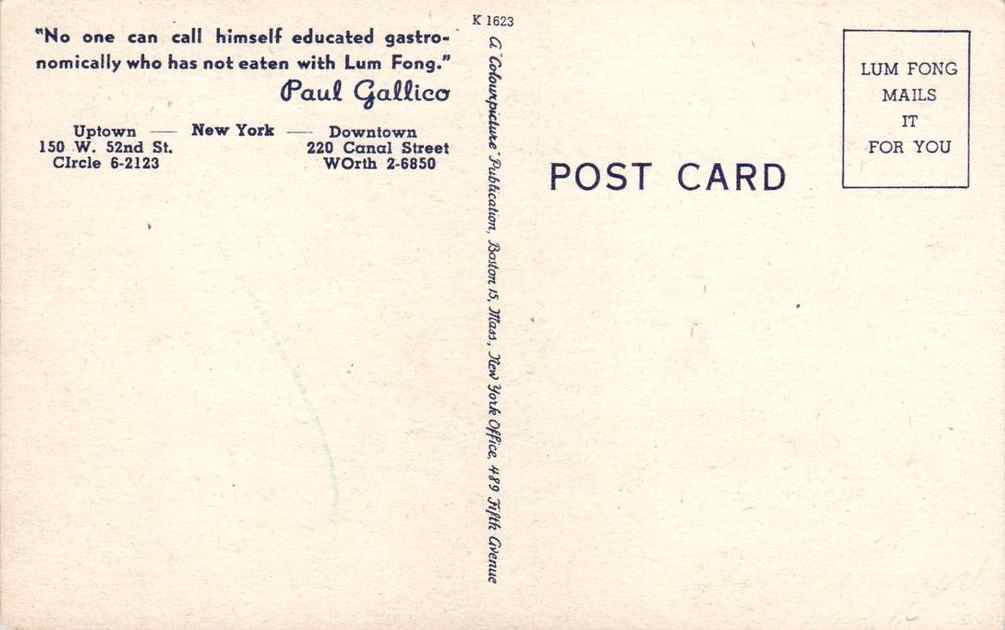
Graphics: Lum Fong’s New York Restaurants


signed with initials PF;
possibly cartoonist Paul Fung


Wine card stapled to menu


Stir-Pic, stirer and fruit pick
 
New York Public Library, What’s on the Menu?
Museum of the City of New York, Lum Fong N.Y. World’s Fair 1939 Button


ABOUT LUM FONG

Lum Fong was born Yung Fong Lum in 1885 in Canton, China. The exact date is unclear. His World War I draft card had December 1, 1885; World War II draft card said January 26, 1885; his wife’s naturalization petition recorded March 12, 1885. 

On June 3, 1916, Lum arrived in Vancouver, British Columbia, Canada. He sailed on the steamship Empress of Russia from Hong Kong. The passenger list said Lum was a merchant, married and a Confucian. He is on line 14.


At Malone, New York, Lum crossed into the United States on July 24, 1916. Newspapers said Lum arrived in 1915. The passenger list said Lum was a merchant and married. He had a friend at 36 Pell Street that was located in Manhattan’s Chinatown. Lum is on line 19.


Lum signed his World War I draft card on September 12, 1918. His address was 36 Pell Street. He was a cashier at “Uie Ye Kwen”. Lum was described as slender build, medium height, with black eyes and hair. Lee Hong was named as a friend. 


Lee Hong was profiled in Warner M. Van Norden’s Who’s Who of the Chinese in New York (1918). Lum worked at the restaurant We Ye Keau, 36 Pell Street. Also located there was the Hock San Society. 

Lum may have been found in the 1920 United States Census. A search of his name produced no results, so I suspect the enumerator misinterpreted Lum’s name. A search of the address, 36 Pell Street, found “Lee Hung”, probably Lee Hong, on line 40. Line 43 listed “Yean Fue Lung”. The age is off by three years but he was married, immigrated in 1916 and worked at a restaurant. He is a good match for Lum. 


In the 1925 New York state census, Lum was not found at 36 Pell Street. 

Newspaper reports said Lum started his Canal Street restaurant in 1925. The New York Times, November 28, 1925, published various business transactions including this item: Capital Increases, Lum-Fong, Manhattan, $10,000 to $15,000.


The Newspaper Enterprise Association (NEA) produced a profile of Lum for its subscribers including the Niagara Falls Gazette (New York). The article is below. 


Regarding the egg roll, the Brooklyn Eagle, January 9, 1940, said
The first person to eat Lum Fung’s [sic] egg roll was Lee Tracy after making his debut as Hildy Johnson in “The Front Page”. 
The Broadway play opened August 14, 1928. The origin of the egg roll is examined at The American Chinese Food Show, Who Really Invented Chinese Egg Rolls?

On December 13, 1928, Lum and Ti Moi Chu obtained marriage license number 31209 in Manhattan. They married ten days later (below). Their address was 174 Canal Street. 


The 1930 United States Census counted Lum, his wife and son, Danward, in Manhattan at 174 Canal Street. The census erroneously said Danward was four years old; he was born on April 7, 1929. Lum was in the restaurant business (see lines 31 to 33). 


Lum advertised in The Handbook of Chinese Students in U.S.A. Below are samples from 1930, 1931, 1932 and 1933. 


Lum’s wife was naturalized on May 8, 1933. She was born in Belmar, New Jersey but lost her citizenship when she married Lum, an alien. The card said Fong was her surname. 


Lum and his family prepared to visit China in 1933. On May 17, 1933 they were interviewed by the Immigration Service. Lum’s Chinese Exclusion Act case files, at the National Archives branches in Seattle, Washington and New York City, are not available. The following transcript is from his wife and sons’ files in Seattle. Pages one through three were the interview of Lum’s wife, Chun Moi Lum Fong. 


On pages four through six, Lum Fong was questioned about his parents; first wife and children; and second wife and children.


On pages six through eight, Lum Fong answered questions about his restaurant businesses and business relationships.


The following Form 430 documents said the Lums, aboard the steamship President Jefferson, departed from Seattle on June 24, 1933.


On September 20, 1933, Lum was aboard the steamship President Cleveland when it departed Hong Kong. He arrived in Seattle, Washington on October 17. His family remained in China.


Lum’s trip was noted by Julia Blanshard who produced a column about New York for the NEA. The Brownsville Herald (Texas), November 21, 1933, published her New York Letter column that said
Lum Fong, popular Chinese restauranteur who has just returned from five months in China, where he went to arrange a dowery for his daughter and to attend her intricate marriage services, was welcomed back this week by his partner, Moe Levy, at a huge Chinese dinner given for stage folks and writers. ...
Lum’s daughter, Wei Ming, was mentioned in his obituary. It’s unknown if she immigrated to the United States. Almost eight years later, Alice Hughes, in the Buffalo Courier-Express, June 26, 1941, wrote in her column
... Lum Fong, the roly-poly Cantonese who is our town’s greatest Chinese food-purveyor, and his pretty young wife in her native dress. This Mrs. Lum is No. 2 wife, No. 1 having been safely settled in Canton years ago. Two delightful small boys are the issue of this marriage. A couple of years ago Lum went back home to attend the wedding festivities of a daughter by No. 1. He came back a worn man. When I asked what had broken him, he replied “At high-class Chinese wedding everybody eat and drink seven days and nights and never stop. It made me tired.” And Americans think they’re hellers when they stay out till sunrise Jan. 1! It’s this sort of thing that makes Occidentals realize what tough stuff the Chinese are.
On August 3, 1935, Lum’s wife and sons departed Hong Kong. They arrived in Seattle on August 20. 


The New York Times, September 10, 1935, published a photograph with this caption.
Mrs. Lum Fong as she brought her 6-year-old son Danward to Miss Flora Rosenberg’s class at P.S. 23, at Mulberry and Bayard Streets, yesterday morning.
Lum’s partner, Moe Levy, was mentioned in a couple of columns; below from the Waterbury Democrat (Connecticut), November 27, 1937. 
It’s Kosher
It would not be fair to mention Lum Fong’s place without noting that its proprietor, an amiable Chinaman with the hospitable virtues of a boniface, runs it in partnership with Moe Levy, the Semitic clothier. They have been partners for year. And that it was at the instigation of the you-know-which-end-of-the-firm that the menu included, besides Bird’s Nest soups, bamboo shoots and Pekin Duck, an incongruous item called gefuellte fish.
The Rochester Times-Union (New York), September 14, 1938, published Charles B. Driscoll’s column, New York Day by Day.
A Chinese restaurant that gets most of its customers from uptown is Lum Fong’s, at Canal Street, near Baxter. You walk up a flight to do your real eating, of course. One doesn’t feel right, eating Chinese food on the ground floor.

Lum is one of the most prominent Chinese in America. He has been active in collecting and forwarding funds for relief of Chinese refugees. He is known in the right circles in Washington.

Lum’s uptown restaurant burned in a horrible conflagration, killing several, a couple of years ago. He has never tried to open another place uptown.

Moe Levy, a clothing merchant, and not a bit Chinese, has long been interested in Lum Fong’s ventures.
Every Friday, the New York Sun published a dining guide. Below is the November 17, 1933 guide with Lum Fong listed. 


The following Friday, the Sun’s dining guide included the restaurant Lums which was next door to Bloomingdale’s on Lexington Avenue at 59th Street.

November 24, 1933

Lum advertised his Christmas and New Year’s Eve dinners in the Sun on December 23 and 26, 1933.


The Brooklyn Daily Eagle, May 14, 1934, reported the first anniversary of Lums. 

A fire destroyed Lums on February 12, 1936; see photograph below. 


The Nassau Daily Review (Freeport, New York), June 17, 1935, published the advertisement announcing the grand opening of Lum Fong Casino in Long Beach, New York. 


Nassau Daily Review, July 24, 1936

Nassau Daily Review, August 14, 1936

The Long Island Daily Press (Jamaica, New York), November 16, 1942, said Lum Fong Casino closed in June. 

Detail

The New York Sun published a series of dining suggestions. Number eighteen appeared November 12, 1938.


The New York Post, April 29, 1939, published a World’s Fair supplement filled with advertisements. 


Official Chinatown Guide Book for Visitors & New Yorkers (1939)

The 1940 census said Lum, his wife and two sons were at the same address (see lines 73 to 76). Lum was a restaurant manager. In the postcard book, Manhattan’s Chinatown (2008), Daniel Ostrow wrote captions for two postcards featuring the Lum Fong Restaurant on pages 25 and 26. Ostrow said Lum met Moe Levy’s son, Isadore (1889–1952), at the Pell Street restaurant. Lum named his second son, Dorey, which was Isadore’s nickname. 


The New York Times, January 9, 1940, reported a lease for “Lum Fong, Chinese restaurant, store and basement in 148-50 W 42d [sic] St”. Three days later, the street number was corrected, “Lum Fong, Chinese restaurant, store at 148 W 52d St”. 

The Brooklyn Daily Eagle noted the anticipated opening of Lum’s restaurant in Manhattan’s Theater District. 

Lum Fong will open a 52d St. branch the first week in March on the site of the defunct Yacht Club.
Lum Fong is spending, he says, $35,000 to redecorate the old 52d St. Yacht Club and will open it in March as a branch of his Canal St. restaurant.
Lum Fong’s new 52d St. branch, which will be located on the site of the defunct Yacht Club, will offer an ultra-modern interior, featuring a soundproof glass-inclosed bar, while the exterior will be reminiscent of the Orient.
Lum Fong, the famed Canal St. restauranteur, announces that his new 52d St. branch will be ready for an end-of-the-month premiere.
The New York Sun, February 8, 1940, wrote about the restaurant’s upcoming opening. 


Alice Hughes wrote about the opening of Lum’s uptown restaurant in the Buffalo Courier-Express, April 11, 1940.


The New York Sun, May 27, 1940, said 
Beginning today, lessons in chopsticks will be offered as a part of the luncheon program at Lum Fong’s West Fifty-second street restaurant every Wednesday and Thursday. According to Lum, Chinese food is tastier when eaten with chopsticks. We don’t know why, but Lum says it is, and he ought to know.
The New York Sun, September 28, 1940, described the Chinese Mandarin Dinner (with fortune cookies) at Lum’s restaurants. 


Lum and his restaurant were mentioned twice in House Beautiful. The May 1941 issue said 
About Chinese food there can no doubt, you either adore it or not. But be sure you’ve had the real McCoy before making up your mind. In New York, Lum Fong is the place to go. We think it superb cuisine. Or try one of Lum Fong’s recipes (he has been collecting them tirelessly for many years) at home.
Photographs of Lum and restaurant interior, plus recipes, appeared November 1941. 

Lum signed his World War II draft card on April 27, 1942. His description was five feet six inches, 185 pounds, with brown eyes and brown and gray hair. 


Cartoonists frequented Lum’s restaurant. The Brooklyn Eagle, November 10, 1939, said
Lum Fong will shortly dedicate a “Cartoonist’s Corner” at his Canal St. restaurant. The Corner will be decorated with original sketches by such artists as Arthur William Brown, Billy De Beck, Rube Goldberg, Ving Fuller, Paul Fung, Chick Young, Ham Fisher and George McManus.
The Times-Union (Albany, New York), October 29, 1939, said Lum saved the tablecloths decorated by his cartoonist customers. 


Lum appeared in Bud Fisher’s comic strip Mutt & Jeff on March 28, 1943. In 1934 Fisher dined at Lums on Lexington Avenue. The strip below was drawn by ghost artist Al Smith who, at some point, ate at Lum’s restaurant.


Cartoonist Ham Fisher mentioned Lum in the comic strip Joe Palooka on July 9, 1943. Fisher, Billy DeBeck and Rube Goldberg ate at Lum’s restaurant in 1939. 


A photograph of Lum with a handful of cartoonists appeared in Samuel Fuller’s book, A Third Face: My Tale of Writing, Fighting, and Filmmaking (2004). 

Vogue, June 1, 1942, published an article about Chinese women in America. Mrs. George Wu and Mrs. Pu-sheng Yen were photographed at Lum Fong.


The Buffalo Courier-Express, April 1, 1943, mentioned Li Ling Ai as a birthday guest at Lum’s downtown restaurant. 
 

The New York Times, February 6, 1946, recommended before-theatre dining restaurants.
… One of the best Chinese restaurants in town is Lum Fong’s, 150 West Fifty-second Street, an uptown branch of the original establishment on Canal Street, which recently celebrated its twentieth anniversary. It features authentic Cantonese dishes, serving the sort of food to be found in the homes and better eating places of China. The room is a pleasant place to enjoy wor shew opp (braised duck), one of the specialties of the house, or chow-ha-look (barbecued shrimps Canton style). If you’ve been to China (as a good percentage of the clientele) and have a yen for some special dish you’ve savored there, the restaurant will prepare it for you. It’s open every day for lunch and dinner, and for the latter meal reservations are in order. Luncheon dishes range upward from 50 cents, dinner from $1.10. …
Lum was naturalized on April 8, 1946. The card said Fong was his surname. 


Alice Hughes’ column, A Woman’s New York, appeared in the Corning Leader (New York), April 17, 1946. She wrote about the upcoming party for Lum’s daughter, Audrey.
Here’s One Invitation Which Won’t Hit the Wastebasket

It reads like this—“You are cordially invited to meet a very young lady, Audrey Lum, aged four weeks, at a party given in her honor by her parents, Mr. and Mrs. Lum Fong, at the Ding Ho, 135 West 49th Street, New York, on April 18 at six p.m.” Well, that is something, for more than one reason. Mr. Lum, in addition to being the leading Chinese restaurateur in our town, is an old and valued friend of mine. His eating place on Canal Street, the brink of Chinatown, made him famous, and a few years ago he opened an uptown branch on W. 52nd St., where I give parties if I have invited guests I cherish, for Mr. Lum orders the food, which is superb.

This plump, smiling host is a Cantonese, where the best Sino-American cookery comes from, and has a lovely young wife, not to mention two fine sons edging toward the teens. Now young Audrey has arrived, and tomorrow we shall bid her hello and ding ho! It is interesting that Mr. Lum is giving this party at the restaurant of a competitor. The Ding Ho is a comparative newcomer, but the grub is really wonderful. You can see that the proud pop is, in the vulgate of Broadway, “scattering his play.” He could easily introduce his daughter at his own spot, but he prefers to shove a bit of trade to a worthy opposition place.

The Lum sons and their pretty mother have been our guests. You can easily guess what a sweet morsel little Audrey is! I wish you could come with us to the Ding Ho at six tomorrow and meet her socially. Mr. Lum’s smile is famous. It will be at its best at the party for his tiny daughter.
A promotional pamphlet, “Welcome to Lum Fong”, was produced in 1948.


The New York Daily News, March 27, 1949, said
... The actual head chefs at Lum Fong’s twin branches now are twins—Ho King Man is in charge at Canal St. and Ho Hon Man in charge at 52d St.
At some point, Lum moved to the suburbs. The 1950 census said the Lums resided in Malverne, Nassau County, New York, at 16 King Street (see lines 15 to 19). 


Lum passed away on June 26, 1952, in New York, New York. Obituaries appeared in several newspapers including The New York Times and Brooklyn Eagle (below) on June 28. 
Lum Fong, Noted Restauranteur, 66
Lum Fong, whose restaurant at 220 Canal St., Manhattan, was one of New York’s most famous Chinese eating places, died Thursday at St. Clare’s Hospital, Manhattan. He was credited with having introduced to Americans such genuinely Chinese dishes as wonton soup, egg roll and shrimp roll. He resided in Malverne.

Mr. Lum was born in Canton 66 years ago, and entered the restaurant business in his native land. He came to America in 1915 [sic] and served as a restaurant manager for 10 years before opening the Canal St. establishment. In 1940 he opened a second Lum Fong’s at 150 W. 52d St. Manhattan.

Surviving are the widow, Mrs. Mae Lum; two sons, Danward and Dorey, and two daughters, Wei Ming and Audrey Lum. The body will be at the Chinese Cheung Sang Funeral Parlor, 22 Mulberry St., Manhattan, on Monday. Funeral services will be held at 2 p.m. Tuesday at True Light Lutheran Church, 195 Worth St., Manhattan. 
Alice Hughes wrote about the Lum’s oldest son, Danward, inheriting the business.
 
Buffalo Courier-Express, October 8, 1952

The New York Post, December 14, 1953, said
Mrs. Lum Fong, widow of the former owner of the Lum Fong Restaurants, has become active in its operations.
Lum’s wife, Mae, was a celebrity in the New York Post.

June 27, 1957

The birthday party for Lum’s daughter was mentioned in the Evening Leader (Corning, New York), April 4, 1958.


New York City 1959: film footage of Chinatown and Little Italy from 5:42 to 13:04; Lum Fong exterior seen at 7:59.

Mae passed away on June 17, 1992; Danward on April 18, 1997; and Dorey on January 20, 2017. 


SIDEBAR: Lum Fong’s Employees
The following employees were found either through their World War II draft cards, which required the name and address of their employer, or in newspaper articles. 

Sixto Araste
Race: Filipino
Age: 40
Birth Date: 5 Nov 1902
Birth Place: Vigan, Philippines
Registration Date: 15 Feb 1942
Registration Place: New York City, New York
Employer: Lum Fong Restaurant, 150 West 52nd Street
Height: 5 4
Weight: 125
Complexion: Light Brown
Hair Color: Black
Eye Color: Brown
Contact Person: Aesente Remolete

Harold Ming Au
Race: Oriental (Asian)
Age: 44
Birth Date: 20 Jul 1898
Birth Place: Canton, China
Registration Date: 15 Feb 1942
Registration Place: New York, New York
Employer: Lum Fong, 220 Canal Street
Height: 5 5
Weight: 118
Complexion: Sallow
Hair Color: Black
Eye Color: Brown
Contact Person: Edward Seto

Bill Chan
New York Sun, March 30, 1945, Cafe Life in New York
Bill Chan, the Chinese bartender at Lum Fong’s 52d Street restaurant, will be screen tested. 
Kenneth Ng Chan
Race: Oriental
Age: 21
Birth Date: 5 Mar 1919
Birth Place: San Francisco, California
Registration Date: 16 Oct 1940
Registration Place: New York City, New York, New York
Employer: Lum Fong, 150 West 52nd Street
Height: 5 8
Weight: 144
Complexion: Sallow
Hair Color: Black
Eye Color: Brown
Contact Person: Lum Fong

Chin Hwong Chen
Race: Oriental
Age: 33
Birth Date: 16 Mar 1907
Birth Place: Canton, China
Registration Date: 16 Oct 1940
Registration Place: New York City, New York, New York
Employer: Lum Fong Restaurant, 150 West 52nd Street
Height: 5 7
Weight: 115
Complexion: Sallow
Hair Color: Black
Eye Color: Brown
Contact Person: Michael Yee

Kai Cheung
Address: 13 Eldridge Street, New York, New York
Race: Oriental
Age: 42
Birth Date: 13 Oct 1899
Birth Place: Canton, China
Registration Date: 15 Feb 1942
Registration Place: New York City, New York, New York
Employer: Lum Fong, 220 Canal Street
Height: 5 2.5
Weight: 133
Complexion: Sallow
Hair Color: Black
Eye Color: Brown
Contact Person: Jay Toy

Jew Fook Chow
Race: Oriental
Age: 18
Birth Date: 23 Feb 1926
Birth Place: Canton, China
Registration Date: 9 Mar 1944
Registration Place: New York City, New York
Employer: Lum Fong Restaurant, 150 West 52nd Street
Height: 5 4
Weight: 126
Complexion: Light Brown
Hair Color: Black
Eye Color: Black

William Chu
Race: Oriental
Age: 21
Birth Date: 22 Jul 1919
Birth Place: Albany, New York
Registration Date: 16 Oct 1940
Registration Place: New York City, New York, New York
Employer: Lum Fong Restaurant, 220 Canal Street
Height: 5 7
Weight: 138
Complexion: Sallow
Hair Color: Black
Eye Color: Brown
Contact Person: Mrs. Lum Fong

Lee Chuen
Race: Oriental
Age: 27
Birth Date: 4 Sep 1914
Birth Place: China
Registration Date: 16 Feb 1942
Registration Place: New York, New York
Employer: Lum Fong Inc, 220 Canal Street
Height: 5 4
Weight: 125
Complexion: Sallow
Hair Color: Black
Eye Color: Brown
Contact Person: Jay Gum

Lew Fung Chun
Race: Oriental
Age: 42
Birth Date: 10 Mar 1899
Birth Place: San Francisco, California
Registration Date: 16 Feb 1942
Registration Place: New York City, New York, New York
Employer: Lum Fong, 150 West 52nd Street
Height: 5 5
Weight: 116
Complexion: Dark
Hair Color: Black
Eye Color: Brown
Contact Person: Tuck High

Fa Yew Dea
Race: Oriental
Age: 33
Birth Date: 11 Nov 1907
Birth Place: Canton, China
Registration Date: 16 Oct 1940
Registration Place: New York City, New York, New York
Employer: Lum Fong, 150 West 52nd Street
Height: 5 6
Weight: 125
Complexion: Sallow
Hair Color: Black
Eye Color: Brown
Contact Person: Sinoyow Dea

Ng Fat
Race: Oriental
Age: 40
Birth Date: 15 May 1902
Birth Place: Canton, China
Registration Date: 16 Feb 1942
Registration Place: New York City, New York, New York
Employer: Lum Fong Restaurant, 150 West 52nd Street
Height: 5 3
Weight: 135
Complexion: Sallow
Hair Color: Black
Eye Color: Black
Contact Person: Ng Chung

Wong Foo
Race: Oriental
Age: 40
Birth Date: 9 Apr 1901
Birth Place: New York, New York
Registration Date: 15 Feb 1942
Registration Place: New York City, New York, New York
Employer: Lum Fong Inc, 220 Canal Street
Height: 5 4
Weight: 128
Complexion: Ruddy
Hair Color: Black
Eye Color: Brown
Contact Person: Lum Fong

Ching Hoy Ho
Address: 220 Canal Street, New York, New York
Gender: Male
Birth Date: 14 Oct 1886
Birth Place: Nam Hoy, Canton, China
Residence Place: New York City, New York
Military Draft Date: April 27, 1942
Contact Person: Lum Fong

A photograph of Ho Ching Hoy, head chef of Lum Fong restaurants, appeared in PM Daily, February 5, 1943. 


Lee Hoy
Race: Oriental
Age: 30
Birth Date: 1 Mar 1910
Birth Place: Hong Kong, China
Registration Date: 16 Oct 1940
Registration Place: New York City, New York
Employer: Lum Fong Restaurant, 220 Canal Street
Height: 5 8
Weight: 145
Complexion: Sallow
Hair Color: Black
Eye Color: Brown
Contact Person: James Lee

James Jay
Race: Oriental
Age: 21
Birth Date: 23 Mar 1919
Birth Place: Canton, China
Registration Date: 16 Oct 1940
Registration Place: New York City, New York, New York
Employer: Lum Fong, 150 West 52nd Street
Height: 5 9
Weight: 137
Complexion: Light Brown
Hair Color: Black
Eye Color: Brown
Contact Person: Jay Hung

John Wo Kee
Race: Oriental
Age: 32
Birth Date: 27 Nov 1907
Birth Place: San Jose, California
Registration Date: 16 Oct 1940
Registration Place: New York City, New York, New York
Employer: Lum Fong Inc, 220 Canal Street
Height: 5 6
Weight: 165
Complexion: Sallow
Hair Color: Black
Eye Color: Brown
Contact Person: Wong Shee Kee
Social Security Death Index: November 1984

Willson Kong
Race: Oriental
Age: 35
Birth Date: 11 Nov 1905
Birth Place: San Francisco, California
Registration Date: 16 Oct 1940
Registration Place: New York City, New York, New York
Employer: Lum Fong Restaurant, 150 West 52nd Street
Height: 5 4
Weight: 137
Complexion: Sallow
Hair Color: Black
Eye Color: Black
Contact Person: Ho Chong Wing

Huey Shue Koon
Race: Oriental
Age: 39
Birth Date: 17 Apr 1902
Birth Place: Hoyshan, China
Registration Date: 16 Feb 1942
Registration Place: New York City, New York, New York
Employer: Lum Fong Restaurant, 150 West 52nd Street
Height: 5 7
Weight: 150
Complexion: Light Brown
Hair Color: Black
Eye Color: Brown
Contact Person: Lum Fong

Wah Chung Lau
Race: Oriental
Age: 26
Birth Date: 19 Sep 1914
Birth Place: Canton, China
Registration Date: 16 Oct 1940
Registration Place: New York City, New York, New York
Employer: Lum Fong Restaurant, 220 Canal Street
Height: 5 7
Weight: 133
Complexion: Sallow
Hair Color: Black
Eye Color: Brown
Contact Person: Lau Kow
New York, New York Death Certificate: December 12, 1944

Ling Law
Race: Oriental
Age: 35
Birth Date: 19 Sep 19075
Birth Place: San Francisco, California
Registration Date: 16 Oct 1940
Registration Place: New York City, New York, New York
Employer: Lum Fong, 220 Canal Street
Height: 5 10
Weight: 138
Complexion: Dark
Hair Color: Black
Eye Color: Brown
Contact Person: Louis Leung

Grace Lee
New York Post, February 17, 1952
Grace Lee, pretty Chinese hostess at Lum Fong’s, will be screen-tested by Columbia. 
New York Post, May 28, 1952
Grace Lee, hostess at Lum Fong’s, will be featured in a Judson Hughes short, “American Beauties”.

James Chew-Young Lee
Race: Oriental
Age: 31
Birth Date: 28 Nov 1908
Birth Place: New York, New York
Registration Date: 16 Oct 1940
Registration Place: New York City, New York
Employer: Lum’s 52nd St. Corp., 150 West 52nd Street
Height: 5 11
Weight: 165
Complexion: Sallow
Hair Color: Brown
Eye Color: Brown
Contact Person: Mrs. James C.Y. Lee

New York Sun, June 21, 1946, Cafe Life in New York


Eat, Think and Be Slender, Leonid Kotkin, Hawthorne Books, 1954
The Chinese restaurant offers much variety to the person on the diet. Jimmy Lee, manager of Lum Fong, made it a point to note that many dishes prepared in the Chinese fashion are sautéed in strained chicken broth, rather than in butter. Mr. Lee also pointed out that in dishes where a flour binder is required, ...
James A. Lewis
Race: Oriental
Age: 35
Birth Date: 12 Jul 1905
Birth Place: Kentung, China
Registration Date: 16 Oct 1940
Registration Place: New York, New York
Employer: Lum Fong Restaurant, 150 West 52nd Street
Height: 5 7
Weight: 120
Complexion: Light Brown
Hair Color: Black
Eye Color: Black
Contact Person: Nadine Elizabeth Fanning

Fernando Mendoza
Race: Filipino
Age: 44
Birth Date: 30 May 1897
Birth Place: Philippine Islands
Registration Date: 15 Feb 1942
Registration Place: New York
Employer: Lum Fong, 150 West 52nd Street
Height: 5 5
Weight: 174
Complexion: Dark
Hair Color: Black
Eye Color: Brown
Contact Person: Consuelo Cartagena

Leonard Priore
Race: White
Age: 25
Birth Date: 23 Aug 1915
Birth Place: New York City, New York
Registration Date: 16 Oct 1940
Registration Place: Brooklyn, Kings, New York
Employer: Lum Fong, 220 Canal Street
Height: 5 3
Weight: 150
Complexion: Dark
Hair Color: Black
Eye Color: Brown
Contact Person: Lillian Priore

Patrocino E. Ramirez
Race: Filipino
Age: 27
Birth Date: 7 May 1913
Birth Place: San Esteban, Philippines
Registration Date: 16 Oct 1940
Registration Place: New York City, New York, New York
Employer: Lum Fong Restaurant, 150 West 52nd Street
Height: 5 5
Weight: 142
Complexion: Light Brown
Hair Color: Black
Eye Color: Brown
Contact Person: James Ramiriez

Ah Jing Seetoo
Race: Oriental
Age: 42
Birth Date: 24 Aug 1899
Birth Place: Kantung, China
Registration Date: 15 Feb 1942
Registration Place: District of Columbia
Employer: Lum Fong Inc, 220 Canal Street
Height: 5 2
Weight: 130
Complexion: Light Brown
Hair Color: Black
Eye Color: Brown
Contact Person: Henry Seetoo

Louis Lum Tang
Race: Oriental
Age: 35
Birth Date: 17 Dec 1905
Birth Place: San Francisco, California
Registration Date: 16 Oct 1940
Registration Place: New York City, New York, New York
Employer: Lum Fong, 150 West 52nd Street
Height: 5 5
Weight: 145
Complexion: Light Brown
Hair Color: Black
Eye Color: Brown
Contact Person: Henry Ong

Shung F. Thom
Race: Oriental
Age: 39
Birth Date: 26 Oct 1903
Birth Place: China
Registration Date: 15 Feb 1942
Registration Place: New York City, New York
Employer: Lum Fong, 150 West 52nd Street
Height: 5 2
Weight: 115
Complexion: Light Brown
Hair Color: Black
Eye Color: Brown
Contact Person: Lum Fong
Massachusetts Death Index: March 17, 1986

Sing Tieng
Address: 174 Canal Street
Residence Place: New York City, New York
Birth Date: 18 Jul 1894
Age: 48
Birth Place: Canton, China
Registration Date: 27 Apr 1942
Employer: Lum Fong Inc. 220 Canal Street, New York City, New York
Race: Oriental
Height: 5 2.5
Weight: 160
Complexion: Dark
Hair Color: Black
Eye Color: Black
Contact Person: Lum Fong

Buck Nin Tom
Race: Oriental
Age: 42
Birth Date: 11 Nov 1899
Birth Place: Canton, China
Registration Date: 16 Feb 1942
Registration Place: New York City, New York
Employer: Lum Fong Rest, 220 Canal Street
Height: 5 7
Weight: 153
Complexion: Sallow
Hair Color: Black
Eye Color: Brown
Contact Person: Tom Yen

Pon Kin Tom
Race: Oriental
Age: 33
Birth Date: 6 Jun 1907
Birth Place: Canton, China
Registration Date: 16 Oct 1940
Registration Place: New York City, New York
Employer: Lum Fong, 150 West 52nd Street
Height: 5 5
Weight: 114
Complexion: Light Brown
Hair Color: Black
Eye Color: Brown
Contact Person: Charlie Kee

Jerry Han Toy
Race: Oriental
Age: 30
Birth Date: 8 Aug 1910
Birth Place: China, China
Registration Date: 16 Oct 1940
Registration Place: New York City, New York, New York
Employer: Lum Fong, 150 West 52nd Street
Height: 5 7
Weight: 165
Complexion: Sallow
Hair Color: Black
Eye Color: Brown
Contact Person: Harry Young

Robert Seid Won
Race: Oriental
Age: 35
Birth Date: 15 May 1905
Birth Place: San Francisco, California
Registration Date: 16 Oct 1940
Registration Place: New York City, New York, New York
Employer: Lum Fong Inc, 150 West 52nd Street
Height: 5 7
Weight: 152
Complexion: Sallow
Hair Color: Black
Eye Color: Brown
Contact Person: Jerry Toy
Find a Grave: January 8, 1953

New York Post, February 14, 1941, Today’s Toast
“Dragon Lady,” as prepared by Won at Lum Fong’s on 52d St.: Mix 1-3 pineapple and orange juice, 2-3 applejack, a dash of lemon juice and a dash of grenadine. Shake well with cracked ice and swerve in a cocktail glass.
Dow Hing Wong
Race: Oriental
Age: 34
Birth Date: 15 Aug 1906
Birth Place: Hoy Ping District, China
Registration Date: 16 Oct 1940
Registration Place: New York City, New York, New York
Employer: Lum Fong, 150 West 52nd Street
Height: 5 7
Weight: 150
Complexion: Light Brown
Hair Color: Black
Eye Color: Black
Contact Person: Barbara Wong

Fred Yensye Wong
Race: Oriental
Age: 30
Birth Date: 16 Jan 1910
Birth Place: Canton, China
Registration Date: 16 Oct 1940
Registration Place: Brooklyn, Kings, New York
Employer: Lum Fong Restaurant, 150 West 52nd Street
Height: 5 7
Weight: 152
Complexion: Dark
Hair Color: Black
Eye Color: Black
Contact Person: Frank Yenshue Wong

Gew Sun Wong
Race: Oriental
Age: 39
Birth Date: 8 Jul 1902
Birth Place: Hoy Sun, Canton, China
Registration Date: 15 Feb 1942
Registration Place: New York City, New York, New York
Employer: Lum Fong, 150 West 52nd Street
Height: 5 2
Weight: 125
Complexion: Light Brown
Hair Color: Black
Eye Color: Brown
Contact Person: James C Y Lee

Tippy Wong
Brooklyn Eagle, October 1, 1947, Night Life
Tippy Wong, Lum Fong’s song-writing head waiter, wrote a song about the boss, “Sum Fun, Lum”. 
Brooklyn Eagle, December 3, 1950, Night Life
Lum Fong’s song-writing headwaiter, Tippy Wong, will appear in a movie short on the art of using chopsticks. 
New York Post, February 20, 1955
Tippy Wong, popular head-waiter at Lum Fong’s, has been promoted to night manager
Danny Yong
Race: Oriental
Age: 40
Birth Date: 20 Nov 1902
Birth Place: Canton, China
Registration Date: 16 Feb 1942
Registration Place: New York City, New York, New York
Employer: Lum Fong Inc, 220 Canal Street, 150 West 52nd Street
Height: 5 5
Weight: 135
Complexion: Light Brown
Hair Color: Black
Eye Color: Brown
Contact Person: Moo Chong

Charles Young
Race: Oriental
Age: 34
Birth Date: 30 Nov 1905
Birth Place: Pittsburgh, Pennsylvania
Registration Date: 16 Oct 1940
Registration Place: New York, New York
Employer: Lum Fong Restaurant, 220 Canal Street
Height: 5 4
Weight: 153
Complexion: Sallow
Hair Color: Black
Eye Color: Brown
Contact Person: Virginia Young Chu

Bartenders
Marcellus Observer (New York), March 5, 1948
If you want a booklet on Oriental Cocktails, Sandy, Jimmy and Reggie, Lum Fong’s (N. Y.) bartender trio, are compiling one.
Hat Check Room
no names mentioned


The success of Lum Fong produced similarly named restaurants. Found in the draft cards were Lum’s Garden, 111 West 49th Street, New York, New York; Lum’s, 2351 8th Avenue, New York, New York; Lum’s Chinese American Restaurant, 85 Avenue B, New York, New York; Lum’s Tea Garden, 766 Broadway, Brooklyn, New York; and Lun Fong’s Restaurant, 546 Eastern Parkway, Brooklyn, which was owned by Louis Lun Fong.


Further Reading and Viewing
The New Yorker, February 22, 1930: Chinese actor, Mei Lan-fang, ate at Lum Fong Restaurant in Chinatown.
Life
, December 15, 1952, Lum Fong restaurant cucumber and meat slice soup recipe
Shanghai Evening Post and Mercury 1943, 1944, 1945 and 1946
The television espionage comedy, Get Smart, November 2, 1968, had a character named Lum Fong (Spencer Chan) in the episode, “A Tale of Two Tails”. 
YouTube, American Chinese Food Show, I Found a Lost Chinese Cookbook—Then Wrote the Book It Deserved
沉埋的粵菜檔案
The Buried Archive of Cantonese American Cooking
徐子君
Xu Zijun/Kristie Chow
字字研究所有限公司, 2025
Zizi Research Institute Co., Ltd., 2025
978-988-70781-6-6
Text in Chinese

Related Posts

 
(Updated May 29, 2026; next post on Wednesday: Chinese Laborers at the Completion of the Transcontinental Railroad)