1936
In the 1930s, Kwan Tak-hing (Guan Dexing 關德興) made two visits to America. The book,
Between Shanghai and Hong Kong: The Politics of Chinese Cinemas (2003), said Kwan was in California in 1933.
The Cinema of Hong Kong: History, Arts, Identity (2002) explains how Kwan got involved with films.
The two men [Moon Kwan Man-ching and Joe Chiu] first offered a contract to Ma Sze-tsang, one of the top opera actors then on tour in the United States, but Ma did not accept. In San Francisco, there was another touring opera troupe whose leading players—actor Kwan Tak-hing (Guan Dexing) and the U.S. born actress Wu Dip-ying (Hu Dieying)—seemed well-suited for the leads.
Thus in 1933, the two men engineered the establishment of the Grandview Film Company at 12 Ross Alley, San Francisco, for the purpose of making this film….Their first feature was Romance of the Songsters, starring Kwan Tak-hing and Wu Dip-ying. It was one of the world’s first Cantonese talkies….It was also one of the first films to depict the lives of overseas American-Chinese.
Thanks to the
National Archives branch in Seattle, Washington, the dates and length of Kwan’s visits are now known. The branch has Kwan’s Chinese Exclusion Act case files 7022/6-49 and 7022/7-101.
The
Hong Kong Movie Database said Kwan was known for his performances in Cantonese Opera and film, in particular, as the character Wong Fei Hung. The site has a short profile of Kwan.
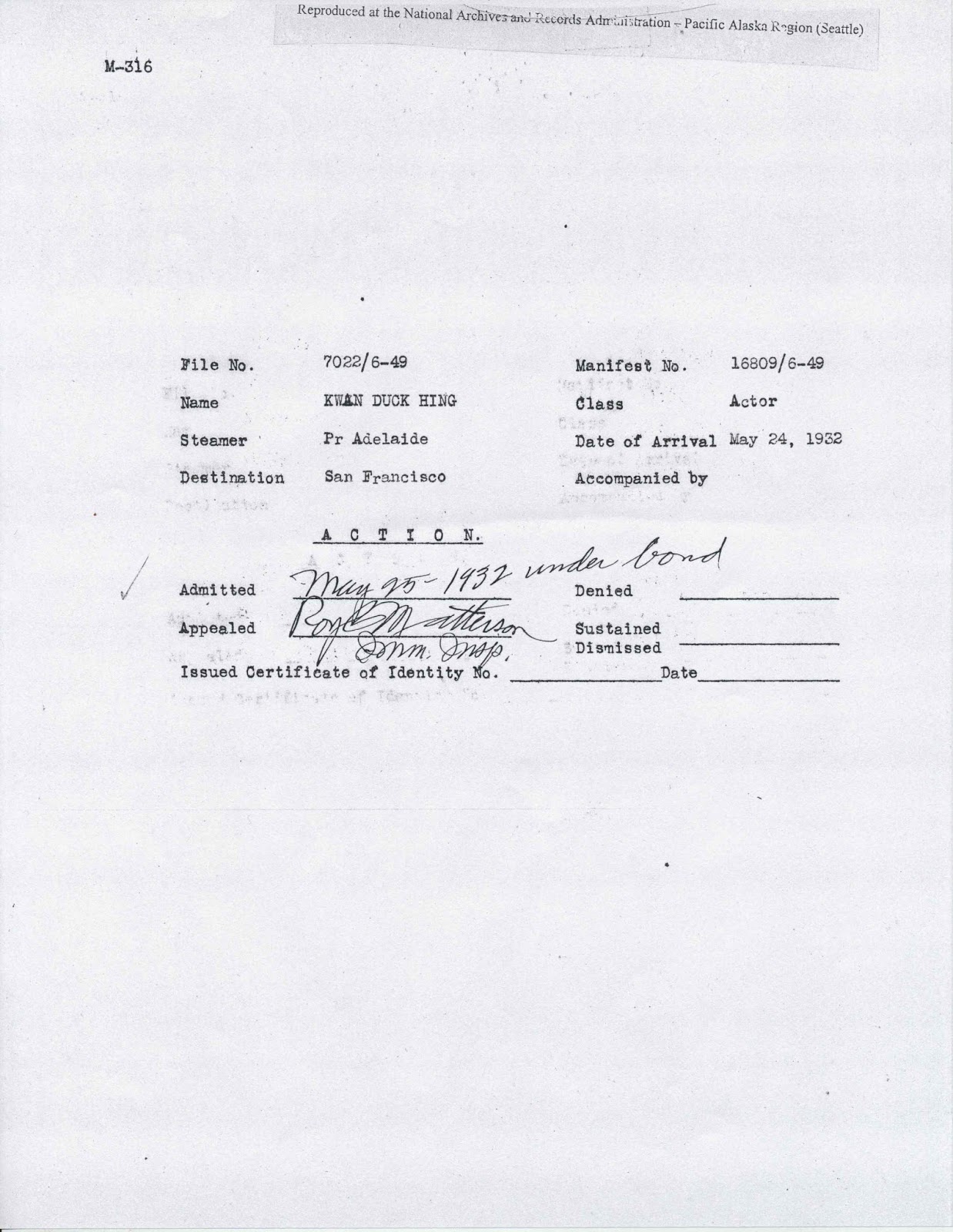
When Kwan visited America in 1932, his name was spelled Kwan Duck Hing. Below is Kwan’s Professional Chinese Actor Identification Passport Affidavit. It was dated March 6, 1931 and signed by Kwan. He was under contract to the Lun Hop Company.
Below are the left and right halves of the passenger list with Kwan. The left side recorded his name, age, gender, marital status, occupation (actor), language abilities, nationality, ethnicity, birthplace (Kay Leng Village, Hoiping, Kwongtung), travel document, and last residence (Saigon, French Indo-China). Aboard the steam ship Empress of Japan, Kwan departed from Hong Kong on May 6, 1932.
On the right half, Kwan arrived in Vancouver, British Columbia on May 24, then, aboard the steam ship Princess Adelaide, continued on to Seattle, Washington the same day. Recorded on this half was his mother (Mrs. Kwan Yuen Shee) and her address (129 Connaught Road, Apt. #4, Hong Kong); final destination (San Francisco, California); payer of his passage (Luen Hop & Co.); possessed three dollars; employer’s address (801 Grant Ave, San Francisco); personal questions and physical description.
Sources such as the
Hong Kong Movie Database and
Wikipedia said Kwan was born June 27, 1905 in Guangzhou (Canton), China.
Kwan’s birth information on the Declaration of Nonimmigrant Alien said: “I was born 5th moon, 25th day, year unknown, age 27, Kay Leng Village, Chek Hom Sect[ion], Hoiping [Kaiping], China.” Kwan’s birth date was based on the Chinese calendar. Subtracting Kwan’s age, 27 from 1932, the year of the declaration, results in the year 1905.
The Department of Labor’s Bureau of Immigration published the
Chinese-American Calendar for the 102 Chinese Years 1849–1951 which converted Chinese dates (black) into Gregorian calendar dates (red). Below is a page from
Chinese-American Calendar showing Kwong Sui 31st Year–1905, the year of Kwan’s birth. Column five is the fifth moon with the number 25 in black, on the left, next to 27 in red. At the bottom of column four are the first two days of June which continues in column five. The conversion of the Chinese date KS 31-5-25 into the Gregorian date is June 27, 1905. (Artists
Yun Gee and
Chee Chin S. Cheung Lee were also born in Hoiping/Kaiping which is about a two-hour drive west of Canton/Guangzhou.
Martin Yan’s ancestral roots are in Kaiping.)
Chinese-American Calendar
Declaration of Nonimmigrant Alien stated Kwan’s occupation, employer, references, reason for visit and included a photograph.
Below is Kwan’s visa from the American Consulate General in Hong Kong. It repeats some of the information on the declaration.
Transcript of Form M-316
Form M 234, Report of Medical Examination
Form 554, Bond That Alien
Shall Not Become a Public Charge
Form 285, Detention Release
Form 289, Bonds covering four periods
Letter from Ying Mee Lun Hop Theatrical Co. Inc., dated June 14, 1934, informed the Commissioner of Immigration, in Los Angeles, about Kwan’s upcoming departure for China.
Letter informed the Seattle Immigration and Naturalization Service of Kwan’s departure for China.
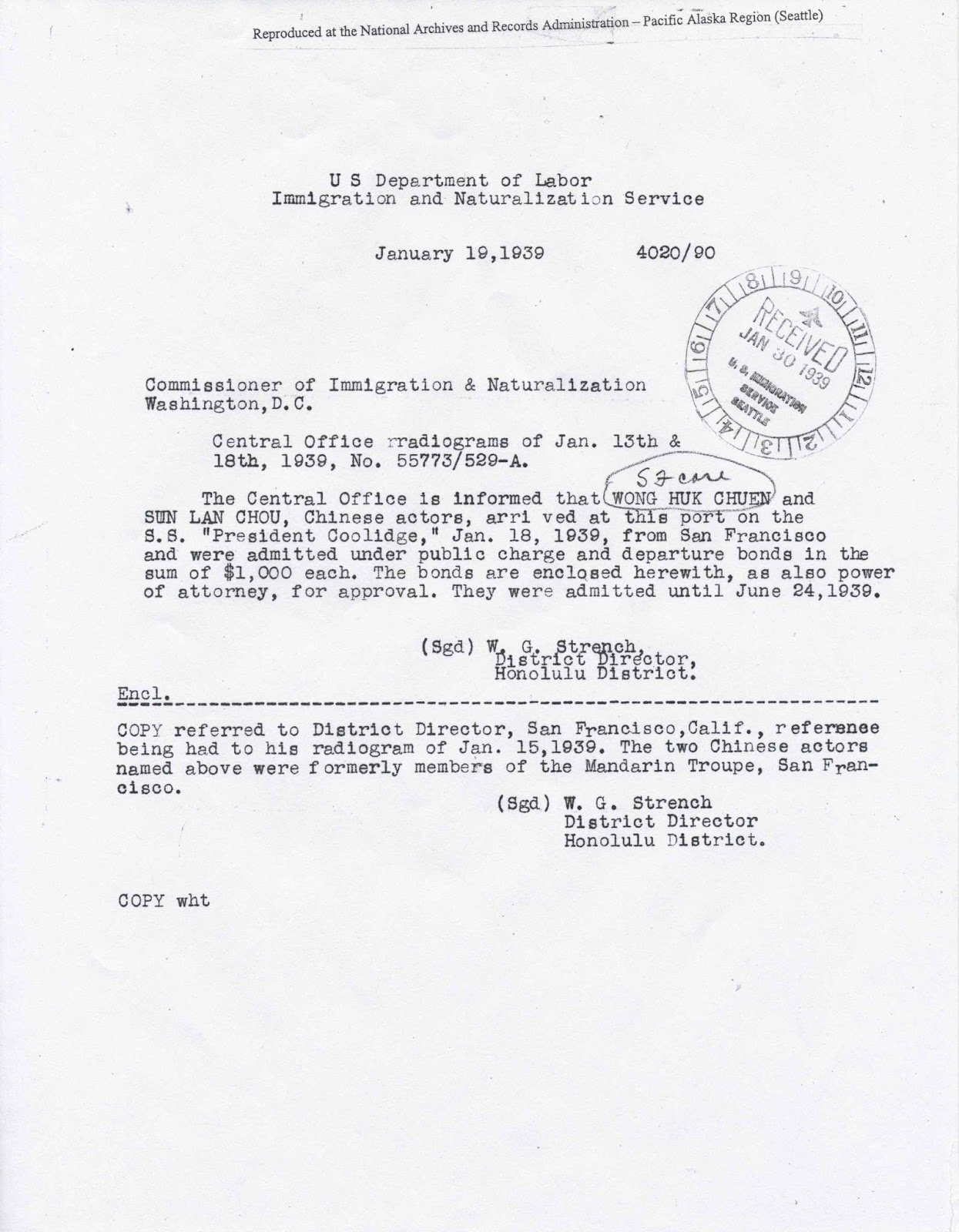
Letter informed the Washington, D.C. Immigration and Naturalization Service of Kwan’s departure from Honolulu to China.
The Online Archive of California has two undated photographs of Kwan costumed as a cowboy
here and
here.
When Kwan prepared to return to America, he used the name Sun Lan Chou. On December 4, 1936, Kwan signed the Declaration in Support of Application for Temporary Admission of Chinese Actors into United States. The declaration was attached to two American Consulate General documents. One page was his testimony on December 17, 1936.
Q. You solemnly swear you will tell the truth and nothing but the truth in the testimony you are now about to give, so help you God.
A. I do.
Q. What is your name?
A. Sun Lan-chou.
Q. And what is your profession?
A. Actor.
Q. How long have you followed this profession?
A. 17 years. [since 1919]
Q. Have you ever previously entered the U.S. in any capacity?
A. Yes, I went to the U.S. as an actor before.
Q. What year?
A. 1932.
Q. And for how long did you remain?
A. Two years and one month.
Q. Did you obtain your visa from this office or elsewhere?
A. Hong Kong.
Q. What salary will you receive under the Mandarin Theatre contract which you are now concerned with?
A. $12,000 a year, half in Canton currency and half in U.S. currency.
The American Consulate General Precis was the cover page for the Declaration and testimony documents. The Precis had a description of Kwan (5 feet, 9 inches with brown eyes and black hair) and his birth information (Kay Leng Village, Chak Hom, Hoiping, Kwangtung, China; KS 31-5-25 (June 27, 1905)).
Below are the left and right halves of the passenger list with Kwan listed as Sun Lan Chou. The left side recorded his name, age, gender, marital status, occupation (actor), language abilities, nationality, ethnicity, birthplace (Hoi Ping, Chick Ham), travel document, and last residence (Hong Kong, China). Aboard the steam ship Empress of Asia, Kwan departed from Hong Kong on December 23, 1936.
On the right half, Kwan arrived in Vancouver, British Columbia on January 9, 1937, then, aboard the steam ship Princess Alice, continued, on the same day, to Seattle, Washington. Recorded on this half was his wife (Mrs. Chan) and her address (30 Fort Street, 1st floor, Hong Kong); final destination (San Francisco, California); payer of his passage (employer); his employer’s name and address (Mandarin Theatre, 915 Grant Avenue, San Francisco, California); personal questions and physical description.
Form 316
Form 554, Bond That Alien
Shall Not Become a Public Charge
January 15, 1937 letter informed the Immigration and Naturalization Service in Washington, D.C. of Kwan’s admission.
Form 289, Bonds covering three periods
Below are the left and right halves of the passenger list with Kwan listed as Sun Lan-chou and Kwan Duck-hing. The left side recorded his names, age, gender, marital status, occupation (actor), language abilities, nationality, ethnicity, birthplace (Hoiping, Kwangtung, China), travel document, and last residence (San Francisco, California). Aboard the steam ship President Coolidge, Kwan departed from San Francisco on January 13, 1939.
On the right half, Kwan arrived in Honolulu, Territory of Hawaii on January 18, 1939. Recorded on this half was Kwan’s friend or relative Mo-yuen Shee, Shumsiup, Hong Kong; final destination (Hong Kong); payer of his passage (self); possessed $1,000; date of his previous visit; personal questions and physical description.
Fireman’s Fund Indemnity Company notified the San Francisco Immigration and Naturalization Service office of the problem with their bond for Kwan.
Honolulu Immigration and Naturalization Service notified Washington, D.C. office of Kwan’s arrival.
San Francisco Immigration and Naturalization Service notified Seattle office of Kwan’s situation.
Seattle Immigration and Naturalization Service explained circumstances to Washington, D.C. office.
Fireman’s Fund Indemnity Company notified Seattle, San Francisco and Honolulu Immigration and Naturalization Service offices about the cancellation of Kwan‘s bond.
Kwan’s file has no documentation about his departure to China.
The Nevada Marriage Index at Ancestry.com said “Tak Hing Kwan” married “Yut Chur Kwan” in Reno on November 5, 1984.
According to the Social Security Death Index, Kwan was born on “May 25, 1905”, and died June 28, 1996. His last residence was in Campbell, California. Kwan’s birth date was based on the Chinese calendar date “5th moon, 25th day” which had not been converted to a Gregorian calendar date. The person who reported Kwan’s death did not know how to convert the Chinese birth date to June 27 as explained earlier.