Friday, June 19, 2020

Television: Keye Luke, Gunslinger


Top: Robert Culp and Keye Luke in a
publicity photograph for the TV series
Trackdown that aired September 19,
1958. The episode is “Chinese Cowboy”.
In the town of Porter, laundryman Wong
is harassed by Morgan and some of his
friends. They call him China Boy. Wong
buys a hand gun in the belief that the
townspeople will respect him. He prac-
tices shooting days and nights. Morgan
and friends damage Wong’s laundry shop
then cut off his queue. Wong, wearing
his gun belt, goes to the saloon and tells
Morgan to draw first. Morgan goes for
his gun and Wong shoots him dead. The
next day Wong packs his belongings and
prepares to leave. Some of the towns-
people implore him to stay but he refuses
and walks away with his donkey.

(Next post on Friday: The Memoir 1947)

Friday, June 5, 2020

Television: The Rock Springs Massacre

The Quest
Welcome to America, Jade Snow
aired November 24, 1976

The location is Rock Springs, Wyoming, scene of an 1885 massacre. The episode has Chinese railroad and mining laborers; a Chinatown; Chinese doctor, merchant, prostitute and infant; a past interracial romance; a mining strike; a scheming mining owner; a riot against the Chinese; and flashes of kung fu. The slurs used are pigtailed scabs, John Chinaman, and Chinaman.

Irene Yah-Ling Sun, Frank Michael Liu, Richard Loo and George Chiang are in the cast.


Further Reading and Viewing
About The Quest
About the writer Anthony Lawrence


(Next post on Friday: The Young Companion)

Friday, May 22, 2020

Friday, May 15, 2020

Asian Americans: Wong Yook Yee 黄玉瑜


The Certificate of Identity of Wong Yook Yee was shown at 22 minutes and 35 seconds in the first part of Asian Americans, a five-part documentary series on PBS. “Departed 1929 and has not returned” was highlighted on his certificate. Here is the story of Wong Yook Yee and why he had not returned.


Wong Yook Yee was born on September 16, 1902, in Lung Hon, a village in Hoiping (Kaiping in Mandarin), China. He was the second of four children born to Wong Lon Seong and Jew Shee. In 1908 his family moved to nearby Chung Hing Lee village. Wong and a few village boys were chosen to be enrolled in the Ng Lee School in Hong Kong.

Under Section Six of the Chinese Exclusion Act, Chinese students were allowed to enter the United States for an American education. In December 1909, Ng Niehong and Ida K. Greenlee, a university teacher, established the Ng Lee School in Seattle, Washington. Various complications caused the school to close. Around 1911, Greenlee established an Ng Lee School in Hong Kong and San Francisco, California. By 1913, the school had relocated to East Oakland. The Polk-Husted Directory Co.’s 1913 Oakland, Berkeley, Alameda Directory said the Ng Lee School was located on the California College grounds. (For details, read Krystyn Moon’s “Immigration Restrictions and International Education: Early Tensions in the Pacific Northwest, 1890s–1910s”.)

Here is an excerpt from a February 22, 1913 letter by Vice Consul General in Charge A. E. Carleton of the American Consular Service in Hong Kong.
The school in Oakland is intended to prepare the boys for the public schools or certain private schools. At the end of such period of preparation as Miss Greenlee finds necessary, supposedly about one year, the boys are to be distributed to certain churches throughout the United States which are under agreement to provide homes for the boys in Christian American families and keep the boys in suitable schools usually the public city schools, and report regularly to Miss Greenlee as to the conduct and progress of the boys. Miss Greenlee states that she will supervise the education of all her boys until they have attained to high school standing and that in any case where a boy abandons his studies before that time she will endeavor to return him to China by her personal efforts or through official action. Miss Greenlee is strongly supported and assisted in her work by Dr. M. A. Matthews of the First Presbyterian Church in Seattle. Her ability and the worthiness of her motives are well established by our observation as well as by various excellent testimonials. She is assisted here in collecting her boys by Mr. Yee On Lai, a Chinese of American birth, concerning whom only favorable reports have reached this office.
Wong was eleven years old when he sailed from Hong Kong to the United States. His group of 30 Chinese students were on the steamship Minnesota. The ship departed Hong Kong on March 1, 1913, and picked up passengers in Shanghai, China and Yokohama, Japan, where Miss Greenlee came aboard.

On March 24, 1913, the ship arrived in Seattle, Washington. Greenlee and her students were news in the San Francisco Call, March 26.
Thirty Chinese Held
Seattle, March 25.—The local United States immigration officials today refused admission to 30 Chinese boys who arrived here on the steamship Minnesota, bound for an Oakland, Cal., school, unless the Chinese should furnish a bond of $60,000. It is expected that the bond will be forthcoming. The boys are under the care of Miss Ida K. Greenlee, formerly an inspector of the University of Washington. These boys, she says, are the sons of the wealthiest families in Kwangtung province, China, and their tuition is paid by the Chinese government out of the Boxer indemnity fund.
Admission was granted to the students who were released to Rev. Mark Allison Matthews. The students are Chew Haw Sing, Fong Tan Jew, Jew Fook Wa, Ko Hing, Kung Mow, Kwan Fui Wai, Kwan Wing Yik, Kwan Wo Kwun, Lee Kee Tung, Lee Kwok Yew, Lee Kong Ngoon, Lee Soo Ching, Lew Lin Gong, Ma Hung, Ng Ah Yen, Ng Jow Leun, Tom Yee Kong, Wong Ak Kun, Wong Mow Sing, Wong Wa Ngoon, Wong Yen, Wong Yook Yee, Woo Ngui Shin, Woo Suey Jin, Yee Dip, Hui Sun Fong, Lau Fuk Tai, Mah Wai Shun, and Yung Tsan Sam.

Here is the transcript of Wong’s immigration interview on March 24, 1913.
Description: Age, 11; Height, 4' 6 3/4"; Large scar outer and right eyebrow, small scar and two small moles back of neck; Student, going to Ng Lee school, Oakland, California; Family name is Wong.

Inspector: Q What are your names?
Applicant: A Wong Yook Yee; I am not married; I am of the Wong family and have no other names.

Q Do you wish to have present during your examination an attorney or an independent interpreter?
A No.

Q Have you ever before been in the United States or tried to gain admission to this country?
A No.

Q How old are you and where were you born?
A I was born 15 day, 8th month, K.S. 28. I am now 11 years old. I was born in Chung Hen Lee village, Hoy Ping district, China.

Q Where are your parents and what are their names?
A My father’s name is Wong Lon Seong. He died in China three years ago. My mother’s name is Jew Shee. She is now living in my native village, in China.

Q Have you any sisters or brothers?
A One younger brother* and two younger sisters. My younger brother’s name is Nook Nay, 7 years old. My sister’s names are: Chuey Git, 10 years old; Fong Gay, 4 or 5 years old.

Q Where have you been living in China and what have you been doing?
A I have been attending 5 years Chinese school in my native village. Two months and a half in Ng Lee school, in Hong Kong, studying English.

Q Why are you coming to the United States now and how long do you expect to stay?
A Going to Ng Lee School, Oakland, California, and I don’t know how many years I will remain in this country. (Applicant recites the alphabet in English.)

Q What provision has been made for your support in this country?
A My cousin Ngong Suey will pay my expenses. He is a merchant on Wing Lock Street, Hong Kong, name of his firm is Kwong Yuen Co.

Q Do you know any persons now in the United States?
A Know Ong Sow, he is a merchant, member of the Chung Lung Co., Waverley Street, don’t know the number, San Francisco.

Q What arrangements has your cousin made for your support in this country?
A My cousin made arrangements with Miss Greenlee to bring me over to this country to attend school. He give Miss Greenlee five hundred dollars gold for me.

Q Have you any money with you?
A No, I have no money with me?

Q Have you a ticket to Oakland?
A No, I have not. Miss Greenlee will attend to that.

Q Who induced you to come to this country?
A My cousin Ngong Suey wanted me to come to this country.

Q How long do you expect to be here and what will you study?
A Go to English school. I don’t know how many years I will remain here. I am going to Ng Lee School in Oakland now.

Q Do you understand that during your stay in this country you must not engage in any laboring work in the United States and if you do you may be returned to China?
A Yes, I understand.

* Wong had an older brother but named a younger brother to create a slot for a paper son.
In early 1914, Wong moved from Oakland to Boston, Massachusetts where his address was the restaurant, Mon Yen Low, 34 Beach Street. At the restaurant he was a busboy. With postcards provided by Greenlee, Wong was told to write to Mr. Monroe, an immigration officer in Seattle, and describe his activities. On the postcards and letters, Wong used his Christian name, Perry.

An oral history story said nuns visited Wong at the restaurant and told him he could work the rest of life in a restaurant or get an education for a better life. Wong enrolled in the Pierpont School then the Josiah Quincy School which was near Chinatown. In 1917 he attended the Northeastern Preparatory School. His talent for drawing was developing.

On September 12, 1918 Wong signed his World War I draft card. At the time he was working as a draftsman at the United Shoe Machinery Company in Beverly, Massachusetts. For about a year he was at Camp Eustis, Virginia, where he did Army construction.

After his discharge. Wong’s drafting skills led to a job at the architectural firm Coolidge & Shattuck in Boston. In 1920 Wong took a leave of absence from the firm to attend the Bromfield-Pearson School at Tufts College where he studied civil and structural engineering. After a year at school, Wong returned to Coolidge & Shattuck.

Wong enrolled in the School of Architecture at Massachusetts Institute of Technology (MIT). In 1923 Wong received the F.W. Chandler Prize and the Triglyph Fraternity Prize for his architectural drawings. He was a member of the Chinese Students’ Club, Architectural Society and Rifle Club. The school’s publication, Technology Review, July 1925, said ten architecture students, including Wong, visited New York City and an architectural firm in May. Wong graduated with a Bachelor of Science in 1925. His thesis project was “A Residence in the Greek Style”.

After graduation, Wong resumed his drafting job at the renamed firm Coolidge, Shepley, Bulfinch & Abbott. His assignments were drawing interior structures and ornaments. Some of the buildings he worked on include the Fabyan Building, New York Hospital and Cornell University Medical College, the Washington Building, and Harvard Medical School. One of his co-workers was Edward Durell Stone. In 1926 Wong was a junior member of the American Institute of Architects.

On March 11, 1929 Wong married Lee Sue Doy, a former Cantonese opera performer, with Lok Tin Tsau, whose husband, Chin Wing, had died of tuberculosis in October the previous year. She had two children. The newlyweds’ travel plan to China ran into problems with a tong according to the Boston Herald, March 25, 1929.
Police Guard Chinese Couple
Actress-Bride Who Defied Tong Starts with Husband for China
Are Placed Aboard Montreal Train

While leaders of the Hip Sing tong, police say, were secretly meeting to formulate a plan to delay the departure of Mrs. Loo Shue Yee [sic], pretty Chinese actress who defied tong laws, and her husband, Yee Yook Wong, graduate of Massachusetts Institute of Technology, the couple were placed aboard a Montreal-bound train under police guard yesterday morning.

Special Patrolmen Amelotte and Sullivan, of the Lagrange Street station, who protected the Chinese while they were packing their effects yesterday, met them at the Hotel Touraine, where they were taken after darkness Saturday night, and escorted them to the North station on the first lap of a trip intended to leave them at Nanking, China.

Special arrangements for the protection of Mr. and Mrs. Yee while enroute to the Canadian city, and from there to the city where they will embark for China, were made. The conductor of the Montreal train was informed of the facts, railway police were on hand and the passengers carefully scrutinized before the train left. None of the scores of strange Chinese noticed in Boston’s Chinatown Friday and Saturday were found. There is a powerful Hip Sing organization in Montreal and police feared that the Yees [sic] would suffer at their hands. The Chinese pair will not enter the city under present arrangements.

Meanwhile, Chinatown seethed as word of the defiance of Mrs. Yee, widow of a respected leader of the Hip Sing tong, Yen Shue [sic], went around. The Hip Sing tong headquarters at 23 Harrison avenue, and on Hudson streets, were filled with Chinese yesterday talking over the case.

Mrs. Yee had often declared to police that her life and the life of her husband were in danger as a result of her marrying the man of her choice long before the time limit, according to tong custom, had passed.

It is rumored that Yen Shue left a considerable sum of money which the tong lay claim to as funds of that organization. Mrs. Yee told police that tong leaders wanted to keep her in Boston for an immoral purpose, and that she had married her husband and decided to go to China, where he will be engaged in a reclamation and city planning project, to escape the law of the tong.
A March 25, 1929 Immigration Service letter said Wong and his family traveled on the Boston & Maine Railroad and Canadian Pacific Railway to Vancouver, Canada, where they would sail, on March 30, aboard the steamship Empress of Russia to China.

In Shanghai the Wong family went to Nanking (Nanjing) the capital of the Nationalist Party or Kuomintang. A national competition was held to design the new capital. In November 1929, Wong and Shinn-hong Howard Jee received a third prize award for their entry in the Nanking Capital Plan competition. First and second prizes were not awarded. Wong worked on other projects in Nanking. An oral history story said Madame Chiang Kai-shek sent her car to pick up Wong for an official event.

In 1930 Wong moved his family to Canton (Guangzhou). He was a professor at Lingnan University’s College of Engineering. (The university was originally called the Canton Christian College and is now known as Sun Yat-sen University.) Wong assisted American architect Henry Killam Murphy who designed the new engineering building known as Chit Sang Hall. Wong designed the New Girl’s Dormitory, also known as Moon Palace, which was finished in 1933. Wong’s projects in 1934 include the Canton Hospital (later renamed Sun Yat-sen Memorial Hospital) and the Hua An Hotel. Wong’s article, “How to Appreciate Good Architecture”, was published in the Journal of the Lingnan Engineering Association, June 1935. Photographs of Wong’s house are here.

When Japan invaded Canton in 1938, Wong moved his family to Hong Kong. He resigned from the university to work for the Nationalist government. In 1942 Wong was sent to an aircraft factory in Baoshan, Yunnan Province. On April 18, 1942 U.S. bombers attacked Japan in what is known as the Doolittle Raid, named after Lieutenant Colonel James Doolittle who led the raid. In early May Japan retaliated by bombing Baoshan. On May 4 Wong was severely wounded and died at the age of 40. After the war his family returned to Canton.

It took about forty years for Wong’s family to settle in the United States. The American-born son and daughter went in 1947. The 1970s brought his wife and a daughter. Three more daughters and their families came in the 1980s. His son passed away in 2011. His five daughters visited China in 2014.

Chinese American: Exclusion/Inclusion” was an exhibition at the New-York Historical Society from September 26, 2014 to April 19, 2015. One of the exhibits was an immigration office. In one of the filing cabinet drawers was a tablet with images of certificates of identity. The certificate of Wong’s wife, Lee Sue Doy, was included. The entire exhibition was in San Francisco at the Chinese Historical Society of America Museum. Currently, the exhibition is at the American Chinese Museum in Philadelphia. 


Wong’s work was exhibited at the Guangdong Overseas Chinese Museum in September 2015. In 2017 Wong was one of scores of Chinese students included in the exhibition “China Comes to MIT: 1877-1931”. The website profiled several students including Wong.

That is the story of Wong Yook Yee. I am one of his sixteen grandchildren.


(Updated December 1, 2023; next post on Friday: Sun Fong-Lin, Long Tack Sam and Paul Fung, 1926)

Friday, March 20, 2020

Ethel Chun, Artist

Ethel Chun was born Wai Eng Chun on September 1, 1914, in Honolulu, Hawaii. Her Chinese name was found in a family tree published in the 1977 Hawaii Chinese History Center publication, The Bamboo Path: Life and Writings of a Chinese in Hawaii; the 1920 U.S. Federal Census; and a passenger list. Chun’s birth date is from the Social Security Death Index and birthplace from the census and newspaper articles.

A family history was written by Chun’s brother-in-law, Tin-Yuke Char, who was married to Wai Jane, the third of five sisters. Here are two excerpts from Char’s story.
… Wai Jane’s father was Chun Kam-chow, proprietor of the C. K. Chow Dry Goods Store on King and River Streets. Her mother belonged to the Mark family. Both families came from Shekki in Chungshan district. Both grandfather Chun and grandfather Mark had lived in San Francisco and Honolulu as merchants until they returned to the home village in Shekki and arranged for the engagement of their son and daughter. Chun Kam-chow had been born in 1875. …

… he could leave on January 27, 1903, for China on the S.S. Korea to marry his betrothed, Mark Choy-kan on March 16, 1903. The newlyweds took the S.S. China and arrived in Honolulu on April 15, 1903.
In the 1920 census Chun’s father was a retail dry goods merchant. Chun was the sixth of seven children (five daughters and two sons) all Hawaii-born. The birth order was Wai Tung, Wai Sue, Ellery, Calvin, Wai Jane, Wai Eng (Ethel), and Wai Chee. The family resided in Honolulu at 1050 Beretania Street.

The address was the same in the 1930 census. The Honolulu Advertiser, March 3, 1997, said Chun attended the Punahou school. The school’s 1930 yearbook, The Oahuan, published a photograph of the sophomore class that included Chun.


Chun was listed in the 1931 Chinese Students’ Alliance Annual: “Chun, Ethel, ’32 (Pun). 1050 S. Beretania Street”.

Chun continued her education at the University of Hawaii. She had a listing in The Handbook of Chinese Students in U.S.A., 1933: “Chun, Ehtel Wai Eng, Home Econ., Univ. of Hawaii, 1050 Beretania St., Hawaii.” In the 1934 University of Hawaii yearbook, Ka Palapala, she was in the Home Economics Club and Yang Chung Hui, a Chinese sorority.

Home Economics Club

 Yang Chung Hui

Chun was in the class of 1936. She was a member of both groups in the 1936 yearbook but did not have a senior photograph. The Honolulu Advertiser said Chun “graduated from the University of Hawaii at Manoa in 1936, with a degree in home economics. … Encouraged by California artist Millard Sheets, Lum [her married name] won a scholarship to the Chouinard School of Art in California for two years.”

A passenger list, at Ancestry.com, listed Chun aboard the steamship Malolo which departed Honolulu on August 2, 1936. She arrived in Los Angeles on September 3. A hand-written note by Chun’s Christian name added her Chinese name, Wai Eng, and Certificate of Identity number 18962.

The Chinese Digest, October 2, 1936, reported the Four Arts Club’s newest member.
Miss Ethel Chun, recent arrival from Honolulu, is now a student at the Chouinard Art institute, leading art school on the Pacific Coast. Miss Chun is from the University of Hawaii, and was a major in home economics. She is the first Oriental girl to become a member of the exclusive Four Arts Club.
Eight weeks later the Chinese Digest, November 27, 1936, said “Ethel Chun is a scholarship student from the U. of Hawaii. She is studying at the Chouinard Art Institute in L. A. Some of Miss Chun’s work from the Island is on exhibit at the school.”

Chun’s second trip to Los Angeles began in Honolulu on June 11, 1937. The steamship Lurline arrived in Los Angeles on September 18. The passenger list had the same Certificate of Identity number plus Chun’s Chinese Exclusion Act case file number 4500/3052 in Honolulu.

After Chouinard Chun spent several months on the Mainland. The March-April 1939 issue of Chinese Digest published the following article.
First Colored Map of Chinatown Published
San Francisco—An illustrated color map of Chinatown was published here last month, and marked the first publication of the recently organized California Chinese Pioneer Historical Society.

Measuring 17 by 22 inches and lithographed in five bright colors, this is the first picture map every [sic] published here. It contains more than fifty illustrated figures, each showing a distinct phase of Chinatown life or an interesting locale.

Interestingly enough, the drawing of the map was executed by an Honolulu Chinese artist, Ethel Chun. A graduate in liberal arts from the University of Hawaii, Miss Chun studied art for two years on a scholarship at the Charnard [sic] Art School in Los Angeles until about a year ago. Then, while on a visit to San Francisco she was asked by the California Chinese Pioneer Historical Society to draw a colored cartograph of Chinatown, giving not only its geography and interesting spots but also injecting into it human interest and humorous touches. The finished product showed artistry, imagination, and humor.

Miss Chun has since returned home and is now teaching art in a high school on the island of Maui. On the back of the map is a 2,000 word guide to Chinatown, plus a check list of its most interesting places. It is thus a useful guide for Chinatown visitors and a good reference map for Chinatownians as well.

The California Chinese Pioneer Historical Society, publisher of this cartograph, is an organization devoted to the preservation, collection, and publication of data and history on the Chinese in this state. Its headquarters is located at 24 Old Chinatown. Its members are now preparing an exhibition of interesting California Chinese relics to be shown to the public soon.
Chun’s map was included in Picturing America: The Golden Age of Pictorial Maps (2017) with this description:
Above, Ethel Chun, Chinatown San Francisco, 1939, 41.5 × 54.4 cm. A well-known Hawaiian-Chinese artist, Chun created one of the most distinctive of all American pictorial maps. The map, sold to tourists, uses vibrant colors to reflect Chinese culture. Yellow is associated with prestige (the Chinese emperor's color) and the earth, hence the map’s yellow ground, while red represents good fortune. Ethel M. Fair Collection
The Honolulu Academy of Arts News Bulletin and Calendar announced, in a 1939 issue, “The Jon and Eleanor Freitas prize for the best painting by an Island-Born artist exhibiting for the first time was given to Ethel Chun’s watercolor “The Fisherman.”

Chun was counted twice in the 1940 census. She was counted in her parents’ household whose Honolulu address was 1311 Victoria Street. Chun was a teacher at the Lahainaluna School in Lahaina, Maui. She was a lodger in the household of Milton and Hattie Foster, both teachers. Also teaching at the school was Alfred Lum Lung, Chun’s future husband.

Chun was featured in the Honolulu Advertiser, February 17, 1941.
Ethel Chun, one of Honolulu’s promising native born artists, works in water color but sometimes paints in oil and tempera. Miss Chun finished her training at the University of Hawaii and later continued at Chouinard’s School of Design, Los Angeles, studying with Millard Sheets. She works as a textile designer and her patterns are printed on the Mainland and then made up into attractive sport and beach models. Miss Chun has swift, sure strokes that are strong. Her pictures are well composed, rich in tonal values and her colors are brilliant and transparent. Her favorite compositions are marines that teem with action and color and she is interested in flying spray that is released against contrasting dark volcanic shore line.
The marriages of Chun and sister Wai Chee were published in the Honolulu Advertiser, January 25, 1942.
The marriages of Miss Ethel Chun to Mr. Alfred Lum of Lahaina, Maui, and Miss Wai Chee Chun to Mr. Jewitt E. Y. Yee, son of Mr. and Mrs. Yee Young, are being announced by the brides’ parents, Mr. and Mrs. Kam Chow Chun.

Ethel was married to Mr. Lum in Lahaina on New Year’s Day. Mr. and Mrs. H.C. Du[?] were attendants. The bride graduated from Punahou school and the University of Hawaii and Chouinard Art institute in Los Angeles. She is a member of the Honolulu Art society and Association of Honolulu Artists and was formerly a member of Lahainaluna high school staff. Mr. Lum is an instructor at Lahianaluna [sic]. The couple are making their home at the school. …
Lum signed his world War II draft card on February 14, 1942. His full name was Alfred Kuulei Lum Lung. Almost a month later Lum Lung was crossed out on the card and replaced with Lum, and, at the top of the card, was written “Name Changed by Decree—3-12-42”.

Chun’s address was 2311 Bingham Street according to Honolulu city directories (in various years at Ancestry.com) from 1947 to 1981. Her husband was a clerk at King-Smith Sportswear into the mid-1960s.

Chun’s father passed away June 30, 1960. His obituary appeared the next day in the Honolulu Advertiser.
Kam C. Chun Dies At 85; Services Set
Kam Chow Chun, founder of King-Smith Sportswear, died yesterdav at Queen’s Hospital. He was 85. A native of Canton, Mr. Chun was an active member of the United Chinese Society, Chinese Chamber of Commerce, Chun Wing Chein Tong and Anti-Opium Society.

He is survived by his wife, Mrs. Choy Kan Mark; two sons, Ellery Joe Quain Chun and Calvin Joe Hee Chun; five daughters, Mrs. Bo Yee (Wai Tung) Wong, Mrs. Fawn S. (Wai Sue) Louie, Mr. Tin Yuke (Wai Jane) Char, Mrs. Alfred (Ethel) Lum, and Mrs. Jewett (Wai Chee) Yee; 24 grandchildren, and 7 great grandchildren. Funeral services will be held at Nuuanu Memorial Park Mortuary at 1 p.m. Monday followed by burial at Nuuanu. Memorial Park. Friends may call at the mortuary after 9 a.m. Monday. The family requested that flowers be omitted.
In 1974 the U.S. Consumer Product Safety Commission considered banning firecrackers but decided against it. The Associated Press report quoted from a letter by Chun to the commission.
“There are religious, cultural and ceremonial rites for the kitchen gods” at 5 a.m., New Year’s from 1 p.m. to 2 a.m., celebrations for birthdays, weddings, deaths, anniversaries, memorial days, house warnings, openings of businesses, completions of new homes and buildings, special holy days foe the numerous Taoist gods and Buddha, and many, many other religious rites.”

“The bombardments of firecrackers for these rites come any time during the day or night without warning to neighbors,” she wrote. “So, please be firm with the ban.”
Chun’s mother passed away on December 29, 1976. Her obituary appeared in the Vancouver Chinatown News, February 3, 1977, and was reprinted in The Bamboo Path. Here is an excerpt:
Centenarian Choy-Kan Mark Chun, [Mrs. Kam-Chow Chun,] passed away Dec. 29, at the age of 101, just two days before another birthday. Born Dec. 31, 1874, in Shekki Village, Heungshan district in the province of Kwangtung, she was predeceased by her husband C.K. Chow, an early settler, and her eldest daughter Mrs. Bo Yee [Wai Tung] Wong. Surviving are: Mrs. Fawn S. [Wai Sue] Louie of Oakland, Ellery J.Q. Chun, Calvin J.H. Chun, Mrs. Tin-Yuke [Wai Jane] Char, Mrs. Alfred K. [Ethel Wai Eng] Lum, Mrs. Jewett [Wai Chee] Yee, 24 grandchildren and 28 great-grandchildren.

Mrs. Chun immigrated to Hawaii immediately after her marriage in China in 1903 to Mr. Chun from Honolulu, who had established and operated the C.K. Chow Dry Goods Store at King and River St. The store, the sign of which is still visible on its western facade, was a popular shop at one time for paniolas from outer islands and plantation workers just off the Oahu trains looking for palaka and sweat shirts, blue denim, felt hats, Panamas and Stetsons, and holiday wear kerchiefs of China silk. Mrs. Chun worked as a finisher of these work clothes on her manually operated sewing machine. While raising her family, Mrs. Chun observed with interest the steady growth of Honolulu for 75 years. She started out using kerosene lamps, gas lanterns, horse carriages and progressed to sound and color TV in her home. She watched the bygone era streetcars clanging along city streets to be replaced eventually by the silver buses to the still later colorful mass passenger transport of today which she enjoyed observing from the lanai of her Beretania St. home near the Honolulu Art Academy. The Chun family had lived there for more than half a century. Mrs. Chun had seen a World War I Gold Star at her neighbor’s window. During World War II she cared for some of her own little grandchildren who had become refugees from the Far Eastern front. The Vietnam and Korean conflicts provoked much anguish in her heart and she was constantly querying: “Has the war ended yet?”

This gentle mother was a firm believer in the value of education. When a family member graduated, she would regard it as a major event and would put on her best finery of a Chinese satin jacket over velvet-chiffon cheongsam for the occasion. On her “lily” feet she would make her way into Punahou’s Dillingham Hall or University’s Andrew Amphitheatre. She was always there at the pier or airport to see a family member departing for institutions of higher learning across the seas. Her legacy was a family in outstanding professions—teacher, librarian, astrophysicist, doctor, lawyer, pharmacist; also government and corporation officers.

In her golden years, she was still active in Gum Larn Hui (Golden Orchid Society), a group of senior Chinese women who met at monthly luncheon meetings. Private services were held Jan 4, by Rev. Harold Jow of the United Church of Christ. Interment took place at Nuuanu Memorial Park.
Chun and her brother Ellery were profiled and pictured in the Honolulu Advertiser, October 6, 1987.

Chun passed away on February 22, 1997, at her home in Honolulu. An obituary was published in the Honolulu Advertiser, March 3, 1997, and explained Chun’s role in her father and brother’s businesses and the development of the aloha shirt.

In 1998 Chun’s son made a donation to the Smithsonian Institution as noted in the Annals of the Smithsonian Institution 2000.
Arnold L. Lum: 97 pieces of artwork and related material created by Mr. Lum’s mother, Ethel Chun Lum, for the first Aloha shirts made for King Smith Clothiers including 64 printing blocks, 19 fabric samples, 8 hand tools, 5 illustrations, and a King Smith label, 1933–40. (1998.9273).
Ellery passed away May 16, 2000. Obituaries appeared in the Star-Bulletin, Los Angeles Times and Washington Post.


Further Reading and Viewing
The Aloha Shirt: Spirit of the Islands
Hawaii’s Forgotten History: 1900-1999: The Good...The Bad...The Embarrassing
Honolulu
Distinguished Asian American Business Leaders
Made In Hawai’i
The Lahana Sun
Ho‘okuleana
Google Images


(Next post: Asian Americans: Wong Yook Yee  黄玉瑜)

Friday, February 7, 2020

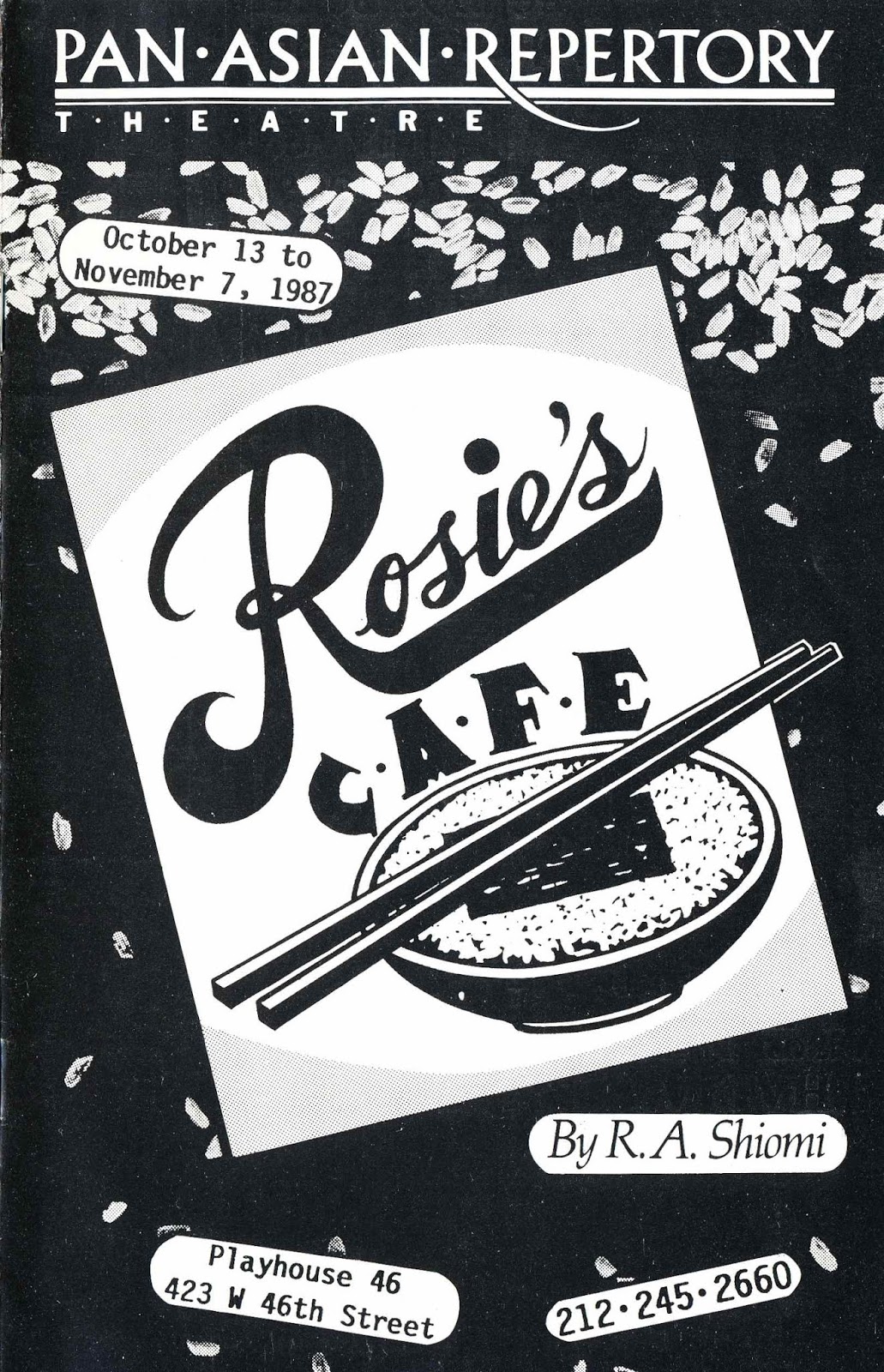
Rosie’s Cafe


Pan Asian Repertory Theatre
October 13–November 7, 1987
Playhouse 46, New York City
Cast: Carol A. Honda, Keenan Shimizu, Donald Li, Dalton Leong, Steve Park, John Quincy Lee, Mary Lee-Aranas, Ann M. Tsuji, Micahel Arkin
By R.A. Shiomi
Directed by Raul Aranas


The New York Times
October 21, 1987
Rosie’s Cafe


Related Posts
Yellow Fever
Once Is Never Enough


(Next post on Friday: Ethel Chun, Artist)