Showing posts with label Lunar New Year. Show all posts

Wednesday, February 25, 2026

Harriet Quimby and Chinese Food in Leslie’s Weekly, 1904 and 1905


An odd conceit for spring luncheons is a cooked dessert made from flowers. The idea has been borrowed from the Chinese “four hundred,” who, dating from the time of Confucius and before, have been noted for their epicurean tastes, and its very novelty makes it worth a trial. The flower best suited to the Chinese palate, and the one which is served with almost every elaborate Chinese dinner, is the chrysanthemum. The flower has a peculiar flavor and requires a taste educated by many trials before it can be fully appreciated; but Chinese epicures, and a few New Yorkers who enjoy Chinese foods, frequently pay fancy prices for chrysanthemums, which they take to the Chinese chefs to have prepared for them. The old-fashioned nasturtium, the rose, and the violet seem to please the American taste, however. For a luncheon an element of interest is always added by introducing the chafing-dish at table. The flower desserts are particularly adapted for luncheons because of the blossoms’ beauty and fragrance as well as the novelty of preparing them for food. To make the dessert, or the “blossom delight,” as some enthusiasts call it, first stir a thin batter of eggs and flour. This should be brought in from the kitchen already prepared. The flowers, thoroughly washed, should be arranged in a glass vase on the sideboard. Have the chafing-dish ready, half filled with oil, smoking hot. Pluck the petals from the flowers, stir briskly into the batter, then dip out in very small portions and drop into the oil. The fritters puff up immediately, and if taken out quickly they retain the color of the flower from which they are made. When removed from the oil they should be placed for a moment on absorbent paper before being dusted with powered sugar and passed to the waiting guests, who are more than anxious to sample the new idea. The tiny wafers, which are crisp and dainty, are good substitutes for the inevitable champagne wafers in serving ices of any kind.


 (Next post on Wednesday: Wah Ming Chang and the Grammy Award Trophy)

Sunday, January 22, 2023

Wednesday, June 8, 2022

Graphics: Author C.Y. Lee in Magazines

Theatre Arts, July 1944
Page 440: Chinese Plays
... Thy Son Is Right by Lee Chin-Yang, a four-act melodrama dealing with a Sino-Burmese border incident, was the major spring production at Yale. The play, Mr. Lee’s third, is the climax of two years of uprooting at the hands of the Japanese which tore the playwright from his position as overseer of a section of the Burma Road and eventually brought him to the United States.
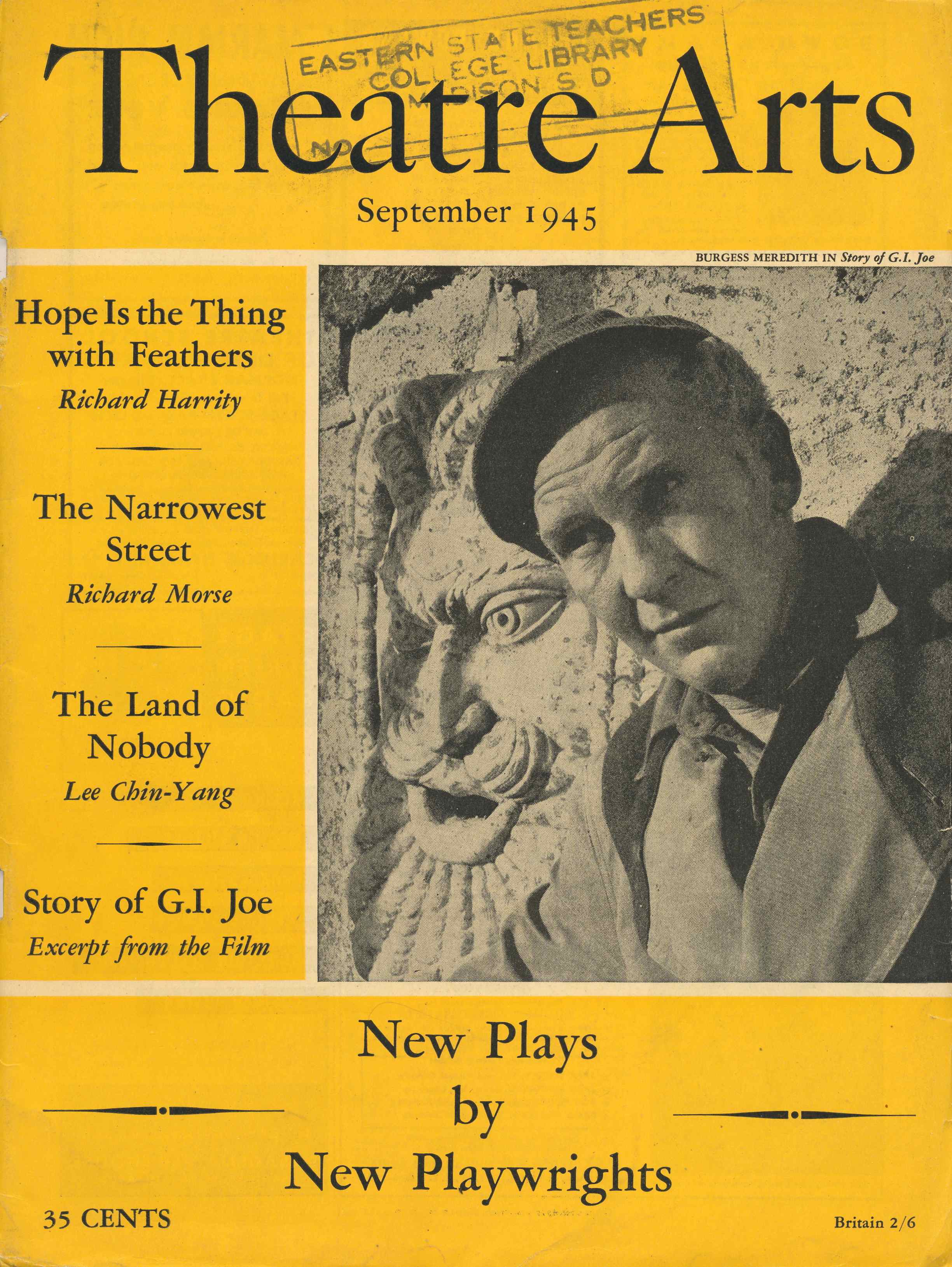
Theatre Arts, September 1945
Pages 532–538: The Land of Nobody


Theatre Arts, November 1945
Pages 656–660: Movies Come to China


Theatre Arts, July 1946
Page 424, column 3 
... two new plays at the Yale University Theatre, Gideon by Randolph Goodman and Laurel in the Moon, a Chinese comedy by Chin-Yang Lee ... 


Writer’s Digest, August 1954
Page 46: Prize Winners
$3,000 Writer’s Digest Short Fiction Contest
1st Prize of $750 Goes to C. Y. Lee
226 Third Street
Pacific Grove, California


(story published in Ellery Queen’s Mystery Magazine)

Writer’s Digest, August 1955
Page 36: 1955 Short Short Story Contest Winners

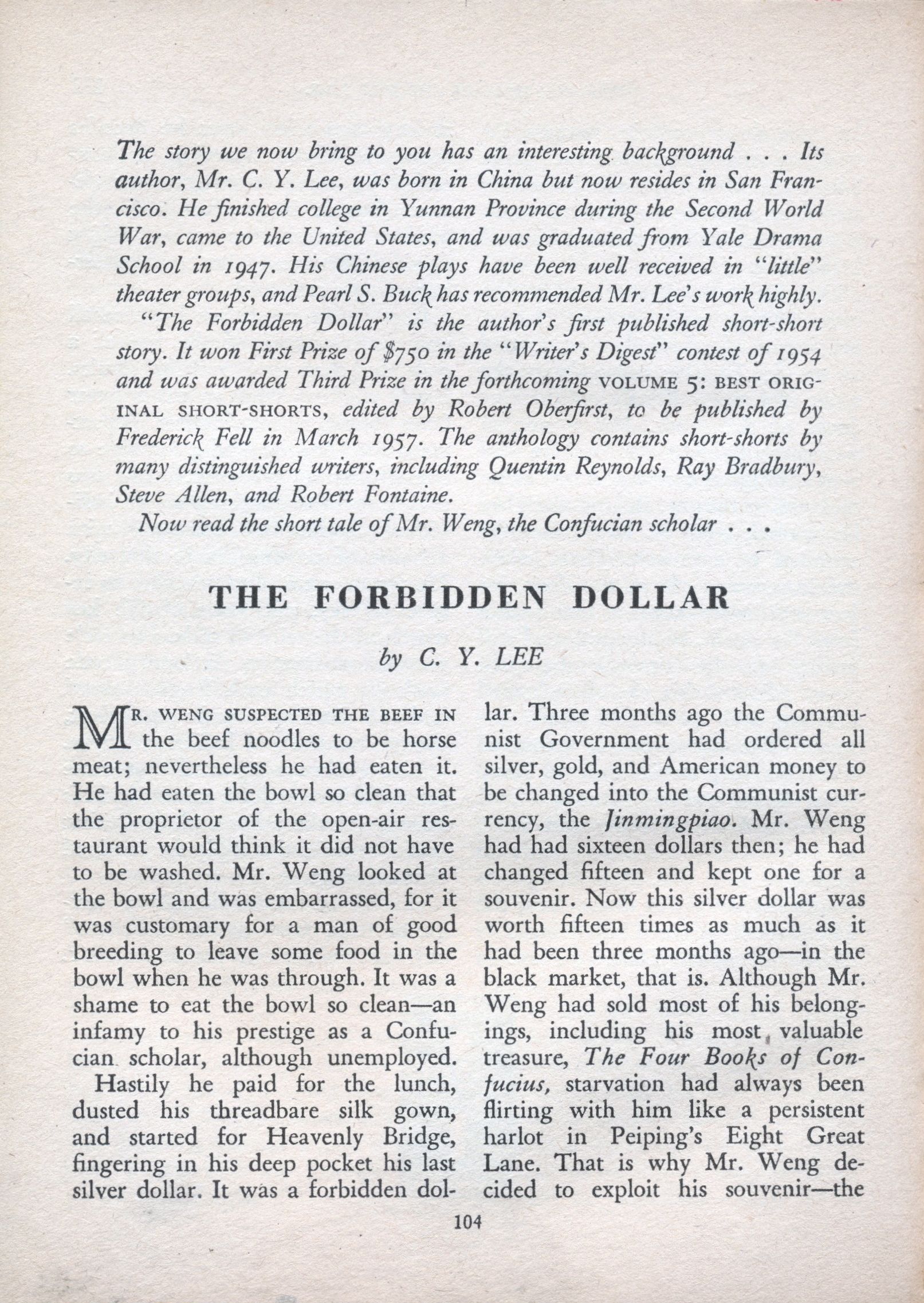
Ellery Queen’s Mystery Magazine, February 1957
Pages 104–106: The Forbidden Dollar


The Greenwood Encyclopedia of Asian American Literature (2008) and Chinese Americans: The History and Culture of a People: The History and Culture of a People (2015) said Lee’s “Forbidden Dollar” won the 1949 Writer’s Digest short story contest and was anthologized in Best Original Short Stories. Both are wrong on the date and title of the book. Below is an excerpt from the introduction (above) to Lee’s story. 
“The Forbidden Dollar” is the author’s first published short-short story. It won First Prize of $750 in the “Writer’s Digest” contest of 1954 and was awarded third prize in the forthcoming Volume 5: Best Original Short-Shorts, edited by Robert Oberfirst, to be published by Frederick Fell in March 1957. 
“Mr. Weng’s Last Forbidden Dollar” appeared in Anthology of Best Short-Short Stories, Volume 5 (1957). 

The New Yorker, March 30, 1957

Writer’s Digest, September 1957


The New Yorker, July 26, 1958

The New Yorker, August 30, 1958

The New Yorker, September 12, 1958

Playboy, October 1958
Page 15: ... Rodgers and Hammerstein’s The Flower Drum Song, their adaptation of C. Y. Lee’s novel on San Francisco’s Chinatown ...

The New Yorker, December 6, 1958

The New Yorker, December 20, 1958

Stanford University Dramatists’ Alliance, 1958
Page 2: Came the Year of the Rooster
In the competitions of Dramatists’ Alliance for 1953, a young writer named Chin Yang Lee submitted plays for all three categories: Half Hour at Paradise (Alden), a comic sketch of the Chinese student practising his American slang; The Laurel in the Moon (Etherege), a delicate and elusive play of happy love on the China-Burma border; and Madam Gold Flower (Stevens), an austere story of a bold, a enchanting woman patriot during the Boxer Rebellion. The last two won honors and went to the judges, but the elusive atmosphere, the hinted plot, the sly humor, all as true (and as strange) as a painting on Chinese silk, left the judges uncertain was to how these shrewd and brittle pieces could be staged in a way to show the value and charm; they remained honors plays. 
Pageant, May 1959
Pages 136–141: Meet Your Chinese Neighbors


Rogue, September 1959
Pages 40–41, 74, 86: The Casanova of Kearny Street


Gent, February 1960
Pages 52–55, 70: Chicken, Wanna Neck


Coronet, March 1961
Page 5: Dear Reader: 


Aware, December 1961
Pages 28–39, 70: The Cheongsam


Cavalcade, December 1961
Pages 17–18, 60–62, 70: Sideline Girl


Writer’s Yearbook, 1961
Pages 33–34: The Flower Drum Song


Rogue, March 1963
Pages 50–52, 60, 62, 79–81: What Makes a Smash Hit? ... or: how “Flower Drum Song” danced its way from the pages of The New Yorker to Broadway and Hollywood, bringing its writer fame and fortune.


Los Angeles Times, West magazine, February 13, 1972
Pages 12–13: The Year of the Rat Is Here


Further Reading
Cavalcade (Playboy magazine imitator)
Gent (Playboy magazine imitator)
Rogue (Playboy magazine imitator)
The Comics Journal, Remembering Playboy & Hef


Related Posts


(Next post on Wednesday: David Henry Hwang in School Yearbooks)

Friday, February 4, 2022

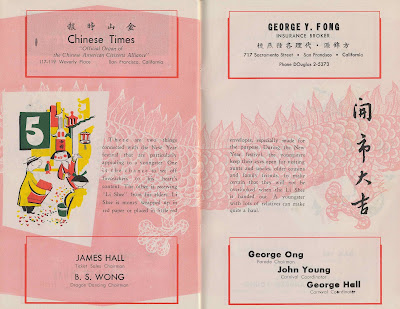
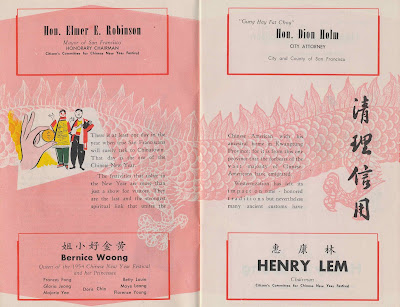
Ephemera: Chinese New Year Festival Souvenir

San Francisco Chinatown
February 5–7, 1954
Cover artist: Hubbard
Interior illustrations uncredited

Selected Businesses
The Hong Kong & Shanghai Banking Corp.
National Dollar Store
Kan’s Chinese Restaurant
The Chinese World
Chinese Hour
KSAN TV
Chinese Times
Kem Lee Studio


Citizens Committee Chinese New Year Festival Program


(Next post on Friday: Charles Leong in School Yearbooks)