Wednesday, April 30, 2025

Searching for C.W. Young, Artist and Member of the Chinese Art Club

C.W. Young was also known as Chu W. Young and may have, at times, dropped his middle initial.

An artist named Chu Young was profiled in the newspaper, Daily Argus (Mount Vernon, New York), August 30, 1938. According to the profile Young was 34 years old and born in Canton, China. His friend and fellow artist, Wu Tan-Ku, age 32, was also profiled. There is the possibility that Wu Tan-Ku was the artist known as Don Gook Wu.

The article was reprinted in the Herald Statesman (Yonkers New York), September 7, 1938. The caption reads:

Chu Young (left) and Wu Tan-Ku are shown as they set to work on their latest paintings of Westchester scenes. Residents of Mount Vernon for the past seven years, the Oriental artists sell their work for a living and send a good part of the proceeds to their countrymen in war-torn China.
 
The earliest mention of Young was in the New York Post, October 24, 1936.
Chinese Art Club Holds Canal Street Exhibit

Those who cherish the racial interpretation of art will find some matter to ponder in the exhibit by members of the Chinese Art Club in their new quarters at 175 Canal Street. For nine-tenths of the work shown is indistinguishable from contemporary occidental art.

Howard Low is most alert to advanced modern trends, creating abstract designs, lively drawings of city life, and intimate paintings like “Goldfish Bowl,” all very well done. Chu W. Young is an able exponent of impressionist landscape art, and Chu H. Jor paints still life with a soft patine of color. Others showing are Mowee Tiam, Harry Wong, Stanley Chin, Tschai Lanzene, K. L. Eng, Bennie Sonn and S. V. Pang.
The Daily Worker (New York, New York), September 18, 1937, said
Dismissed WPA Chinese and Japanese Artists Express Unity in Paintings at ACA Gallery
The New York art season is getting under way. Galleries in the Champagne Belt are brushing the summer’s cobwebs from the ceiling corners and oiling the door hinges. Collectors, professional and amateur, have returned to the city. The critics have returned from their summer wanderings prepared, as far as adjectives are concerned, for whatever may befall them.

One gallery has kept the torch bright during the past months, spreading both heat and light. The A. C. A. Gallery, 52 West 8th Street, has been staunch in its support of the pink slip artists of The Federal Art Project, having given them three consecutive shows.

The current one is of great importance. Chinese and Japanese artists are exhibiting together, symbolizing their common persecution as aliens without the right to apply for citizenship in a more oblique way, but in a sharper manner, they represent the unity of the Chinese and the Japanese people against the Japanese war-machine.

Dismissed from Art Field

However, it is on the basis of their work as artists that this group presents its case. Victims of the most reprehensible type of legislative discrimination on WPA, they are in serious danger of being wiped out of the art field.

In his prefatory statement, Harry Gottlieb, president of the Artists’ Union, one of the sponsoring organizations, states the case simply, “As artists this group has made important contributions to our cultural life. They have exhibited in American museums and galleries. They are members of American artists organizations and are accepted as American artists. Their dismissal not only deprives the country of their talent, but in effect, denies their right to be artists.”

The exhibition’s level is high, with Chuzo Tamotzu and Yasuo Kuniyoshi representing the high water marks. Tamotzu’s “Jersey Station” is a sober harmony of greens and browns, with, a breath-taking freshness in the handling of the palette knife.

Kuniyoshi’s painting of a demimondaine in a wicker chair is as fine in its aristocratic greys and sensuous drawing as anything the artist has done which means that it is very fine indeed.

Eitaro Ishigaki devotes two pictures to the feats of the Basque women who hurled the Italian “volunteers” into the sea. Sakari Suzuki has three solidly constructed conceptions, ingratiatingly painted; C Yamasaki’s “Noonday Rest” is good solid painting with genuine feeling; Don Gook Wu’s “Unlovely Sunset” is wild Expressionism a la Orient; Thomas Nagai’s gouache and water colors are able renditions of mood and place.

Other exhibitors are Yosei Amemiya, Roy Kadowaki, Kaname Miyamoto, Fuji Nakamizo, Kiyoshi Shimisu, George Tera, Moo-Wee Tiam, Bunji Tagawa, Chu H. Jor and C. W. Young.
The New York Post, September 18, 1937, said
Chinese Artists Join Japanese in WPA Job Protest
Forget War in Fighting Project Exclusion—“Fail to Support” China Invasion

While their fellow-countrymen were fighting it out to the death 10,000 miles away, many of New York’s Chinese and Japanese artists collaborated this week in a joint art exhibition at the A. C. A. Gallery under sponsorship of the Artists’ Union and the American Artists’ Congress.

Though the artists manifested their solidarity in the face of the Sino-Japanese conflict, the primary motivation for their show arose not from the situation in the Far East but that in the United States. I refer to the exclusion of noncitizens from WPA jobs.

Because of their ineligibility for American citizenship, the discrimination against Orientals was 100 per cent. Let Chuzo Tamotzu, delegate of the Japanese-Chinese group on the recent job march to Washington, sum up the situation:

“Most of us have been here at least fifteen to twenty-five years, living and working as American artists, and accepted as such. For example, Kuniyoshi has been invited to the Carnegie International not as a Japanese but as an American.

Still Subject to the Draft

“We expect to continue to live here. In the event of war, we should be subject to the draft, just as we were in the last war. Why, then, should we be discriminated against in social benefits?

“I might add that we want to live here peacefully and as advocates of peace and culture, in harmony with the peace policy of the present United States Administration. Thus we have nothing to do with support of the Japanese Army now unjustly invading China.”

This is a case that does not have to be supported on principles alone. The exhibit presents achievements which were largely made possible, except in the case of Kuniyoshi, by WPA. They are now deprived of its support.

Exhibit Excellent Work

There is the powerful thrust of Ishigaki’s aroused peasants and workers, the forceful symbolist work of Suzuki, the sensitive naturalism of Tamotzu and the light fancy of Nagai. Sober strength marks Tagawa’s “Chinese Toilers.” Excellent textural quality is found in a still life by a quite new exhibitor, Kiyoshi Shimizu.

G. [sic] W. Young’s impressionist landscapes and Don Gook Wu’s more subjectively accented canvases are the most interesting work by Chinese-born painters.

Here, then, is a challenge to liberals. A group of artists active in the midst of American cultural life has been legally put beyond the pale. Can progressives afford to rest until this reactionary step which narrows the base of American culture has been rescinded?
Art Front, October 1937, said
Chinese and Japanese Artists
While the minions of Mitsui and Mitsubishi are pouring death on China from the sea and air and the torn bodies of women and children writhe in the shattered cities, American reactionaries are conducting their own offensive against American Orientals. With the impartiality characteristic of American diplomacy, which goes in for “neutrality” measures like the current embargo against both imperialist Japan and bleeding China, the W.P.A. Administration has ruled all aliens off the projects. This includes, of course, all those who are prohibited by law from becoming citizens. Since only white aliens and those of African descent are eligible for citizenship, Asiatics find themselves on the proscribed list.

Japanese and Chinese artists have just concluded an exhibition at the A.C.A. Gallery, welding in common persecution their collective desire to function as artists and Americans. Sponsored by the Artists Union, the Artists’ Congress and the Citizens’ Committee for Support of W.P.A., the exhibition indicated the contributions of the Chinese and Japanese to American culture.

Yasuo Kuniyoshi, for instance, who is represented in many American museums as an American artist, and who was invited to the Carnegie International as an American, is a major influence in our art life. Not on W.P.A., Kuniyoshi sent one of his finest canvasses and several lithographs to the show as a gesture of solidarity with his brother artists and Orientals.

With W.P.A. support withdrawn and the chances of private patronage as remote as ever, these Japanese-American and Chinese-American artists are in serious danger of being eliminated from the art field, to say nothing of life itself. And, despite their great contribution to American culture, they will become the victims of reaction unless the liberal and progressive forces get busy and build a strong defense.

In the exhibition are the vibrant landscapes of Chuso Tamotsu, with “Jersey Station” and “Firetrap” outstanding in their quiet harmonies of green and brown: the anti-imperialist canvases of Eitaro Ishigaki, with two Spanish subjects of Basque women hurling Italian fascist “volunteers” into the sea; the sensitive water-colors and gouaches of Thomas Nagai; the socially symbolic montages of Sakari Suzuki; Don Gook Wu’s colorful impressionism and work by C. Yamasaki, Yosei Amemiya, Roy Kadowaki, Kaname Miyamoto, Fuji Nakamizo, Kiyoshi Shimisu, George Tera, Moo-Wee Tiam, Bunji Tagawa, Chu H. Jor and C. W. Young.
The New York Post, March 19, 1938, said
Chinese Club Show
The third annual exhibition by members and friends of the Chinese Art Club is now current at 175 Canal Street.

Some participants, such as K. L. Eng, Jack Chen and Mowee Tiam, have turned in work bearing on the dedication of the show to the defense of the Chinese people. Others have followed their older tendencies, Chu H. Jor showing richly painted still lifes of livid lobsters and fruit. Chu W. Young an impressionist landscape, Tschai Lenzene genre landscapes and Yee Ching-Chih landscapes in the Chinese brush technique.

Work by American artists includes Oronzio Maldarelli’s handsome dancer, Guy Maccoy’s “The Old Tree,” two compositions by Genoi Pettit, a still life by Arthur Schwieder and a drawing by Neysa McMein.
An endnote mentioned Young in Asian American Art: A History, 1850–1970 (2008).

Young has not been found in the 1930, 1940 and 1950 United States censuses. A search for his World War II draft card or enlistment record yielded no results.
 
Young was listed as a life member of the Art Students League in the 1951 publication, The Metropolitan Museum of Art Presents the 75th Anniversary Exhibition of Painting & Sculpture by 75 Artists Associated with the Art Students League of New York.

The following are possible matches for the artist. The Schenectady Gazette (New York), August 15, 1944, published the Schenectady Savings Bank notice for unclaimed property. The list included someone named Chu Young who lived at 409 Franklin Street in Schenectady. On March 17, 1956 a passenger named Young Chu was aboard a Pan American World Airways flight bound for London, England. Someone named Young Chu became a naturalized citizen on June 17, 1968 in New York City. He was born on November 16, 1901.

What became of the artist is not known.

 
Related Posts
Artist Chu H. Jor and the Chinese Art Club 


Wednesday, April 23, 2025

Searching for Moowee Tiam, Artist and Member of the Chinese Art Club

Moo-Wee Tiam has not been found in the United States censuses, immigration and military records. His name may have been a pseudonym. Tiam’s first name had been spelled Moowee, Mowee, and Moo-Wee.

The New York Post, October 24, 1936, said
Chinese Art Club Holds Canal Street Exhibit
Those who cherish the racial interpretation of art will find some matter to ponder in the exhibit by members of the Chinese Art Club in their new quarters at 175 Canal Street. For nine-tenths of the work shown is indistinguishable from contemporary occidental art.

Howard Low is most alert to advanced modern trends, creating abstract designs, lively drawings of city life, and intimate paintings like “Goldfish Bowl,” all very well done. Chu W. Young is an able exponent of impressionist landscape art, and Chu H. Jor paints still life with a soft patine of color. Others showing are Mowee Tiam, Harry Wong, Stanley Chin, Tschai Lanzene, K. L. Eng, Bennie Sonn and S. V. Pang.
The New York Sun, April 27, 1937, said
City Artists Open Their Exhibition
Preview of Display Given in Municipal Gallery
The twenty-second exhibition in the series arranged by the resident artists of New York city in the temporary galleries of the Municipal Art Committee, 62 West Fifty-third street, was opened with a preview this afternoon for the exhibiting artists and members of the Municipal Art Committee. The exhibition will open to the public tomorrow at noon and will continue through Sunday, May 16.

Four groups of artists are showing oil paintings of their own selection in the four galleries of the building. These groups are self-organized and applied for space for the exhibition and sale of their works without expense and without jury. The members of these groups are as follows.

Gallery 1—Ignatius Banasewicz, Aaron Fastovsky, Ben Galos, F. Wynn Graham, Gitel Kahn, Ragnar Olson, Emma Shumaker and Ted Witonski.

Gallery 2—William Cole Gray, Carolyn Haeberlin, Sally Mewhinney, Laura S. Parsons, Roslyn Reich, Roger Vernam and Mary Burton Wallis.

Gallery 3—Lucien Bildsteln, Eugene H. Bischoff, Paula Eliasoph, Rodney Lethbridge, S. L. Margolies, Albert A. Munro, Leslie H. Nash, Sara M. Pinkus, Malvina C. Slonin and Robert Zoeller.

Galleries 4 and 5—Salvatore Cannizzo, Stanley H. Chin, Frank Giovinazzo, Chu H. Jor, Nicholas Markatos, Irving H. Novick, Evangeline St. Clair and Moowee Tiam.

The temporary galleries are open daily including Sundays from 12 noon to 6 P. M. They are closed on Mondays. Admission is free.
The New York Times, May 2, 1937, said
Five of the Current Group Shows
A reasonably modern tinge may be noted at the temporary galleries of the Municipal Art Committee, where the galleries on all four floors are occupied by oil paintings in the twenty-second exhibition of the series by resident New York artists. Thirty-three are represented in the four self-organized groups currently showing (until May 16). More than half of the artists have studied at the Art Students League. ...

... Three Chinese artists and two of Italian birth are exhibitors in Gallery IV. Chu Jor’s painstaking still-life study of textures, in vivid color, is inscribed to the memory of Gauguin. Moowee Tiam contributes a self-portrait which gives no warning of the other work from his brushes—“The Awakening,” suggesting something from the Book of Revelations.
The New York Times, May 24, 1937, said
Chinese Children Exhibit Art Work
First Show Its Kind Contains Scarcely Anything That Is Oriental in Character

The Chinese Art Club at 175 Canal Street opened yesterday its first exhibition of art work by Chinese children. The odd thing about the show is that scarcely any of it is Chinese in character.

The gallery itself, with its white ceiling, walls covered with monks’ cloth and white shaded lights, is very up to date. And instead of drawing dragons, mandarins, pagodas and almond-eyed princesses, the children have drawn cowboys, Indians, airplanes and such characters from our comic strips as Buck Rogers, Dickie Dare, Mandrake the Magician and Mickey Mouse.

In fact, were it not for the thirty examples of Chinese handwriting by the elder children, the snatches of Chinese writing beside some of the drawings, and the series of fifteen realistic pencil drawings of modern Chinese warfare by 13-year-old Paul Chu—were it not for these, the exhibition might be the work of any group of American children.

The Chinese children have drawn what other American children draw—Vikings, Arthurian knights, court ladies of the eighteenth century, and Indians with feathered head-dresses.

All but ten or twelve of the young artists were born in this country. They have been taught drawing in their homes, the Chinese Public School and the Chinese Christian Kindergarten. Moowee Tiam of the club’s governing board, who was in charge yesterday, said that none had gone to the WPA free art classes.

There is only one mural in the show. It was painted by 10-year-old Cora May Chu and shows two girls playing on a greenware. To their left is the bough of a fruit tree in blossom. Behind them is a lake and a mountain. There are three pieces of clay modeling, twenty-nine paintings, and about 215 drawings.

Among the patrons of the show are Dr. Lin Yutang, Pearl S. Buck, Rabbi Stephen S. Wise and Dr. Tsune-Chi Yu, Chinese Consul General in New York.
The Daily Worker (New York, New York), September 18, 1937, said
The Art World
Dismissed WPA Chinese and Japanese Artists Express Unity in Paintings at ACA Gallery
The New York art season is getting under way. Galleries in the Champagne Belt are brushing the summer’s cobwebs from the ceiling corners and oiling the door hinges. Collectors, professional and amateur, have returned to the city. The critics have returned from their summer wanderings prepared, as far as adjectives are concerned, for whatever may befall them.

One gallery has kept the torch bright during the past months, spreading both heat and light. The A. C. A. Gallery, 52 West 8th Street, has been staunch in its support of the pink slip artists of The Federal Art Project, having given them three consecutive shows.

The current one is of great importance. Chinese and Japanese artists are exhibiting together, symbolizing their common persecution as aliens without the right to apply for citizenship in a more oblique way, but in a sharper manner, they represent the unity of the Chinese and the Japanese people against the Japanese war-machine.

Dismissed from Art Field

However, it is on the basis of their work as artists that this group presents its case. Victims of the most reprehensible type of legislative discrimination on WPA, they are in serious danger of being wiped out of the art field.

In his prefatory statement, Harry Gottlieb, president of the Artists’ Union, one of the sponsoring organizations, states the case simply, “As artists this group has made important contributions to our cultural life. They have exhibited in American museums and galleries. They are members of American artists organizations and are accepted as American artists. Their dismissal not only deprives the country of their talent, but in effect, denies their right to be artists.”

The exhibition’s level is high, with Chuzo Tamotzu and Yasuo Kuniyoshi representing the high water marks. Tamotzu’s “Jersey Station” is a sober harmony of greens and browns, with, a breath-taking freshness in the handling of the palette knife.

Kuniyoshi’s painting of a demimondaine in a wicker chair is as fine in its aristocratic greys and sensuous drawing as anything the artist has done which means that it is very fine indeed.

Eitaro Ishigaki devotes two pictures to the feats of the Basque women who hurled the Italian “volunteers” into the sea. Sakari Suzuki has three solidly constructed conceptions, ingratiatingly painted; C Yamasaki’s “Noonday Rest” is good solid painting with genuine feeling; Don Gook Wu’s “Unlovely Sunset” is wild Expressionism a la Orient; Thomas Nagai’s gouache and water colors are able renditions of mood and place.

Other exhibitors are Yosei Amemiya, Roy Kadowaki, Kaname Miyamoto, Fuji Nakamizo, Kiyoshi Shimisu, George Tera, Moo-Wee Tiam, Bunji Tagawa, Chu H. Jor and C. W. Young.

Tiam had four paintings in the exhibition, “The Russian Kettle”, “Still Life”, “The Chinese Seamen”, and “The Farm House”.

Art Front, October 1937, said
Chinese and Japanese Artists
While the minions of Mitsui and Mitsubishi are pouring death on China from the sea and air and the torn bodies of women and children writhe in the shattered cities, American reactionaries are conducting their own offensive against American Orientals. With the impartiality characteristic of American diplomacy, which goes in for “neutrality” measures like the current embargo against both imperialist Japan and bleeding China, the W.P.A. Administration has ruled all aliens off the projects. This includes, of course, all those who are prohibited by law from becoming citizens. Since only white aliens and those of African descent are eligible for citizenship, Asiatics find themselves on the proscribed list.

Japanese and Chinese artists have just concluded an exhibition at the A.C.A. Gallery, welding in common persecution their collective desire to function as artists and Americans. Sponsored by the Artists Union, the Artists’ Congress and the Citizens’ Committee for Support of W.P.A., the exhibition indicated the contributions of the Chinese and Japanese to American culture.

Yasuo Kuniyoshi, for instance, who is represented in many American museums as an American artist, and who was invited to the Carnegie International as an American, is a major influence in our art life. Not on W.P.A., Kuniyoshi sent one of his finest canvasses and several lithographs to the show as a gesture of solidarity with his brother artists and Orientals.

With W.P.A. support withdrawn and the chances of private patronage as remote as ever, these Japanese-American and Chinese-American artists are in serious danger of being eliminated from the art field, to say nothing of life itself. And, despite their great contribution to American culture, they will become the victims of reaction unless the liberal and progressive forces get busy and build a strong defense.

In the exhibition are the vibrant landscapes of Chuso Tamotsu, with “Jersey Station” and “Firetrap” outstanding in their quiet harmonies of green and brown: the anti-imperialist canvases of Eitaro Ishigaki, with two Spanish subjects of Basque women hurling Italian fascist “volunteers” into the sea; the sensitive water-colors and gouaches of Thomas Nagai; the socially symbolic montages of Sakari Suzuki; Don Gook Wu’s colorful impressionism and work by C. Yamasaki, Yosei Amemiya, Roy Kadowaki, Kaname Miyamoto, Fuji Nakamizo, Kiyoshi Shimisu, George Tera, Moo-Wee Tiam, Bunji Tagawa, Chu H. Jor and C. W. Young.
The New York Post, November 20, 1937, said
M. Tiam has been elected president of the Chinese Art Club, succeeding Chu H. Jor.
Chinese Digest, December 1937, said
N.Y. Art Club Starts Painting Class
New York City — The Chinese Art club, 175 Canal street, which has sponsored many cultural and art activities among the Chinese here, has recently embarked on another activity which promises to bring out art talent and appreciation of Chinese art among Chinese and Americans alike.

This new activity is the engagement of Miss Yee Ching-chih, professor of Chinese painting at the Shanghai Art college. As instructor of Chinese art, Miss Yee has started a class in Chinese painting at the art club’s studios. Classes are being held three times a week, and a limited number of American students may be enrolled.

The Chinese Art club, in announcing this class, said, “This is the first time that such an opportunity to study Chinese art under an experienced native teacher … has ever been made possible in New York.”

This organization is now in its third year of existence and is about the most active one of its kind in the country. Last June it sponsored the first Chinese children’s art exhibition in America which attracted wide attention among American educators and art critics (Chinese Digest for July, 1937, p. 13). The club has an annual membership exhibition, sponsors native plays, and opens its studios for cultural gatherings of all kinds. Its present president is Moowee Tiam.
Chinese Digest, March 1938, said
Art Club to Hold Painting and Photography Exhibits
New York—The Chinese Art club here will hold its third annual exhibit of paintings and sculpture at the club’s gallery, 175 Canal street, beginning March 1 and extending through March 25.

The exhibit will include works by Miss Yee Ching-chih, Jack Chen, Chu H. Jor, Kailuen Eng, Moowee Tiam, Tschai Lenzene, Howard Low, and others. Guest exhibitors will include Neysa McNein [sic], Oronzio Maladrelli, Guy Maccoy, Dimitri Romanovesky, and others.

Beginning April 1 and extending through April 15 the Chinese Art club will hold its second photographic salon. Prints for showing may be submitted by any Chinese in any part of the country, and may be of any size, but must be mounted. Submission of prints must be made on or before March 25, announced W. Yukon, in charge of this exhibit. All pictures submitted will be returned in their original wrappings to the senders after the close of the exhibition.
The New York Post, March 19, 1938, said
Chinese Club Show
The third annual exhibition by members and friends of the Chinese Art Club is now current at 175 Canal Street.

Some participants, such as K. L. Eng, Jack Chen and Mowee Tiam, have turned in work bearing on the dedication of the show to the defense of the Chinese people. Others have followed their older tendencies, Chu H. Jor showing richly painted still lifes of livid lobsters and fruit. Chu W. Young an impressionist landscape, Tschai Lenzene genre landscapes and Yee Ching-Chih landscapes in the Chinese brush technique.

Work by American artists includes Oronzio Maldarelli’s handsome dancer, Guy Maccoy’s “The Old Tree,” two compositions by Genoi Pettit, a still life by Arthur Schwieder and a drawing by Neysa McMein.
The New York Times, December 9, 1938, said
The Chinese Art Club has elected Chu Jor as its president succeeding Moowee Tiam, at its fourth annual meeting, recently held. The club will continue this season to introduce to the Chinese and American public the work of Chinese and American artists. The annual children’s exhibition, which will include the work of Chinese children from San Francisco, Chicago, Cleveland, Boston and other cities, will be held in the club gallery in February.
Chinese Digest, January 1939, said
New Officers for N.Y. Chinese Art Club
New York—The Chinese Art Club here at its fourth annual meeting elected Chu Jor for its next president, succeeding Moowee Tiam. Others elected included K.L. Eng, Wesley S. Chan, Marquis Chunn, Arthur Lee, and Stanley H. Chin.

The club is now preparing for its next annual Children’s Art exhibition. This year it intends to have a nation-wide representation and Chinese children’s art work from the Chinese communities of San Francisco, Chicago, Cleveland, Boston, and other Chinatowns.
Tiam was mentioned in Asian Americans: An Encyclopedia of Social, Cultural, Economic, and Political History (2013). Tiam was listed in the 1948 book, Supplement to Mallett’s Index of Artists, International—Biographical Including Painters, Sculptors, Illustrators, Engravers and Etchers of the Past and the Present.

What became of Tiam is not known.

 
Related Posts


Wednesday, April 16, 2025

Chu Jor in the American Artists Congress 2nd Annual Exhibition

May 5–21, 1938
John Wanamaker, New York


The catalog was unpaginated. The artists of paintings were listed in alphabetical order.


Chu Jor’s “Composition” was printed eleven pages after his listing.


Chu Jor’s address appeared four pages later: 175 Canal Street, New York City.

The above scans are from the author’s collection. The catalog can be viewed at the Smithsonian’s Archive of American Art.

The New York Post, March 19, 1938, reviewed the Chinese Art Club’s third annual exhibition and said
 
           Chu H. Jor showing richly painted still lifes of livid lobsters 
           and fruit.

Chinese Digest
, May 1938, may have referred to “Composition” or a similar painting.
... Chu H. Jor’s “Painting No. 1,” (Red Lobster on Blue Plate) shows promise of still further works to come. ...
 
Related Posts
Artist Chu H. Jor and the Chinese Art Club 
Chu H. Jor, Moo-Wee Tiam, Don Gook Wu and C. W. Young at ACA Gallery, September 1937
Searching for Moowee Tiam, Artist and Member of the Chinese Art Club
Searching for C.W. Young, Artist and Member of the Chinese Art Club
K. L. Eng, Artist and Member of the Chinese Art Club


Wednesday, April 9, 2025

Chu H. Jor, Moo-Wee Tiam, Don Gook Wu and C. W. Young at ACA Gallery, September 1937

“Paintings by New York Chinese and Japanese Artists”

1. Chu H. Jor: “Still Life”
2. Moo-Wee Tiam: “The Russian Kettle”, “Still Life”, “The Chinese Seamen”, 
    “The Farm House”
3. Don Gook Wu: “Unlovely Sunset”, “The Island”
4. C. W. Young: “The Window”, “Landscape”
 
September 18, 1937
Dismissed WPA Chinese and Japanese Artists Express Unity in Paintings at ACA Gallery
 
The New York art season is getting under way. Galleries in the Champagne Belt are brushing the summer’s cobwebs from the ceiling corners and oiling the door hinges. Collectors, professional and amateur, have returned to the city. The critics have returned from their summer wanderings prepared, as far as adjectives are concerned, for whatever may befall them.

One gallery has kept the torch bright during the past months, spreading both heat and light. The A. C. A. Gallery, 52 West 8th Street, has been staunch in its support of the pink slip artists of The Federal Art Project, having given them three consecutive shows.

The current one is of great importance. Chinese and Japanese artists are exhibiting together, symbolizing their common persecution as aliens without the right to apply for citizenship in a more oblique way, but in a sharper manner, they represent the unity of the Chinese and the Japanese people against the Japanese war-machine.

Dismissed from Art Field

However, it is on the basis of their work as artists that this group presents its case. Victims of the most reprehensible type of legislative discrimination on WPA, they are in serious danger of being wiped out of the art field.

In his prefatory statement, Harry Gottlieb, president of the Artists’ Union, one of the sponsoring organizations, states the case simply, “As artists this group has made important contributions to our cultural life. They have exhibited in American museums and galleries. They are members of American artists organizations and are accepted as American artists. Their dismissal not only deprives the country of their talent, but in effect, denies their right to be artists.”

The exhibition’s level is high, with Chuzo Tamotzu and Yasuo Kuniyoshi representing the high water marks. Tamotzu’s “Jersey Station” is a sober harmony of greens and browns, with, a breath-taking freshness in the handling of the palette knife.

Kuniyoshi’s painting of a demimondaine in a wicker chair is as fine in its aristocratic greys and sensuous drawing as anything the artist has done which means that it is very fine indeed.

Eitaro Ishigaki devotes two pictures to the feats of the Basque women who hurled the Italian “volunteers” into the sea. Sakari Suzuki has three solidly constructed conceptions, ingratiatingly painted; C. Yamasaki’s “Noonday Rest” is good solid painting with genuine feeling; Don Gook Wu’s “Unlovely Sunset” is wild Expressionism a la Orient; Thomas Nagai’s gouache and water colors are able renditions of mood and place.

Other exhibitors are Yosei Amemiya, Roy Kadowaki, Kaname Miyamoto, Fuji Nakamizo, Kiyoshi Shimisu, George Tera, Moo-Wee Tiam, Bunji Tagawa, Chu H. Jor and C. W. Young.
New York Post
September 18, 1937
Chinese Artists Join Japanese in WPA Job Protest
Forget War in Fighting Project Exclusion—“Fail to Support” China Invasion

While their fellow-countrymen were fighting it out to the death 10,000 miles away, many of New York’s Chinese and Japanese artists collaborated this week in a joint art exhibition at the A. C. A. Gallery under sponsorship of the Artists’ Union and the American Artists’ Congress.

Though the artists manifested their solidarity in the face of the Sino-Japanese conflict, the primary motivation for their show arose not from the situation in the Far East but that in the United States. I refer to the exclusion of noncitizens from WPA jobs.

Because of their ineligibility for American citizenship, the discrimination against Orientals was 100 per cent. Let Chuzo Tamotzu, delegate of the Japanese-Chinese group on the recent job march to Washington, sum up the situation:

“Most of us have been here at least fifteen to twenty-five years, living and working as American artists, and accepted as such. For example, Kuniyoshi has been invited to the Carnegie International not as a Japanese but as an American.

Still Subject to the Draft

“We expect to continue to live here. In the event of war, we should be subject to the draft, just as we were in the last war. Why, then, should we be discriminated against in social benefits?

“I might add that we want to live here peacefully and as advocates of peace and culture, in harmony with the peace policy of the present United States Administration. Thus we have nothing to do with support of the Japanese Army now unjustly invading China.”

This is a case that does not have to be supported on principles alone. The exhibit presents achievements which were largely made possible, except in the case of Kuniyoshi, by WPA. They are now deprived of its support.

Exhibit Excellent Work

There is the powerful thrust of Ishigaki’s aroused peasants and workers, the forceful symbolist work of Suzuki, the sensitive naturalism of Tamotzu and the light fancy of Nagai. Sober strength marks Tagawa’s “Chinese Toilers.” Excellent textural quality is found in a still life by a quite new exhibitor, Kiyoshi Shimizu.

G. [sic] W. Young’s impressionist landscapes and Don Gook Wu’s more subjectively accented canvases are the most interesting work by Chinese-born painters.

Here, then, is a challenge to liberals. A group of artists active in the midst of American cultural life has been legally put beyond the pale. Can progressives afford to rest until this reactionary step which narrows the base of American culture has been rescinded?
Art Front
October 1937
Chinese and Japanese Artists

While the minions of Mitsui and Mitsubishi are pouring death on China from the sea and air and the torn bodies of women and children writhe in the shattered cities, American reactionaries are conducting their own offensive against American Orientals. With the impartiality characteristic of American diplomacy, which goes in for “neutrality” measures like the current embargo against both imperialist Japan and bleeding China, the W.P.A. Administration has ruled all aliens off the projects. This includes, of course, all those who are prohibited by law from becoming citizens. Since only white aliens and those of African descent are eligible for citizenship, Asiatics find themselves on the proscribed list.

Japanese and Chinese artists have just concluded an exhibition at the A.C.A. Gallery, welding in common persecution their collective desire to function as artists and Americans. Sponsored by the Artists Union, the Artists’ Congress and the Citizens’ Committee for Support of W.P.A., the exhibition indicated the contributions of the Chinese and Japanese to American culture.

Yasuo Kuniyoshi, for instance, who is represented in many American museums as an American artist, and who was invited to the Carnegie International as an American, is a major influence in our art life. Not on W.P.A., Kuniyoshi sent one of his finest canvasses and several lithographs to the show as a gesture of solidarity with his brother artists and Orientals.

With W.P.A. support withdrawn and the chances of private patronage as remote as ever, these Japanese-American and Chinese-American artists are in serious danger of being eliminated from the art field, to say nothing of life itself. And, despite their great contribution to American culture, they will become the victims of reaction unless the liberal and progressive forces get busy and build a strong defense.

In the exhibition are the vibrant landscapes of Chuso Tamotsu, with “Jersey Station” and “Firetrap” outstanding in their quiet harmonies of green and brown: the anti-imperialist canvases of Eitaro Ishigaki, with two Spanish subjects of Basque women hurling Italian fascist “volunteers” into the sea; the sensitive water-colors and gouaches of Thomas Nagai; the socially symbolic montages of Sakari Suzuki; Don Gook Wu’s colorful impressionism and work by C. Yamasaki, Yosei Amemiya, Roy Kadowaki, Kaname Miyamoto, Fuji Nakamizo, Kiyoshi Shimisu, George Tera, Moo-Wee Tiam, Bunji Tagawa, Chu H. Jor and C. W. Young.


Wednesday, April 2, 2025

Exhibition: Asian Comics, Evolution of an Art Form

Exhibition at the Museum of Pop Culture
Seattle, Washington

Forbes, March 13, 2025, review
New ‘Asian Comics’ Exhibit Offers a Deep Dive into a Rich Visual Culture


Wednesday, March 19, 2025

Etta Lee, Public School Teacher and Actress

March is Women’s History Month.

Etta Elizabeth Lee was born on September 11, 1886 in San Jose, California. The September date was on a 1918 passenger list and her Social Security application which had her full name. According to Lee’s application, her parents were Harry Lee and Lillie M. Liddle.


Lee’s birth information was also recorded in her Chinese Exclusion Act case file interview, dated July 19, 1911. Lee had recently returned from Hawaii.
Q State your name and present residence?
A Etta Elizabeth Lee, 1375 East Washington Street, Los Angeles.

Q Where and when were you born?
A In San Jose, California, September 11, 1886.

Q Have you any documentary proof of your American nativity?
A No, I haven’t anything.

Q Are your parents living?
A My mother is; my father died when I was about nine years old.

Q What was your father’s name?
A Mr. Lee is all I know.

Q What was your father’s nationality?
A Chinese.

Q Do you know what his business was in the United States?
A He was a doctor.

Q What is your mother’s name, and present address?
A 1375 East Washington Street; Mrs. L. M. Martin.

Q Have you any brothers or sisters?
A I have a sister.

Q Give your sister’s name, age and birthplace?
A Barbara Ella Lee, born in Portland, Oregon, 1885. She is older than I am.

Q You have no brothers?
A No.

Q Where is your sister?
A In Hawaii. Makaweli, Kauai.

Q Have you ever visited China?
A No, sir.

Q Have you visited any foreign country?
A Never been out of the United States until I went to Hawaii.

Q When did you go to Hawaii?
A 1910, from San Francisco, in March, on the “Korea.”

Q Where did you reside from the time of your birth until March, 1910?
A Most of the time in Los Angeles, Cal.

Q What is your present occupation?
A Teacher. Principal of Makaweli school, Kauai.

Q Was your birth registered in any state or county office?
A My mother had Dr. Harris, and I suppose he did. If he didn’t it was not done.

Q Where were you educated?
A Spring Street school, Sisters’ school in the rear of the Catholic cathedra—South Los Angeles Street, and eight years in Occidental College, and the State Normal School, Los Angeles.
Lee’s mother was interviewed next.
Q State your name and address?
A Mrs. L. M. Martin, 1375 East Washington Street, Los Angeles.

Q Are you engaged in any business?
A Real estate operator.

Q Have you been married more than once?
A Yes, I have been married twice.

Q What was your first husband’s name?
A Lee. I believe Hing or Hong, I can’t remember it now.

Q Where is he now?
A He died in 1894 or 1895 in Los Angeles. His death was registered, I believe, in the Los Angeles health office.

Q What was your first husband’s nationality?
A Chinese.

Q What was his occupation during his lifetime?
A He was a doctor—in the drug business on North Los Angeles Street.

Q Did you have any children by your first marriage?
A Two girls; no boys.

Q Tell the names of the girls, and the dates of their birth?
A Barbara Ella, March 1885, born in Portland, Oregon. Etta Elizabeth, September 1887, born in San Jose, California.

Q Where were you living at the time Etta was born—what street?
A South Second Street, San Jose, Cal. He was a doctor then.

Q What physician attended you at the time Etta was born?
A Dr. Harris. Don’t remember his first name. I heard he died. And the midwife was Mrs. Rose; she lived next door to me.

Q Is this young lady (indicating) your daughter Etta Elizabeth who was born in South Second Street, San Jose, California in September, 1887, and the daughter of Dr. Lee your first husband?
A Yes, sir.

Q Where were you married to your first husband, and when?
A In Winnipeg, Manitoba, Canada, in January 1884.

Lee’s Certificate of Identity application dated August 31, 1911.


I believe the following person was Lee’s father. The Los Angeles Times, October 6, 1893, reported the extortion attempt on “Dr. Chin Lee Dai”. The two extortionists, on three occasions, spoke to the doctor’s white wife, “Mrs. Dai”. After the extortion attempt failed, she testified against them. A death notice for “Dr. Chin Lee” appeared in the Los Angeles Herald, September 16, 1895. The Daily Colusa Sun, September 18, 1895, reported the death of “Dr. Chin Lee Die”. The article mentioned his white wife and their two children. The doctor also had a son. The Los Angeles Times, September 18, 1895, did not mention the wife and children. On September 19, 1895, the Los Angeles Herald responded to the Colusa Sun and Los Angeles Times reports. Another article appeared in the Los Angeles Times on September 21, 1895. Find a Grave and the California Death Index, at Ancestry.com, said the date of the doctor’s death was September 15, 1895.

Illustration for Dr. Chin Lee’s article, 
“Health and How to Preserve It” appeared in 
the San Francisco Chronicle, January 7, 1894.

There was a Dr. Chin Lee who was the subject in the Virginia Evening Chronicle (Virginia City, Nevada), January 12, 1878; see page three, column one, “A Chinese Lothario”. He might be the same doctor above.

The Los Angeles Times, April 1, 1923, profiled Lee and said she was half Chinese and French. Lee said her “father was a Chinese doctor, educated in an American university, died when I was 9 years old. My mother, my very young mother—then was a French girl.” The movie magazine, Classic, June 1923, said her father was a Chinese physician and “mother a very charming and well educated French lady.” In the 1900 census, Lee and her sister said their mother was French Canadian; the 1910 census and Find a Grave said Irish; the 1920 and 1930 censuses recorded English.

Lee’s mother’s second marriage was to someone surnamed Martin. There is a possible match in the California marriage records at Ancestry.com. On October 25, 1895, Lillie Lee married Francis Marion Martin in Colton, California. The marriage was about six weeks after her husband’s death. What became of her second husband is not known.

The 1900 census said thirteen-year-old Lee, a student, lived with the Dilworth family in Los Angeles, California at 5622 Pasadena Avenue. Her fifteen-year-old sister, [Barbara] Ella, boarded with the Allen family at 493 Pasadena Avenue. The whereabouts of their mother is unclear but there is a possible match. The census recorded a Lillie Martin, born April 1865 in France, who was a seamstress in Sacramento. She was also single. The 1903 Sacramento city directory said she provided furnished rooms. Her occupation explained why she lived apart from her daughters. She reunited with them before the 1910 census enumeration.

In 1905 Lee and her sister, Barbara Ella, graduated from the Occidental Academy. They enrolled at Occidental College. The Los Angeles Times, March 6, 1906, reported the Capitola Fete at Occidental where Lee dressed in Japanese costume. During her junior year, Lee was a gypsy fortune teller.

The Lee sisters graduated in 1909 with a Bachelor of Arts degree.

Etta Lee, 1909 La Encina yearbook

 Etta Lee, 1910 La Encina yearbook
 

Ella Lee, 1910 La Encina yearbook

Lee and her sister completed the General Professional Course at the Los Angeles State Normal School in March 1910. The Exponent yearbook said
Barbara Ella Lee—Her voice was ever sweet, gentle and low.
Etta Lee—As brown in hue as hazel nuts and sweeter than the kernels.
Evidently Lee skipped the graduation ceremony which was held on March 25. Two days earlier she was aboard the Pacific Mail ship Korea whose first stop was Honolulu.
 
The 1910 census (enumerated in April) counted “Etta E. Martin”, her mother (a widow) and sister in Los Angeles at 1375 East Washington Street. At the time Lee was a public school teacher in Hawaii.

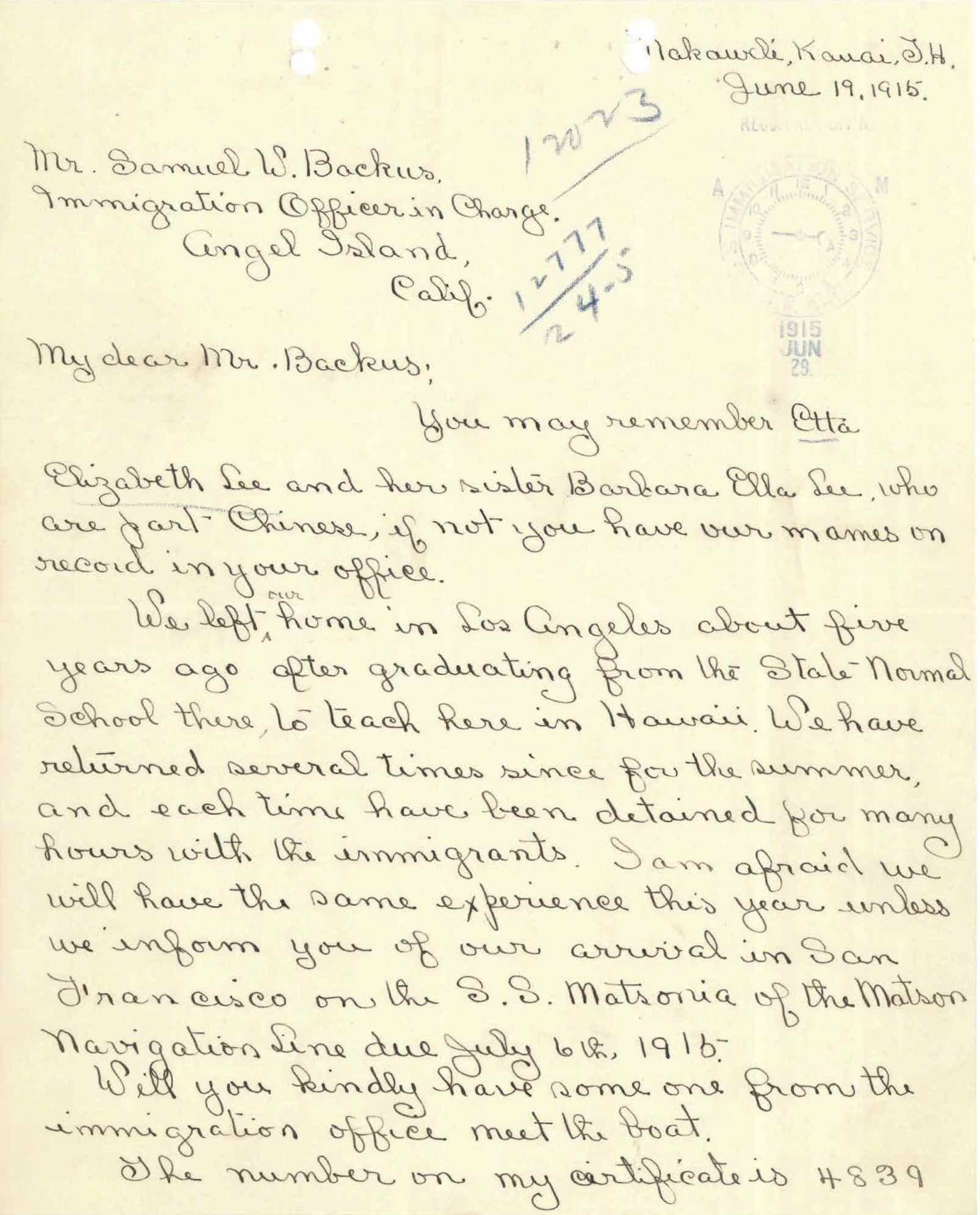
Lee returned to the mainland on July 11, 1911. On the next trip, Lee testified she went to Hawaii in September 1911. At San Francisco she returned on July 9, 1913. Lee sailed to Hawaii in 1915, 1916, 1917 and 1918. Below are Lee’s letters to an immigration officer.


On July 10, 1918 Lee was aboard the ship Logan when it departed Honolulu. She arrived in San Francisco on July 17. Her final destination was Los Angeles.

The Hawaii Educational Review, June 1918, said Lee was scheduled to teach at Waimea. On October 4, 1918, Lee departed San Francisco. The ship Sachem was scheduled to arrive in Honolulu on October 12. Lee’s destination was Waimea, Kauai.

On June 28, 1918, Lee’s mother’s third marriage was to Andrew Jackson Frost.

At some point Lee returned Los Angeles. The 1920 census recorded Lee and her sister (both public school teachers) and their mother with the Frost surname. Lee’s stepfather was 70 years old. He passed away on July 16, 1923.

From 1921 to 1935, Lee appeared in at least twenty-two films, numerous newspapers and magazines, and two stage plays. She and Anna May Wong appeared in “The Toll of the Sea”, “The Thief of Bagdad”, and “The Chinese Parrot”.

Los Angeles Times, April 1, 1923

Classic, June 1923, mentioned small 
roles in “The Infidel” and “East Is West”
 
Niagara Falls Gazette, July 11, 1924
“One Night in Rome” role mentioned

October 16, 1924

Los Angeles Times, October 16, 1924

Photoplay, December 1924

Theatre Magazine, April 1925

Photoplay, April 1925
 
Daily News (Batavia, New York), August 1, 1925. 
Lee listed second.

Brownsville Herald (Texas), October 17, 1927

The New Movie, May 1930

Lee’s stage appearances were in “The Little Clay Cart” (1926) and “The Scarlet Virgin” (1927). The Los Angeles Illustrated Daily News, August 19, 1927, said
Etta Lee Is Chinese Girl in Grove Drama
In spite of her Chinese nativity, Etta Lee, who is cast as Anna in Ramon Cerva’s sex comedy-drama, “The Scarlet Virgin” at the Orange Grove, is offering Occidental prayers for an aviator who if willing to risk his life in a non-stop flight to Shanghai.

Miss Lee, hailed by American film and stage producers as one of the most beautiful, Chinese girls in this country, was born in Honolulu. Her father is said to be one of the foremost Chinese business men of wealth and power on the islands and gave Etta his blessing plus financial backing when she asked his permission to attempt to fly from Los Angeles to Shanghai.

Miss Lee has never been in her mother country and desires to visit China. She also hankers to be the first girl to make such a trip as a passenger in an airplane. Several local aviators have been interviewed by Miss Lee, but none has voiced their desire to make the trip in planes at their command. During the past few days Miss Lee has flown many miles as a passenger in Henry Ford’s, big monoplane stationed at Rogers airport and has learned many things about aviation from various instructors.
According to the 1930 census, Etta E. Lee resided in the St. Francis Hotel at 5533 Hollywood Boulevard. She was a public school teacher.

In 1932 Lee married Frank Robinson Brown.

Lee filed her Social Security application in December 1936. 
 
Lee was listed in The Motion Picture Almanac 1931. She had listings in the 1936 and 1937 editions of the Film Daily Year Book of Motion Pictures. The 1938 Los Angeles city directory listed Lee and her husband at 5555 Hollywood Boulevard. The same address was recorded in the 1940 census.

On October 16, 1940, Frank Brown signed his World War II draft card. He listed Lee as next of kin. His address was 831 South Serrano Avenue which was crossed out replaced with 3101 Ellington Drive, Hollywood. Later it was updated to 5849 Sunset Boulevard, Hollywood.


The 1948 California Voter Registration listed Lee and her husband at 433 Third Street in Eureka, California. They were Democrats.

Lee and her husband have not been found in the 1950 census.

The 1953–1954 Porterville, California city directory said their address was 699 Grand Avenue.

Lee’s mother passed away on April 30, 1954.

The 1956 Eureka, California city directory listed the couple at 2765 Hall Avenue.

Lee was 70 years old when she passed away on October 27, 1956. An obituary appeared in the Times Standard (Eureka, California), October 27, 1956.
Etta Lee Brown, Former Film Star, Dies in Eureka;

Etta Lee Brown, wife of Radio Commentator Frank Robinson Brown, died at 4 o’clock this morning at her home, 2765 Hall Avenue in Eureka. Mrs. Brown had suffered a long illness.

A former Hollywood in many film star and leading lady in many pictures, she retired from acting following her marriage to Brown in 1932. [See filmography below.] She was a charter member of the Screen Actor’s Guild and the Academy of Arts and Sciences.

During her motion picture career, Mrs. Brown, whose film name was Etta Lee, played exotic roles opposite Rudolph Valentino and the late Douglas Fairbanks Sr. She co-starred with Greta Garbo in the first film production of Camille.

In Eureka, Mrs. Brown was widely known for her interest in community work. She was active in the Eureka Woman’s Club and in 1954 was chairman of the civic affairs committee of that organization. She was also a member of the Episcopal church.

Mrs. Brown was born in Kauai, Territory of Hawaii, in 1906. [Birth information incorrect.] She attended Occidental College in southern California, graduating with high honors.

In addition to her husband, she is survived by a sister, Mrs. Ella Deverill of Beverly Hills and two nephews, Spencer Deverill of Saudi Arabia and Edward Deverill of San Diego.

Funeral services will be Tuesday at 1:30 o’clock at Christ Episcopal church with Rev. J. Thomas Lewis officiating. Private interment will be at Sunset Memorial Cemetery under the direction of Cooper Mortuary.
Variety, October 31, 1956, said
Mrs. Etta Lee Brown, 50, former film actress, died Oct. 27 in Eureka, Calif. She played roles opposite Rudolph Valentino and Douglas Fairbanks Sr., before retiring from films in 1932. Her film credits included “The Shiek,” “Thief of Bagdad” and “Camille,” with Greta Garbo.

Husband, Frank Brown, a news commentator, for radio station KAQM, survives.
Brown passed away on September 11, 1981. Lee’s sister, Ella, passed away on March 23, 1987 in Los Angeles.

 
Filmography
  1. Without Benefit of Clergy (1921), no IMDB credit; first appearance, as 
      an extra, mentioned in Niagara Falls Gazette, July 11, 1924 
  3. Lotus Blossom (1921)
  4. The Infidel (1922), no IMDB credit; Classic, June 1923, noted small role  
  5. East Is West (1922), no IMDB credit; Classic, June 1923, noted small role
  6. The Toll of the Sea (1922)
  7. The Remittance Woman (1923)
  8. The Untameable (1923)
  9. The Thief of Bagdad (1924)
10. One Night in Rome (1924), no IMDB credit; role mentioned in the
      Evening Express, September 13 and 15 (Hindu maid), and The Independent 
      (St. Petersburg, Florida), July 12, 1924
11. A Thief in Paradise (1925)
12. The Dressmaker from Paris (1925)
13. Recompense (1925)
14. The Trouble with Wives (1925)
15. Camille (1926)
16. The Chinese Parrot (1927)
17. Out with the Tide (1928)
18. Manchu Love (1929), see Billboard
19. International House (1933)
Further Reading and Viewing
Chinese in Hollywood (2013)
Instagram, Strong Asian Lead
Messy Nessy, Ode to the Asian-American Faces in the Shadows
    of Hollywood’s Golden Age
Substack, Half-Caste Woman, Young Hollywood Was Asian
The Shot, Forgotten Asian Actors
Eric Brightwell, A History of Asian-American Cinema
The Silent Film Still Archive, Manchu Love
EduRank, 100 Notable alumni of Occidental College, number 93