Wong Hong Kee was not an artist, but he assisted cartoonist Thomas Aloysius “Tad” Dorgan, who “adopted” him and Wong Ho. (You can read more about Dorgan here.) Dorgan was an invalid during the last seven years of his life. Dorgan sent Wong Ho to see many sports events so he could described them to him. Wong Hong Kee did research for Dorgan. Dorgan drew his cartoons based on their information.
Articles mentioned that Dorgan adopted Wong Ho and Wong Hong Kee but they were really assistants. Little information has been found on Wong Ho but Wong Hong Kee has Chinese Exclusion Act case files in New York City and Seattle, Washington. (For information on the Chinese Exclusion Act, read the article at the
National Archives.)
Here is the Chinese Exclusion Act case file testimony by Wong Hong Kee and his father,
Wong Yip Jung:
U.S. DEPARTMENT OF LABOR
Immigration Service
Office of Chinese Inspector in Charge
District of New York and New Jersey
U.S. Barge Office
New York, N.Y.
Telephone: Broad 3411
In Answering Refer to No. 60/841-842
May 4, 1925
In the matter of WONG YIP JUNG and WONG HONG KEE, applicants for return certificates (Forms 430) as citizens
Inspector Lewis R. Reynolds, Inspector & Typist.
Sing Kee, Chinese Interpreter.
APPLICANT, WONG YIP JUNG, presents Certificate of Identity, No. 557, in the name of WONG YIP JUNG, age 31; height 5’, 1 1/2”; two pits inner corn left eye, pit outer corner left eye; showing admission as “native-born”, issued at the port go Malone, N.Y., on August 24, 1909, by E.G. Sperry, Immigration Official in Charge. Photograph and description on certificate are in agreement with applicant.
STATEMENT BY APPLICANT, WONG YIP JUNG
Applicant, being first duly sworn, testified as follows:
Q. What are your names?
A. WONG YIP JUNG, given name. WONG FUN WAN, marriage name.
Q. Have you any other names?
A. No others.
Q. Where were you born?
A. San Francisco, Cal.
Q. Have you ever been out of the United States since your alleged birth at San Francisco, Cal.?
A. Yes, I have made two trips to China.
Q. Describe those two trips?
A. I first went to China when I was 5 years old with my brothers, WONG SING JUNG and WONG MON TIP, and my parents, departing from San Francisco. I returned when I was 21 years old thru Malone, N.Y., and was arrested and discharged by a U.S. Commissioner. I next departed in K.S. 34 thru Malone, N.Y., and went to China and then returned in S.N. 1 thru Malone, N.Y. (Note: New York file in the present case shows that this applicant was admitted as a “Res Adjudicata Native” by the Department on May 20, 1909, (Bureau file, No. 52396/89).
Q. Have you been out of the United States since your entry in S.N. 1?
A. No.
Q. What is your present age, occupation and address?
A. Age 47 years; laundryman; #48 Grand Neck Street, Great Neck, L.I., New York.
Q. For how long have you conducted this laundry at that address?
A. 4 years.
Q. Where do you eat and sleep?
A. In the laundry there.
Q. What is your purpose in now appearing in this office?
A. To get a return certificate to visit China.
Q. Have you any relatives now living in the United States?
A. I have one son, WONG HONG KEE, who is now here in this office with me and who is also applying for a return certificate to visit China.
Q. When, where and how did this alleged son, WONG HONG KEE, originally enter the United States?
A. In 1921 at New York as a son of a citizen.
Q. What has this Wong Hong Kee been doing since his entry into this country?
A. Going to school.
Q. What school?
A. He is attending the public school in Great Neck, L.I., and is making his home with Miss Stockton, one of his school teachers there.
Q. For how long has he made his home with Miss Stockton?
A. Ever since he arrived here.
Q. Why has he not made his home with you?
A. I wanted to give him better quarters and Miss Stockton supports him for what chores he does around the house after school.
Q. Has Wong Hong Kee performed any work of any kind since he has been in this country?
A. No, he helps me out in the laundry every once in a while after school hours.
Q. Have there been any changes in your family since the admission of Wong Hong Kee to the United States?
A. No.
Q. How many children do you claim to have?
A. Only the one son, Wong Hong Kee, who is here with me.
Q. Thru what port do you expect to depart?
A. Seattle.
Q. What will be your address in China?
A. c/o Kong Sang Wing, Connaught Road, Hong Kong, China. I do not know the street address.
Q. Does Wong Hong Kee expect to accompany you to China on this trip?
A. Yes.
Q. Who will pay his expenses on this trip?
A. Myself.
Q. Have you thoroughly understood this interpreter?
A. Yes.
Q. Have you any further statement you wish to make?
A. No.
Q. do you wish to change or correct any part of your previous testimony?
A. No.
Signature of applicant to original typewritten notes.
[facsimile signature in Chinese]
APPLICANT, WONG HONG KEE, presents Certificate of Identity, No. 38089, in the name of WONG HONG KEE, age 14, height 4’, 10”, mole left temple, one left cheek, showing admission as “son of U.S. citizen, Dec. 13, 1921, at N.Y. from China via M’real.” issued at port of New York, N.Y., on January 9, 1922, by Frank S. Pierce, Immigration Official in Charge. Photograph and description on certificate are in agreement with applicant.
Applicant WONG HONG KEE, being first duly sworn, testified as follows:
Q What are your names?
A. WONG HONG KEE is the only name I have.
Q. What is your present age, occupation, and address?
A. 17 years now; occupation student, going to school; I live at #17 Seventh Street, Great Neck, L.I., New York.
Q. When, where and how did you originally enter the United States?
A. On December 31, 1921, at New York, as the son of a citizen.
Q. Have you been out of the United States since your original entry?
A. No.
Q. What have you been doing in the United States since your entry?
A. Going to Great Neck Public Schools.
Q. Have you performed any work in this country since your entry?
A. Of course I help at the place where I live. I wash the dishes there.
Q. Have you ever worked with your father?
A. I used to have a store there and sold Chinese dishes, but the lady where I live will not let me work now.
Q. What is the name of the family where you are now living?
A. Mrs. T. K. Dorgan.
Q. For how long have you lived with this family?
A. For about two years and a half.
Q. Where did you live before going to live with this family?
A. Before I lived with my father in the laundry.
Q. What is your purpose in now appearing in this office?
A. I want to get a paper to go to China.
Q. Who will pay your expenses on this trip?
A. My father, Wong Yip Jung.
Q. When do you expect to leave the United States?
A. I don’t know the date.
Q. Thru what port do you expect to depart from this country?
A. Seattle, Wash.
Q. What will be your address in China?
A. Wong Chung Village, Sun Woy District, China.
Q. Have you understood all the questions which have been asked you?
A. Yes, so far.
Q. Have you any further statement you wish to make?
A. No.
Signature of applicant
to original typewritten notes.
[facsimile signatures in Chinese and English]
Wong Hong Kee’s Form 430
Testimony Typescript
Wong Hong Kee and his father departed before the enumeration of the 1925 New York State Census which began June first. Dorgan, his wife and Wong Ho have not yet been found in the state census.
Wong Hong Kee and Wong Ho were mentioned in several publications. Below is an excerpt from McClure’s, November 1927:
“A Story Without a Sob About Tad”
…Nature took away from Tad the physical strength to enjoy sports when she gave him his genius. But whether it is baseball or boxing, tennis or track, he is in the spirit of every event he sees. And he is so generous he wants both sides to win.
I ask Tad if he ever gets to the fights any more.
“No, that’s impossible for me now, but I’ll tell you how I see them.”
“Boy,” he called.
A Chinese lad, probably seventeen or eighteen, came in. “I want you to meet one of my boys. The other [Wong Hong Kee] is in China getting married. He goes to every fight at Madison Square Garden and then comes home and fights them for me. I get them almost as well as if I were there.”
Then I learned from Mrs. Dorgan about the boys and I also learned another side of Tad and Mrs. Dorgan—Tad is so famous under his cartoonist’s signature that few people know his name is Thomas A. Dorgan; his initials form his public signature.
“I have been immensely interested in mission and other welfare work all of my life,” Tad’s wife told me, “and our Chinese boys didn’t have any home when they were babies, so I brought them home and Mr. Dorgan and I have given them a chance. We have educated them and we are just as proud of them as if they were our own.”
Then Tad took all the sob out of this part of the story by interrupting, “Yeh, the boys beat us playing mah jong and we beat them playing pinocle, so it's fifty-fifty.” What a lesson Mrs. Dorgan could give some women in motherhood and wifehood!
Wong Hong Kee returned from China on March 26, 1928. Below is a transcription of form M 149:
U.S. DEPARTMENT OF LABOR
Immigration service
File No. 8650 10-4
CHINESE LANDED DIRECT FROM STEAMER ON IDENTIFICATION
SS_Pres. McKinley
Date_Mar 26 1928
Class_Ret. Citizen
What are all your names?
Wong Hong Kee; Wong Yao.
How many times have you been married?
Once.
Give names of wives, age, dates of marriage, kind of feet, living or dead.
Lim Shee; 21; CR 14-6-28; natural feet. living in China.
How many children have you ever had?
One[;] Boys: None; Girls: One
Name /Age / Sex / Birth date / Marital Status / Location
Wong Do Lion / 2 yr. / Female / CR 16-10-15 / Single / China
Did you take any money, letters, or anything else from the United States to anyone in China on this trip, if so, give details:
No
While in China on this trip were you introduced to the child or any resident of this country or did you attend the wedding of any such resident or the wedding of the son of any such resident, if so, give details:
No
Are you accompanied by anyone? If so, whom?
No one
CI or CR_38089
RETURNED TO APPLICANT. Mar 28, 1928
By_[illegible initials] Parkhurst, Clerk
If applicant intends to apply for Certificate of Identity the following information is required:
Age_[blank] Occupation_[blank]
Height_[blank] Marks_[blank]
Address_[blank]
Sworn_Wong Hong Kee [signature] Applicant
Admitted_Mar 26 1928
W.F. Watkins [signature] Inspector
H.R. Burgert [signature] Inspector
J. Chen [signature] Interpreter
Form M 149

Dorgan passed away May 2, 1929. Below are reports of his death and mention of Wong Hong Kee and Wong Ho.
New York Evening Post, May 4, 1929:
“Funeral Service for Tad Is Private”
High Mass Requiem Held for Cartoonist at Great Neck
Body to Lie in Mausoleum
Funeral services for Thomas Aloysius Dorgan, cartoonist, who was known to the world as Tad, were held today with a solemn high mass of requiem at St. Aloysius’s Church, Great Neck, L.I. The Rev. Joseph K. Doyle, assistant rector, officiated.
The body will be placed in the chapel at Cypress Hills Cemetery and later in the mausoleum there when it is completed.
The funeral services were quiet, as had been Tad’s wish, and were attended only by relatives and a few close friends. They included his mother, Mrs. Anna Dorgan; his widow, two Chinese boys, whom he had adopted, and his brothers and sisters and their families.
The brothers and sisters are Joseph, Dorgan, advertising manager of a Knights of, Columbus publication; John (“Ike”) Dorgan of the Madison Square Garden personnel; Edwin Dorgan, of the circulation department of the New York Journal; Dick Dorgan, a cartoonist; Mrs. John Tierney, Mrs. Robert Hurliaman, and Miss Alice Dorgan. Another sister, Mrs. Smith of Orlando, Fla., was unable to reach Great Neck in time for the services.
Duck and Spensi
The two boys were Wong Ho, whom Tad called Duck, and Wong Hong Kee, whom he named Spensi. Duck is twenty-one years old and Spensi twenty. Spensi received his name when Tad attempted to teach him to say “Springfield.” “Spensi” was the closest he could come to the pronunciation.
Duck was Tad’s “outside man.” He was interested in boxing, baseball, and all other sports, and when there was an important fight or game, it was Duck whom Tad sent as his personal representative.
Duck was always provided with a ringside seat for every boxing match of importance, and he had a wonderful memory. When he returned home, he would give Tad the fight blow for blow. It was from the verbal pictures brought home by Duck that Tad drew his sport cartoons.
How Tad Followed Baseball
When it came to baseball, Duck was forced to take notes to record everything that happened. When he returned to Tad’s bedside—Tad was an invalid for seven years—he would have pockets bulging with notes on box-scores, batting averages, and the actions of the many plays. He kept each player’s record up to the minute with the dispatch of a sporting editor, and when he arrived back in Great Neck, he would have the day's batting records already entered into the seasons averages for each, player.
Spensi was the “home boy,” He was more interested in obtaining sporting fact, for Tad than in the sporting facts themselves. He stood faithfully at Tads bedside during ring battles and ball games, keeping the radio tuned to the point where reception was beat. Spenai was also a good man at the telephone and brought “inside information” on sporting events by wire.
The two Chinese lads were adopted by the Dorgans nine years ago. Tad and Mrs. Dorgan educated them and wherever they went the two boys went, too. At hotels and on trips there were “Tad’s boys” and members of the family. Tad had no children of his own.
Defied Handicap Seven Year
Tad was kept in bed for seven years with “a bum ticker.” as he termed his weak heart, but through these many months of illness, he remained “game” and cheerful and dally drew his cartoons that brought mirth to millions.
With the words of a physician ringing in his ears that he “might die at any minute,” he kept his pencil working. From his cartoons phrases were picked up which became a part of the native American dialect. “Yes, we have no bananas,” “Drop that wheelbarrow,” “Bonehead,” “Solid Ivory,” “Applesauce.” “Whaddaya mean ya lost yer dog?” “The first hundred years are the hardest,” are expressions of his which became favorites of casual conversation and stage patter.
Tad was game, and it was his gameness that made him the cartoonist that he was. When he was but a boy, he lost all of the fingers of his right hand but one in an accident. He learned to draw with his left hand, and it was through his cartoons he gave the public the explosive humor of his keen wit. Through the seven years of the illness that kept him confined to his bed the greater part of the time, he never lost his sense of humor. His optimism sparkled through the pain of his illness, and his pencil drew on, despite the handicap of almost entire physical disability.
The Brooklyn Daily Eagle (New York), May 5, 1929:
“Sportsmen Honor ‘Tad’ at Funeral”
Great Neck, L. I., May 4—Funeral services for Thomas Aloysius “Tad” Dorgan were held in his home at 17 7th st. here today. At the request cf his widow only 40 intimate friends and members of the family were present.
The service for “Tad,” who died on Thursday after an illness of nearly nine years, was conducted by the Rev. Joseph E. Doyle, assistant rector of St. Aloysius Church, Great Neck. Though Mrs. Dorgan had requested that no flowers be sent, living rooms of the house were filled with floral tributes from friends of the sport world. Interment was made in the receiving vault of Cypress Hills Abbey.
His two adopted Chinese boys, Wong Ho, 21, and Wong Hong Kee, 20, whom “Tad” considered members of his family, were also present.
The Pittsburgh Press (Pennsylvania), May 5, 1929:
“Friends Escort ‘Tad’ to Grave”
Jack Johnson Among Those Who Mourn Cartoonist.
By the United Press.
New York, May 4.—The funeral of “Tad” as T.A. Dorgan, cartoonist was known was held today from the Dorgan home on Long Island. About 40 close friends attended the private services. They included Jack Johnson, former heavyweight champion; “Philadelphia Jack” O’Brien, fighter; Jack Doyle, head of the National Billiard Assn.; Gene Buck, song writer, and former associates in the newspaper profession.
In the procession to the cemetery “Duck” and “Spensi,” two Chinese boys the Dorgans had adopted several years ago, rode with the mourners. They seemed heartbroken.
“Duck” in the years that Tad had been confined to his home, had been the cartoonist’s “eyes.” He had a ringside seat at every important sporting event. His memory was remarkable and it was his duty to return home and describe each happening and each thing he saw to Tad, who later used this afterward in his drawings.
Spensi’s work was that of looking up material and obtaining data. He pored over sporting records and provided Tad with all the varied information he required. Duck’s real name was Wong Ho and Spensi’s was Wong Hong Kee. “Duck” is 21 and Spensi is 20. The names of “Duck” and “Spensi” were given them by Tad.
Century, Autumn 1929:
“Tad for Short”
Cartoonist and Phrase-Maker, a Victim of Circumstance
…Many of Tad’s admirers have wondered how he kept in touch with the sporting world and continued to draw pictures for eight years after he was confined to the house. Tad had two Chinese boys whom he and Mrs. Dorgan adopted years before. After his heart attack in 1920 Tad began to train one of these boys—“Duck,” he called him—to go out in the highways and byways of sportdom and gather material. So “Duck” went to all the baseball games and prize-fights, billiard matches and sport jamborees, acting as eyes and ears for Tad. He would come back from a fight and reenact the battle blow by blow, for even under the most exciting conditions he didn’t lose his head. One of the most thrilling things I have ever listened to was “Duck’s” description of the Dempsey-Firpo fight. It was his careful analysis of the blow that sent Dempsey out of the ring that enabled Tad to make a superbly realistic drawing of an event he had never seen.
Wong Hong Kee was counted on line 36 of the 1930 United States Census. The head of the household was Dorgan’s wife,
Izole M., whose mother, Nana L Messaros, also lived there at 17 Seventh Street, North Hempstead, New York. According to the census, Wong Hong Kee’s relation to Izole was a servant, not a son.
Later
that year, Wong Hong Kee made preparations to return to China; his testimony follows:
U.S. DEPARTMENT OF LABOR
Immigration Service
Office of Commissioner of Immigration
Ellis Island
New York Harbor, N.Y.
In Answering Refer to No. 132/701
December 17th, 1930.
In the matter of WONG HONG KEE, applicant for a citizen’s return certificate, form 430.
W.J. Zucker, Inspector.
P.J. Sivulich, Stenographer.
Warren Wong, Interpreter
Applicant presents certificate of identity No. 38089 in the name of Wong Hong Kee, age 14, admitted as son of United States citizen; issued at New York, Jan. 9, 1922, by Frank S. Pierce, Immigration Official in Charge; photograph and physical marks agree with the applicant. Certificate endorsed and retained.
Applicant being first duly sworn, testifies:
Q What is your name?
A Wong Hong Kee, given name; Wong Yow, marriage name.
Q You speak English well enough to proceed with this examination in that language?
A Yes.
Q State your age and birthplace?
A 23, born in Wong Chung village, Sun Woey Dist. China.
Q State your occupation and present address?
A Handyman for Mrs. T.A. Dorgan, at Great Neck, Long Island, and I live there.
Q When did you first come to this country?
A In Dec. 21, at the port of New York as the son of a citizen.
Q Have you made any trips?
A I departed in 1925 through Seattle, and returned in 1928 (N.Y. file 6/794)
Q You now wish to go to China?
A Yes; through Seattle.
Q What will be your local address?
A c/o Mrs. Dorgan, 17 –7th Street, Great Neck, Long Island.
Q What family have you now?
A Wife, Lum She, living in my native village, and I have one daughter, Wong Do Len, about 3 years, born Oct. 25, 1927. I have no other children.
Q What is your father’s name?
A Wong Yip Jung, he is working in Great Neck, Long Island.
Q Have you any further statements to make?
A No.
Q Have you understood my questions?
A Yes.
Signature of applicant: [facsimile signature]
Certified correct and taken direct on typewriter December 17th, 1930.
[Paul J. Sivulich signature]
Stenographer
Wong Hong Kee’s Form 430
Testimony Typescript
Wong Hong Kee returned to the U.S. on June 25, 1936. Here are his answers on form M 149.
IMMIGRATION & NATURALIZATION SERVICE, SEATTLE, WASH.
CLASS: U.S. Citizen
S.S.: President McKinley
19: Jun 25, 1936
No.: 25040/3
Sworn by: [illegible initials]
You are advised that your statements in reply to the following questions will be used should you testify before this Service in the future. Do you understand? A: Yes
What are your names? Wong Hong Kee—Wong Yow
How many times have you been married? (Names of wives, dates of marriage, feet, living or dead, and if living, where: once; Lim Shee, [illegible]
How many children have you ever had? three_Sons_two_Dtrs._one_Describe below:
Name / Sex / Age / Birthdate / Where Living
Joy Soo / F / 6 /10-17-1931 / Ung Ming
Goot Ten / M / 3 /4-21-1934 / S/[illegible]
Goot Ming / M / 1 / 1-20-1936 S/[illegible]
Have you described all the children you ever had, blood, adopted, living or dead? A: Yes
Did you visit any resident of U.S. who happened to be at home in China during your recent stay, or did you visit the home of any such resident? A: No
Were you introduced to the son, wife, or daughter of any resident of this country while in China? A: No
Did you attend the wedding of any resident of this country, or of the son or daughter of any resident? A: No
Have you arranged to appear as a witness, or do you expect to appear, for any person, now in China who is a prospective applicant for admission to U.S.? A: No
Are you accompanied by any one? A: No
C/I or C/R No. [blank]
Ret. to Appl._19 [blank]
SIGNED–Wong Hone Kee, Appl.
[illegible] Insp.
Roy M. Porter Insp.
[illegible] Int.
It’s not clear if he returned as a servant at Izole’s residence.
In the 1940 census, Wong Hong Kee was not in Izole’s household, which was in Manhattan, New York City. There was a “Hong Kee Wong” (line 16) who resided at the rear of 57 Mott Street in Manhattan’s Chinatown. His birth year was estimated to be 1908. He was a business partner with the head of the household, Toy Ng. The main difference was the marital status, which the census listed as single.
During World War II, a “Kee H Wong” was drafted. His enlistment occurred on May 16, 1941 in Jamaica, New York. His occupation was retail manager and marital status was married. It’s possible this person was Wong Hong Kee.
On January 3, 1950, a “Wong Hong Kee” returned to the U.S. from Hong Kong. The passenger list said he was married and 40 years old. His address was 7 Pell Street, New York City.
The 1950 census counted “H Wong Kee” (line 11) at 7 Pell Street in Chinatown. He was a clerk at a liquor store.

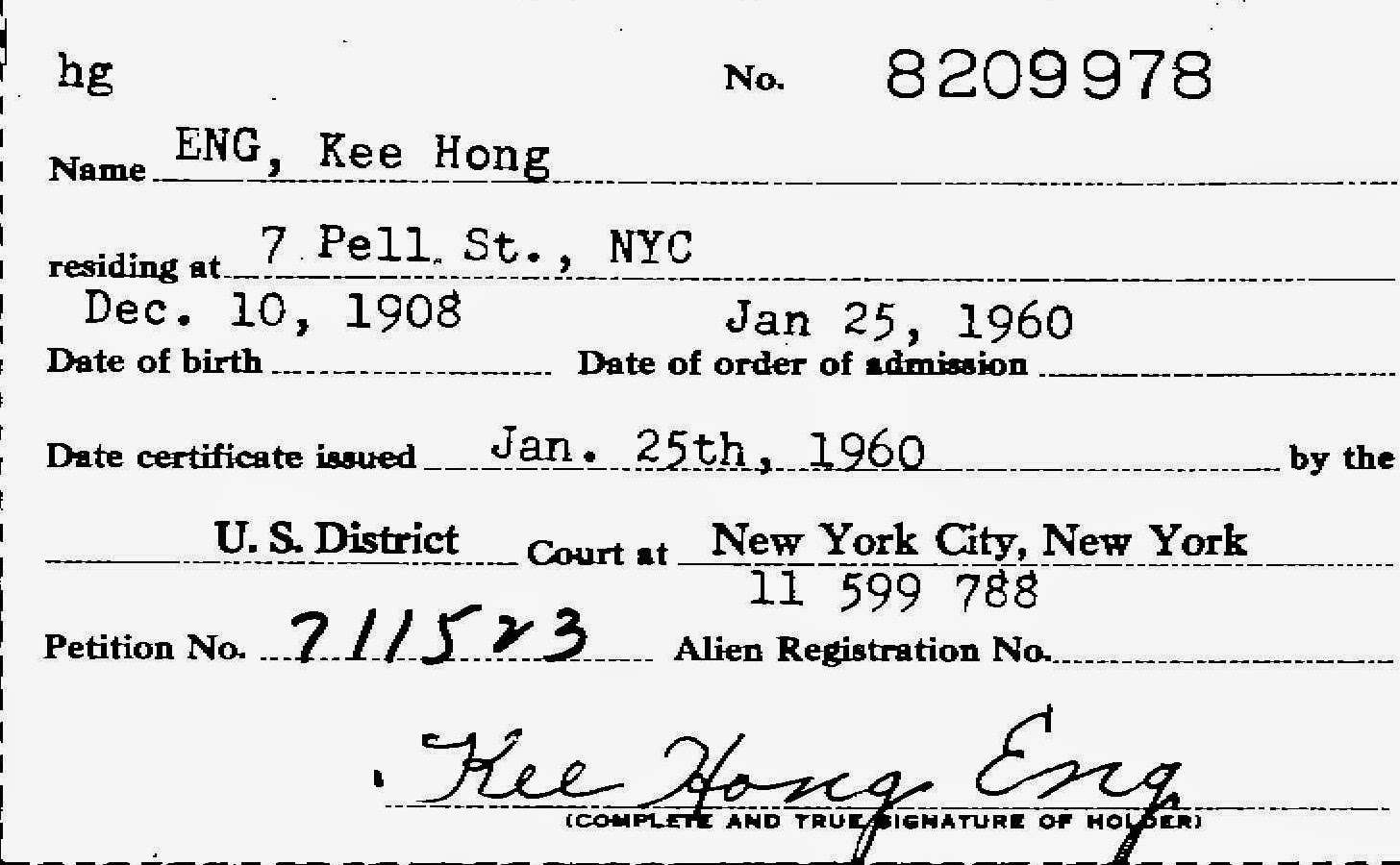
“Kee Hong Wong” became a naturalized citizen on January 25, 1960. The file card said his birth date was December 10, 1908, and his address was 7 Pell Street, New York City.
On the back of the card was his court approved new name: Kee Hong Eng.
The Social Security Death Index has “Kee Hong”, a Brooklyn resident, who passed away in November 1974. The index had his birth date as December 10, 1907.
(Updated June 20, 2024; next post:
Tyrus Wong at the Museum of Chinese in America)