Friday, April 8, 2022

Leong Gor Yun’s Chinatown Inside Out

Barrows Mussey, 1936

The authors of the book were Yiu Kui Chu and Virginia Howell Mussey who used the pseudonym, Leong Gor Yun, which, translated in Cantonese, means two people. The publisher and book designer was Chu’s Haverford College schoolmate, June Barrows Mussey, the husband of Virginia. The dust jacket art was by Oscar Ogg who wrote Ogg in the lower left corner. He probably did the lettering, too. Creighton Peet was credited for many of the photographs.
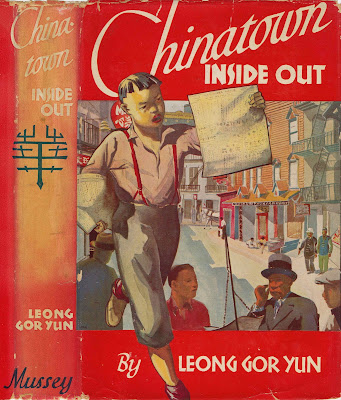
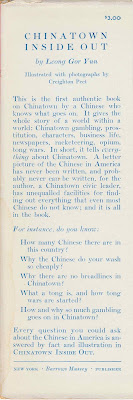
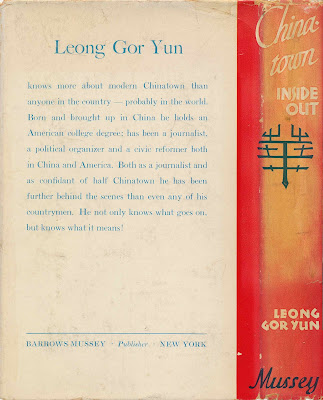
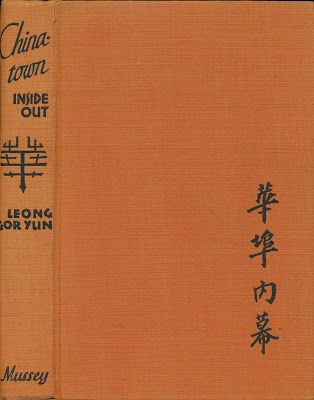

The cloth color differed on some books.


ABOUT THE AUTHORS

Virginia Howell Mussey was born Virginia Tier Howell on February 3, 1910 in New York, New York. The birth information came from her Social Security Application at Ancestry.com. Her middle name was published in Something About the Author (1973). Her parents were William David Howell and Mary Augusta Mapes. 

The 1910 U.S. Federal Census recorded Mussey and her parents in the Bronx, New York, at 1441 Doris Street. Her father built houses. According to the 1915 New York state census, Mussey, her parents and two siblings resided at 1537 Overing Street in the Bronx. 

In the 1920 census, the family lived in Tarpon Springs, Florida at 310 Tarpon Avenue. Her father was a building contractor. The 1925 New York state census listed the family at South East Avenue in Poughkeepsie. The 1930 census said they were on Vassar Road in Poughkeepsie.

Mussey graduated from Vassar College in 1932. She married June Barrows Mussey on June 28, 1932. The couple were aboard the S.S. Europa when it departed Southampton, England and arrived in the port of New York on November 17, 1932. 

The Vassar Quarterly, February 1, 1933, said “Virginia Howell Mussey is running the Children’s Book Agency in New York.” The Vassar Quarterly, May 15, 1936, said “Virginia Howell Mussey and husband have their own publishing business, Loring & Mussey, Inc., at 55 Fifth Avenue, New York City.” 

Something About the Author, Contemporary Authors (1978) and The Writers Directory, 1980–1982 (1979) said Mussey with Y. K. Chu wrote, under the pseudonym Leong Gor Yun, Chinatown Inside Out. She also wrote the book’s foreword. 
By none of my own doing I was suddenly in the seat of the mighty as editor of The Chinese Journal. I knew nothing about running a newspaper, and less than nothing about the Chinese in America, who would read the paper. I had American ideas about the Chinese and Chinatown, and they, I soon learned, were as false as American ideas about Soviet Russia. 

On Monday morning I walked into the office of The Journal. As I approached the editorial office, the Jewish telephone girl stopped me with what appeared to be a Nazi salute. 

“Good morning,” she said. "Have some lickerish drobs; they’re very refreshingg [sic].” 

I had some, and they were refreshingg [sic]. But they also gave me time to take in the situation, and courage to face the eight grinning Chinese boys who were lined up in the office, waiting to greet me. Not one of them was over twenty-five, and not one looked as though he could tell a newspaper from a laundry ticket. They were polite. I in turn was polite, but I assumed an air of savoir-faire to cover my bewilderment. 

“Well,” I began, “have you got the New York papers, Mr. Lee?” 

“A’ he’, A’ he’l” 

“Good. Then let’s clip out all the Chinese and Japanese news, and you can translate it into Chinese.” 

“Yeh, yeh.” 

So we clipped for a good hour, and then I went back to the composing and press-room to see the real inside of a Chinese newspaper. It was cold, so the boys wore their jackets, though the exercise they got running up and down between the cases should have warmed them. I have always marvelled at the skill of type-setters, but I have never seen a more astonishing performance than these Chinese type-setters put on. They picked the characters out of unlabelled boxes as they ran, almost without looking. I watched, wondering what they could be setting, until Mr. Lee told me a cable had arrived from China with the important news. 

“Good,” I said. “Do you get a cable every day?”

“We get cab’e eve’y day, but on’y Mr. Chu know how to make sense.” 

That was my signal to take the cable to the hospital. The paper had to have front-page news and a feature article. I was also instructed to ask Mr. Chu what General the New York Times was talking about in its front-page article on the Chinese civil war. The cable he translated, but he did not know who or what The Times was talking about. The boys would have to look up the General’s name in a Yearbook. 

For the first time in my life I heard an argument in Chinese. Italians in a dispute sound volcanic; Germans, dogmatic; the Irish, sarcastic; the English, frigid; but only the Chinese sound like a bird-store in distress. They chirped and sang as they opened one book after another, searching in vain for the famous General. 

What was said about the General I never knew, but I do know that as I sat in the subway after the day’s work, reading the English dateline of the paper—“PublishedDailyExceptSunday&Certain HolidaysorDayFollowingSuchHolidaysByTheChinese Journal Inc.”—I was the cynosure of all eyes. And I was still chortling over Mr. Lee’s compliment: “You know,” he had whispered to me, “I neva think such a woma’ run up an’ dow’ for a frien’!”. 

After a week Mr. Chu was ready to take back his job. He came to see me, and look over the seven papers he had not edited. For a while he was quiet, reading. Then without warning he laughed, and I knew that I had failed as an editor. 

“It’s nothing. One of Dr. Lin Yutang’s admirers and imitators wrote a funny article. The English he uses wanted editing.” I looked. There were four lines: 

[newspaper clipping in Chinese]

There was silence again, and more reading. I took heart, but not for long. 

“This time the boys got one past you. They didn't have enough news, so they filled up the paper by printing two sample laundry tickets!” 

[newspaper clipping of laundry ticket stub]

The paper, incidentally, lost 500 circulation during my regency.

This was my introduction to Chinatown, and to the Chinese in America; and a logical introduction for this book, the necessity for which would otherwise never have been realized—by me at least. 

After this I asked Mr. Chu who he thought could write for Americans about the Chinese in America. He answered, after considering possible candidates, “Leong Gor Yun.” 

I am glad to see that Mr. Leong has in this book not only introduced us to Chinatown, but turned it inside out.
In the late 1930s Mussey divorced her first husband and married William H. Soskin on April 9, 1941. When he died, she married James W. Ellison on April 11, 1955. They divorced and she married Maurice J. Reis on February 25, 1976, according to the Connecticut Marriage Index at Ancestry.com. 

Mussey (Virginia H. Reis) passed away on April 18, 2000 in Stamford, Connecticut, according to the Connecticut Death Index at Ancestry.com.

* * * * * 

Yiu Kui Chu was born around February 1906, in Canton, China, according to a passenger list at Ancestry.com. He was aboard the S. S. Korea Maru when it arrived in San Francisco, California on September 29, 1927. He was a student with a visa obtained in Tienstin, China on August 9, 1927. Chu named his friend, S. Howard Jee, who lived in Tienstin. (Jee was an architect who studied at the University of Michigan.) Also named was Chu’s father’s friend, Chu Lop Bow, of San Francisco, who was his guardian. Chu’s final destination was Haverford, Pennsylvania. 
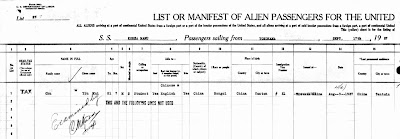


Chu attended Haverford College. He was listed in the Haverford College Directory 1927–1928 and Haverford College Catalogue 1927–1928

Directory

Catalogue

Chu was profiled in the Haverford News, October 31, 1927.
Chinese Finds Student Attitude at Haverford Similar to That in China

Yiu Kui Chu, ’31 Compares Undergraduates’ Interests With Those in Far Eastern Colleges

Although he finds Haverford undergraduates not much different in their attitude toward work from those in the Chinese college which he attended, You Kui Chu, of Canton, China, recently enrolled in the Freshman class, has discovered that the College is quite an interesting place, he stated yesterday in an interview.

“Chinese students seem to work no more or no less than the majority of the fellows work here,” Chu said. “They like to play and have their good times. I notice this one thing, though, that is different from the college I attended last winter in Peking: the undergraduates seem to confine their social activities to the campus more than at home.”

Chu finds that interest in athletics at Haverford is no greater than in the peking institution. Soccer there, he said, is called football, and is the most popular game.

Although he was urged to study in America for several years by an uncle who graduated three years ago from the University of Michigan, it was not until last winter that he definitely decided to come to the United States. His matriculation at Haverford came as the result of recommendation of K. M. Wong, principal of the Pui Ching academy in Canton, to President W. W. Comfort while the latter was in China last winter.

The transportation systems and the high buildings of Philadelphia are the most impressive aspects of the city to Chu. “Of course, we have many autos in the large cities of China, but not such a jumble and confusion of busses, pleasure cars and trolleys as one may see almost any time in the heart of Philadelphia,” he stated.

“It is easy enough to read English,” Chu said, when asked whether he had difficulty with the language. “But when someone starts to talk very rapidly or to use slang I have trouble in understanding him.”

Chu has studied English for approximately five years, but has confined his work almost entirely to reading. English is the most popular foreign language among Chinese students, he claimed.
Chu was mentioned in Our Town (Narberth, Pennsylvania), December 17, 1927. 

In the Haverford College yearbook, The 1928 Record, Chu was listed as a freshman but he was not in the class photograph.


He was listed in the Haverford College Directory 1928–1929 and Haverford College Catalogue 1928–1929. The asterisk by Chu’s name was explained: 
An asterisk {*) is placed before the name of a student who is repeating a course, or has conditions or deficiencies in excess of two half-courses, has failed to remove a condition after the September opportunity, or is carrying an entrance condition after Freshman year.
Chu was also listed in the University of Michigan’s General Register of Faculty and Students 1928–1929. It’s not clear if Chu ever attended the University of Michigan.


Chu appeared in the sophomore class photograph (third row, far left) of The 1929 Record yearbook. 


The Handbook of Chinese Students in U.S.A. 1929 had this entry: Chu, Y.K., Journalism, Haverford College, Haverford, Pa.


The 1930 U.S. Federal Census recorded Chu as “Yao K Chu”, who was one of six Chinese lodgers at 3266 Sansom Street in Philadelphia, Pennsylvania. 


Chu was not named in The 1930 Record yearbook. He was mentioned in The 1931 Record as an Ex-Member.
… Good old Yiu Kui Chu also left, and is probably engaged in sacking Pekin—in his gentle way—at this very minute. … 

Chu’s whereabouts was named in The Handbook of Chinese Students in U.S.A. 1932: “Chu, Yui Kui, 196 Canal St., N.Y.C.” 

The [Chinese Journal] editor, Y. K. Chu, was a reporter by profession and a respected intellectual with an excellent command of English. His politics were liberal; a KMT member in the 1920s, he was now, while not an adherent of the Chinese left, a stern critic of the KMT establishment. He was born into a large immigrant family from Kwangtung province and had many relatives working in New York’s hand laundry trade. As a result, he had an intimate knowledge of the problems facing Chinese laundrymen and was often asked to assist them. When the anti-Chinese posters went up, for example, Chu volunteered to convince store managers to take them down. After he became editor of the Chinese Journal in 1932 he made sure the paper gave extensive coverage to the issues and problems confronting the laundrymen—not the least of which, in his opinion, was the failure of the CCBA and the traditional associations to lend their support to the struggle. When the ordinance crisis occurred, Chu became actively involved in the formation of the CHLA [Chinese Hand Laundry Association], and was elected its temporary spokesman.
The Daily Worker, January 12, 1936, reported the mass march of 45,000 people against war and fascism, and published a photograph of Chu. 


Chinatown Inside Out was published in 1936 by Barrows Mussey who was Chu’s schoolmate at Haverford College. Mussey was in the class of 1930. Chu and Mussey’s wife, Virginia, wrote the book under the pseudonym Leong Gor Yun

Leong Gor Yun was mentioned in the Chinese Digest, February 1937. 
... Leong Gor Yun, in his book, “Chinatown Inside Out,” stated that anything is leable [sic] to happen to any Chinese in these United States, and cited Wong Lee, Democratic delegate, as an unusual example. A Chinese laundryman becomes the first of his race to represent an American community to a big political caucus! What was more, Wong Lee was fortunate in picking his party affiliation, for in 1936 the thousands of Chinese voters in the country had suddenly gone Republican, just as suddenly as they had gone Democratic in 1932. ...
In The New Chinatown (1987), Peter Kwong wrote 
While the CCBA [Chinese Consolidated Benevolent Association] and the traditional associations are not popular, nobody has been able to do much about them. In the past, particularly before the 1960s, public criticism was rare. In the mid-1930s, the editor of the Chinese Commercial Times, Y. K. Chu, became so incensed with the corruption of the CCBA that he wanted to tell the world about it. But he was afraid the CCBA would organize a boycott of his paper, so he wrote a book entitled Chinatown Inside Out, under the pseudonym Gor Yun Leong. I interviewed Chu in the late 1970s, just a few months before he passed away, about events that had taken place some forty years earlier. I also confronted him with the authorship of the book. He readily admitted it, but asked me not to make it public, because he was still active in the community.
In 1937 the Chinese Consolidated Benevolent Association and Chu were involved in a lawsuit

Chu was in China during the 1940 census enumeration which was in April. 

“Yao Kui Chu” was listed on a passenger list. He sailed on the steamship President Taft from Hong Kong on September 17, 1940 and arrived three weeks later in San Francisco on October 7. Chu was involved with the National Relief Commission in Chungking, China. 


The Worcester Democrat (Maryland), November 1, 1940, published the following article.
Dr. G.Q. Adams Is President of Houston Club
Exchange Club Has Interesting Speakers in the Person of a Chinese Editor

The Houston Exchange Club of Texas had an interesting speaker, at its regular meeting last week at the Labor Hotel, in the person of Y.K. Chu, editor of the Chinese Journal of New York, who landed at San Francisco two weeks after a brush with Japanese harbor police in Yokohama, fresh from Chungking.

Said Chu “Japan could not sustain a war with the United States for longer than three months and many Japanese would welcome defeat if it ended their country’s protracted war on China.”

Dr. Granville Q. Adams, president of the Exchange club, presided at the meeting. Dr. Adams is the son of Mrs. A. Granville Adams, of this city.

Quoting the Chinese editor in an article contained in the Houston Post in its issue of October 23:

“Chinese leaders and their people are now convinced that the Japanese advance from the south and east has reached its absolute limit. They are so certain of this that already the government is concentrating on the development of small industrial units in the interior, rather than keeping their attention strictly on immediate defense problems.

“About 3,000 cooperative units are in operation in western China, and it is hoped to have 30,000 of these units providing employment and turning out necessities of life, established as soon as possible. The Chinese are now capable of turning out enough rifles, machine guns, small arms, and ammunition to maintain a guerilla [sic] warfare against Japan. For heavy armament they must look to the outside.”

“The recent reopening of the Burma road to Great Britain may not insure adequate suplies [sic] to China,” the editor said, “but can at least, be expected to help break Japan’s grip. Even with such aid as is now being received the Chinese are confident of forcing Japan to give up within the next three to four years.” 

According to School Musician, March 1942, Chu did a Chinese translation of the song, “You’re a Sap, Mister Jap”.
Dick Robertson is quite a specialist in recording these patriotic songs but too many times his rendition is rather prosaic. His list of patriotic recordings includes: “One For All, All For One”; “Goodbye Mama, I’m Off to Yokohama”; “You’re a Sap, Mr. Jap”; “We Did It Before”; “I Paid My Income Tax Today”; and “Everyone’s a Fighting Son of That Old Gang of Mine.”

“You’re a Sap, Mr. Jap” is published by Mills Music who also publishes “We’ll Knock the Japs Right Into the Laps of the Nazis”, and “We’ll Always Remember Pearl Harbor.” “You’re a Sap, Mr. Jap” is recorded by Eddy Duchin and Carl Hoff. Mills has mailed 400 copies of the tune to army and navy bands. Columbia Records executives were reluctant to allow this tune to be recorded until Mills gave them evidence of the sale of several thousand copies of sheet music. The New York publication “The Chinese Journal” announces that its editor, Y. K. Chu, has written lyrics to “You're a Sap.” Proceeds of this version are to go to China War Relief; It is said to be the theme song of the Chinese New Year (4369) which began on February 15th. The first line begins “Nay se chun choy.
Chu was mentioned in the Brooklyn Eagle newspaper on October 10, 1942 and February 16, 1943

A photograph of Chu (right) appeared in Editor and Publisher, March 30, 1946. 


Chu was listed in the 1956 Haverford College Alumni Directory here and here


Chu was quoted by The New York Times in two Chinatown articles dated November 19, 1970 and October 27, 1971

Chu passed away in the late 1970s. 


Further Reading and Listening
Asian American History in NYC
     CCBA Headquarters/Chinese Community Center (The Zhonghua Dalou)


“You’re a Sap, Mr. Jap”


ABOUT THE PUBLISHER

June Barrows Mussey was born on March 30, 1910, in Tompkinsville, Staten Island, New York, according to his 1924 passport application. 

In March 1916, Mussey traveled with his parents, Henry Raymond Mussey and Mabel Hay Barrows, to China and Japan. They returned to the United States at Seattle, Washington on September 7, 1916. 

The 1920 U.S. Federal Census recorded Mussey and his parents in Cortlandt, New York on Mt. Airy Road. His father was a newspaper editor. 

On November 28, 1924, a passport was issued to Mussey who planned to travel and study in Holland, France, Germany, Czechoslovakia and Belgium. He returned to New York on June 14, 1926. 

Mussey attended Haverford College in Pennsylvania. He was in the class of 1930. The 1930 school yearbook, The Record, identified classmates who left the school before graduating. (Yiu Kui Chu was a Haverford College student, class of 1931, who also dropped out.)
... June Barrow Mussey, after three years of vehemently profane statements concerning the low quality of a Haverford education, had his bluff called at this time and yielded to family pressure to conclude his studies at Columbia. In his own opinion, Muzz was quite the most Satanic young man on campus; but after some acquaintance with him, one soon realized that his boisterous wickedness was confined entirely to speech and thought. As a matter of fact, his chief real vices were an overpowering insistence on performing sleight-of-hand tricks and a pernicious habit of thumbing his nose. ...
According to the 1930 census, Mussey and his parents resided in Manhattan, New York City at 148 East 40 Street. 

Mussey married Virginia Howell on June 28, 1932. They returned to New York from Southampton, England, on November 17, 1932. 

The Vassar Quarterly, May 15, 1936, said “Virginia Howell Mussey and husband have their own publishing business, Loring & Mussey, Inc., at 55 Fifth Avenue, New York City.” 

In 1936, Mussey published Chinatown Inside Out which was written, under the pseudonym Leong Gor Yun, by his wife and Yiu Kui Chu. 

Loring & Mussey published John Mulholland’s Story of Magic. Mussey also wrote under the pen name Henry Hay

In the late 1930s, Mussey divorced his first wife and married Jane Alley. The Brattleboro Reformer (Vermont), March 23, 1939, said “In Vernon, March 23, by Rev. Owen Washburn, J. Barrows Mussey of Wellesley, Mass., and Miss Jane Alley of New York.”

The 1940 census said the newlyweds lived in the household of his brother-in-law, Frances Alley, in Morristown, New Jersey, at 54 Elm Street. 

On October 16, 1940, Mussey signed his World War II draft card. His description was five feet ten inches, 160 pounds, with brown eyes and black hair. Self-employed Mussey lived in Brattleboro, Vermont. Sometime later, the address was crossed out and replaced with Hotel Brevoort, 5th Avenue and 8th Street, New York. Mussey was a captain in the Marine Corp. 

After the war, Mussey moved to Germany where he passed away on July 27, 1985. 


ABOUT THE ARTIST

Oscar Ogg, December 13, 1908, Richmond, Virginia – August 19, 1971, Stamford, Connecticut

Ogg is profiled here


ABOUT THE PHOTOGRAPHER

Creighton Peet, April 12, 1899, New York, New York – May 15, 1977, New York, New York

The New York Times, May 17, 1977
Creighton B. Peet, author of young people’s books, died Sunday at a Manhattan hospital. He was 78 years old and lived at 300 East 34th Street.

Mr. Peet, a graduate of the University of Pennsylvania and Columbia University’s Graduate School of Journalism, wrote 15 books on subjects that ranged from animals to building a house.

He was a contributor to such magazines as The New Yorker, Life, Science Digest, and the Book Review and the Sunday Magazine of The New York Times. He also wrote drama reviews for a West Coast paper.

Surviving are his wife, the former Bertha A. Hauck; a son, Creighton, and two grandchildren.

Related Post


(Next post on Friday: Jim Lee, Artist, Teacher and Chef)

Friday, April 1, 2022

Pulp Fiction: G-Men featuring “Richard Wong, Clever Chinese Federal Man”


The Blue Lotus” by Lee Fredericks


Story featured a Chinese G-Man and
Japanese spies before the start of the 
Second Sino-Japanese War in July 1937. 


Friday, March 25, 2022

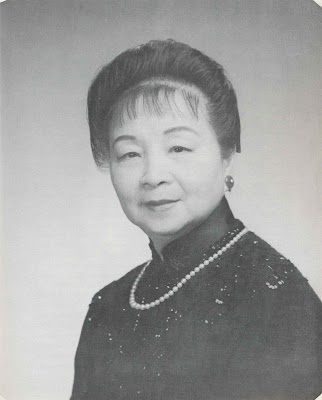
Ching-chih Yee, Artist and Teacher

1936

Ching-chih Yee was born on November 5, 1900, in Hangchow, China. The birth information is from her Chinese Exclusion Act case file, naturalization card and the Social Security Death Index. 

A document dated October 6, 1936, from the Chinese Consulate in Vancouver, British Columbia said Yee was a teacher in Shanghai from 1934 to 1936. The American Consulate General, in Vancouver, B.C., produced an investigative letter, dated October 21, 1936, which said
Miss Yee came to Canada in July, 1936, to display Chinese exhibits at the Chinese Carnival at Vancouver, which was part of the Jubilee program. She has been invited to display these exhibits at the Centennial Central Exposition at Dallas, Texas. She plans to visit various cities in the United States at the close of the Exposition and expects to return to China in March, 1937. The Vancouver Jubilee Committee will provide her return passage to China.
Yee departed Vancouver, aboard the Canadian Pacific Steamship Princess Kathleen, on October 22, 1936. In Seattle, Washington, she was admitted as a visitor the next day. For the next ten years, Yee was granted a series of temporary admission extensions. 

From Seattle, Yee traveled to Dallas. The Texas Centennial Exposition ran from June 6 to November 29, 1936. At the end of the exposition, Yee made her way to New York. Newsweek, December 5, 1938, said she lived in New York beginning January 8, 1937. 

An early sighting of Yee was noted in the Brooklyn Daily Eagle, March 20, 1937. She and artist Chu H. Jor attended the opening of the Frank Crowninshield collection of African Negro Sculpture at the Brooklyn Museum. 

Yee was profiled in the New York Sun, November 24, 1937. 


Chinese Woman Art Professor Teaches Ancient Scroll Painting to New Yorkers
Miss Ching Chih Yee, From Shanghai Art College, Is No Modern—She Goes Back Thousands of Years for Her Precedents.

One of China’s few women professors of painting is reviving the ancient art of the T’angs and the Sungs and the Mings in New York. At 175 Canal street in the Chinese Art Club, Miss Ching Chih Yee opened her first class this week in the art of Chinese scroll painting.

She is doing just what she has been doing in Shanghai for the last five years. She was the only woman professor of Chinese painting in the Shanghai Art College, until she left Shanghai nine months ago. She came to this country at the request of a group of overseas Chinese, to exhibit her work in Vancouver and in Dallas, Texas. Now she has decided to stay in New York until the World’s Fair, where she hopes to hang her scrolls in 1939. Meanwhile, she paints in the mornings, studies English in the afternoon, and teaches Chinese art on two evenings a week.

Her English at the moment is hesitant. It trails off into Mandarin every once in a while. But with the aid of Mr. Chu H. Jor, president of the Chinese Art Club, and in a combination of Mandarin, Shanghai dialect, Cantonese, and English, she told her story yesterday, over cups of tea which she had brewed on the old fashioned gas stove in the corner of her one and a half room apartment at 425 Second avenue.

Not a Modernist.

She paints in the ancient tradition. There are modernists, in China, but she is not one of them. She learned from her grandfather, her father, and her brothers, all of whom were artists.

She prefers her T’ang and her Sung dynasties to any others, but she also paints in the style of the Ming and the Ching dynasties. It depends upon her mood and her subject.

“Here,” she explained, “are two different ones, but both are Sung.” She brought two scrolls, each neatly tied with dark blue tape. from her closet and unrolled them. “This one has lines, squares ... you see?” She pointed to the rather bold outlines of the picture. “But this one is …” she struggled for a word and finally, to illustrate what she meant she sighed very audibly. It was, too, a picture of sighs, with faint washes forming waves and undulating clouds.

She does not paint on an easel. She paints on a flat table. For her minute work she sits down and works close to her picture, as though she were writing. For pictures with bold outlines and little detail she stands up and paints at arm’s length. 

Miss Yee is short and round and rather slow moving. She is calm. Her hands lie still in her lap when she is not talking or painting. Her hands grow expressive when she is talking, because she must illustrate  the words which she cannot remember in English.

Center of Culture.

She is worried about the future of Chinese culture because of what has happened in Peiping and Shanghai. Previously, Peiping was the center of culture for China,” Miss Yee explained through the interpreter. “Then it was Shanghai. For the last ten years there has  been great interest in ancient painting in Shanghai. Nearly 2,000 art students have come from all the provinces of China to study it. But now, if Japan is in command, what will happen to our Chinese culture?” Many art works, she fears, have been destroyed in the bombings. Her own, she has heard, are safe in the French concession.

Miss Yee has never painted from a life model She learned by copying the old masters. She spent weeks, for example, painting hands in every style and position in which hands appeared on the old scrolls. 

Scrolls Give Variety.

Miss Yee not only loves the painting of the Chinese ancients, but she believes that the painting of pictures on scrolls makes for more enjoyment of art. “One week you can have all Mings. The next week you have all Sungs,” she said. Chinese collectors, she sats, change the pictures on their walls every week, because the scroll are so easily handled.

To her first New York class in Chinese painting this week, four Americans came. One of them had expected a lecture. And, said Miss Yee, “he was very surprised when he was given a Chinese brush and some Chinese ink.” But she hopes that she can keep him at it, now that he has started.
The December 1937 issue of Chinese Digest said
N.Y. Art Club Starts Painting Class
New York City — The Chinese Art club, 175 Canal street, which has sponsored many cultural and art activities among the Chinese here, has recently embarked on another activity which promises to bring out art talent and appreciation of Chinese art among Chinese and Americans alike.

This new activity is the engagement of Miss Yee Ching-chih, professor of Chinese painting at the Shanghai Art college. As instructor of Chinese art, Miss Yee has started a class in Chinese painting at the art club’s studios. Classes are being held three times a week, and a limited number of American students may be enrolled.

The Chinese Art club, in announcing this class, said, “This is the first time that such an opportunity to study Chinese art under an experienced native teacher … has ever been made possible in New York.”

This organization is now in its third year of existence and is about the most active one of its kind in the country. Last June it sponsored the first Chinese children’s art exhibition in America which attracted wide attention among American educators and art critics (Chinese Digest for July, 1937, p. 13). The club has an annual membership exhibition, sponsors native plays, and opens its studios for cultural gatherings of all kinds. Its present president is Moowee Tiam.
Yee’s classes were mentioned in Art Digest, December 1, 1937. 
A Class in Chinese Painting: A studio class in Chinese painting is to be conducted by Miss Yee Ching Chih, professor of Chinese Painting at Shanghai Art College, while on her visit to America. At the Chinese Art Club, 175 Canal Street, New York, evening classes will be held three times a week.
The Chinese Digest, March 1938, reported the upcoming New York Chinese Art Club’s exhibition.
Art Club to Hold Painting and Photography Exhibits
New York—The Chinese Art club here will hold its third annual exhibit of paintings and sculpture at the club’s gallery, 175 Canal street, beginning March 1 and extending through March 25. 

The exhibit will include works by Miss Yee Ching-chih, Jack Chen, Chu H. Jor, Kailuen Eng, Moowee Tiam, Tschai Lenzene, Howard Low, and others. Guest exhibitors will include Neysa McNein, Oronzio Maladrelli, Guy Maccoy, Dimitri Romanovesky, and others. 
Beginning April 1 and extending through April 15 the Chinese Art club will hold its second photographic salon. Prints for showing may be submitted by any Chinese in any part of the country, and may be of any size, but must be mounted. Submission of prints must be made on or before March 25, announced W. Yukon, in charge of this exhibit. All pictures submitted will be returned in their original wrappings to the senders after the close of the exhibition.
The New York Times, March 3, 1938, reviewed the exhibition.
The Chinese Art Club’s third annual exhibition was opened to the public yesterday at its galleries, 175 Canal Street. A sign at the entrance announced that the show was dedicated to “the Chinese struggle against Japanese aggression.”

There was little sign of that struggle, however, in the exhibition itself. War scenes were outnumbered by still-lifes by more than two to one. Only five of the fifty-two pictures dealt with the war, and one of these was contributed by Neysa McMein, one of the eight non-Chinese artists exhibiting. 

The most ambitious of the war scenes was K.L. Eng’s painting of a refugee family. It showed a husband and wife fleeing with four children. The other war scenes were all small. They included a drawing of a woman volunteer, by Jack Chen; a wood engraving of a Chinese soldier encouraging men behind him, by Li Chun, and a water-color of a refugee, by Moowee Tiam, the club’s president. 

The rest of the show was made up of pictures of fruits and flowers, pastoral landscapes and peaceful studies of people. And there was little evidence that all but ten of the works were by Chinese artists. Miss Yee Ching-chih’s three pictures and Harry Wong’s landscape were the only ones in the tradition of Chinese painting.

The exhibition will be open until March 25.
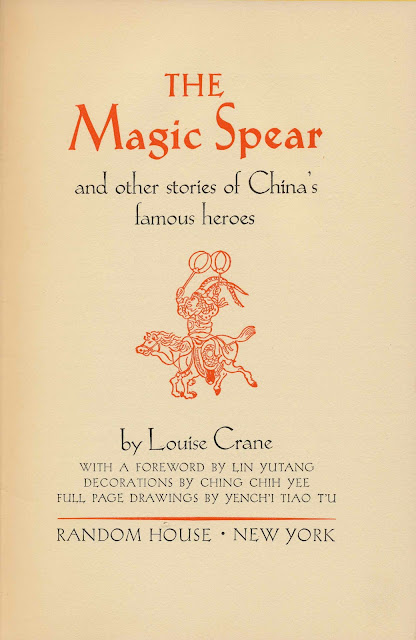
In 1938, The Magic Spear, and Other Stories of China’s Famous Heroes was published by Random House. Louise Crane’s stories featured full-page drawings by Yench’i Tiao T’u and decorations by Yee (below). The book was designed by Evelyn Harter


Horseback rider was taken from a drawing by Yench’i Tiao T’u.


Yee’s gallery show was highlighted in the New York Sun, November 19, 1938.


Paintings in Ancient Manner
Miss Ching Chih Yee’s Work in Divers [sic] Mediums at Tonying Galleries.
The Tonying Gallery, where exhibitions of rare ancient Chinese paintings are often shown, has hung a collection  of contemporary paintings by Miss Ching Chih Yee.

At the preview at 5 East Fifty-seventh street last Saturday, little Miss Yee, in a mixture of Chinese, French and English—the Chinese interpreted by one of her countrymen—told of the great revival in the last ten years of interest in China in the style of painting developed by the “ancients.” She said she had taught painting in China for the last five years, and was the only woman professor of Chinese painting in the Shanghai Art College until she left there nine months ago.

She has made an intensive study of the old Chinese masters under the tutelage of her grandfather, her father and her brothers—all artists. Her exhibition is the first of its kind in New York city, a contemporary Chinese artist painting in the old manner.

Sixteen paintings are shown. Six, in ink and paper, are after the manner of the Sung artists—960-1277. Outstanding among these is the beautifully composed “Prunus,” with strength and simplicity in the rendition of branch and twig structure, studded with blossoms. Miss Yee commented that it represented spring, as “Orchid,” with its long flower sprays, suggests summer. This was one of the favorite subjects of the Yuan masters (1260-1341) such as the great Chao Meng-fu. “Chrysanthemum” and “Bamboo,” typifying autumn and winter, show a more rugged brush stroke than is usually looked for in the old work. Miss Yee’s painting is entirely free from Occidental influence.

“Summer Landscape” and “Winter Landscapes” are the other two in ink on paper, the artist herself, by the way, stating that her preference is for this black and white. Nevertheless, she gets extraordinarily authentic, delicate effects in the old manner using color on silk. One of these, “A Poetess,” shows a large single figure, leaning slightly on a rock on which lies her ink slab. She holds in one hand a red leaf and in the other her brush. The pale pink garment and full white skirt with elaborated knotted long blue cord girdle portray the costume of the Tang period (618-906).

There are ten paintings in color, seven of which are on silk, the other three on paper.
According to the New York, New York Marriage License Index, at Ancestry.com, Yee and Arthur Chor Jhen obtained a license on March 7, 1940. They married on March 9 in Manhattan. Her residence was 425 Second Avenue. Jhen was a contractor who lived at 101 East 116 Street. Five weeks later the newlyweds were counted in the 1940 U.S. Federal Census. They lived at 101 East 116 Street. Yee’s occupation was not stated. 

The New York Sun, March 22, 1941, reported the group show of Chinese artists. 
Chinese Exhibit Decorative Art
Relief Work to Profit by Ritz Tower Show.
Decorative modern Chinese painting fills a gallery in the “Art for ” show at the Ritz-Tower until April 5. C. F. Tau and C. T. Loo, experts on Chinese art, and Prof. George F. Rowley of Princeton, constitute, with Mrs. Carleton S. Cooke, the chairman, the committee. There are approximately one hundred examples. Accordingly to Mr. Yau, this is the first time well-known Chinese artists in this country have exhibited together.

Miss Mai-Mai-Sze, pretty daughter of the former Chinese Ambassador to Washington, who studied in Paris and London and is a graduate of Wellesley, shows an oil, “Eumenides,” a mystical conception of cloud forms resolving into two heads, and two bright-colored watercolors, illustrations for Balinese folktales. Kwan-ye-Chang of Canton, who has served as a war nurse in China, has a group of watercolors, some on silk, some on paper, with some watercolors by her father, a shaggy pony, peony and butterfly, fish, birds in flight, cicadas among grasses, and similar subjects. Miss Ching-chih Yee, who was a professor in the College of Art at Shanghai, has a series, representing the twelve months. Ann Yutseng Hsi, daughter of the general director of the Central Bank of China, has two bright-colored modern watercolors of children at play, and two old-style hanging scroll paintings.
Yee’s Christmas tree appeared in the Brooklyn Eagle, December 21, 1941. 

Art News, November 15–30, 1942, said Yee was one of the fine artists chosen to create designs for Castleton China, Inc. Ma Lin was the name of Yee’s line of dinnerware. 

Beginning in 1947, advertisements for Ma Lin appeared in numerous newspapers and magazines including House Beautiful, House & Garden, Living for Young Homemakers and Sunset


The Evening Star (Washington, DC), December 10, 1947, reported the following. 
Two Chinese Versions of Christian Art to Be Presented C.U.
Two Chinese interpretations of Christian art, painted with imperial Chinese colors 300 years old which will remain bright and true for 1,000 years to come, will be presented to Catholic University Sunday by Mme. Ching-Chih Yee, internationally known Chinese artists.

Presentation of the art works—“Our Lady of Refugees” and “The Good Shepherd”—will be at 4 p.m. in the Mullen Library, under joint auspices of the University and the Institute of Chinese Culture.

Ambassador Koo to Speak.

Speakers will be Archbishop Paul Yu-Pin, of Nanking, Chinese Ambassador Wellington Koo, and the Right Rev. Msgr. Edward B. Jordan, vice rector of the university.

The ceremony will be attended by well-known figures of Washington’s art colony, prominent churchmen and educators, officers of the institute and Catholic University faculty members. Following the presentation the university will honor Mme. Yee at a tea.

Mme. Yee, who is from a distinguished family of artists, spent two years in painting the interpretations. Born in Hanchow, she is said to be one of the few contemporary Chinese artists who remains free from Occidental influences, and her paintings have been described as being unsurpassed for purity of Chinese conception and distinctive Chinese technique.

Art Exhibition on Tour.

Mme. Yee is the founder and director of Shanghai’s Chinese Women’s Art Society. Two volumes of her paintings, published in Shanghai in 1936, are well known in China.

During a world tour in 1937 her works were shown at international exhibitions in Canada and in France, and later throughout the United States. She was twice invited by the Brooklyn Museum to demonstrate her distinctive Chinese technique to art students. In 1934 her paintings were exhibited in the Metropolitan Museum of Art in New York.

Mme. Yee also is the founder of the New York Chinese Art Club.
In a follow-up story, the Evening Star, December 28, 1947, said 
Two Chinese interpretations of Christian art. “Our Lady of Refugees” and “The Good Shepherd,” recently were presented to Catholic University by the internationally known artist, Mme. Ching-Chih Yee, under joint auspices of Catholic University and the Institute of Chinese Culture.

Mme. Yee worked for two years on these paintings, using imperial Chinese colors 300 years old, which will remain bright and true for 1,000 years to come. Born in Hanchow, she comes from a distinguished family of artists. She is one of the few contemporary Chinese artists who remain free from Occidental influences. Her work is noted for purity of Chinese conception and distinctive Chinese technique.

Mme. Yee is the founder and director of Shanghai's Chinese Women’s Art Society. She also founded the New York Chinese Art Club. During a world tour in 1937, her works were shown at international exhibitions in France and Canada, and later in the United States. She was invited by the Brooklyn Museum to demonstrate Chinese technique to art students. Earlier, some of her work was exhibited at the Metropolitan Museum of Art, New York City.
In 1949 Castleton China introduced the “Museum Shape” dinnerware. Yee’s pattern was called Mandalay


Yee’s “Moon Goddess” plaque was part of the exhibition of Castleton China plates and plaques by seventeen artists as reported by the Milwaukee Journal, (Wisconsin), April 15, 1949. “Moon Goddess” was included in the Castleton China Collection by Contemporary Artists traveling exhibition which began in New York, September 1949 and continued into 1950. Among the artists represented were Picasso, Salvadore Dali, Stuart Davis, Modigliani, John Marin, Thomas Hart Benton and Georges Braque.


On January 25, 1954, Yee, as Lily Yee Jhen, became a naturalized citizen according to the New York Index to Petitions for Naturalization at Ancestry.com. Her husband was naturalized on May 25, 1959.


Yee’s show at Argent gallery was noted in Art News, April 1955, and Art Digest, April 1, 1955. 

The 1959 Manhattan, New York telephone directory listed Yee and her husband’s residence at 549 West 123rd Street.


A mid-1960s issue of 中外畫報 (Chinese and Foreign Pictorial) said 
Miss Ching-Chih Yee Prints New Painting Album
Miss Ching-Chih Yee, a classical Chinese painter in New York, recently published the third and fourth albums of her artistic studies. 

The new publications as addenda to the first two books printed in Shanghai in 1936 contain a selection of her work completed in Canada and the U.S.A. in the last three decades, and several other noted painters all commended her highly for what she had achieved.

Miss Yee crossed the Pacific Ocean in the early years of the Sino-Japanese war. Under the sponsorship of overseas Chinese in Canada, she attended the fiftieth anniversary of Vancouver exhibiting her work and demonstrating classical Chinese painting. She also participated in the centennial celebration of Dallas in Texas.

She has since settled down in New York teaching painting in colleges and in private. During these years, she has held several exhibitions in New York, Boston, Chicago and other cities. 

The St. John’s University in Jamaica, New York, last year presented her a president’s medal for lier contribution in the promotion of cultural cooperation between the Republic of China and the United States.
The Paintings of Ching-Chih Yee Number 3 and Number 4 were self-published circa 1965. 

Cover for Numbers 3 and 4

Letter accompanying the two volumes

Number 3
Page 1: Foreword (in Chinese) by Prof. Chang Dai-Chien
Page 2: Foreword (in Chinese) by Y.Y. Pan
Page 3: Foreword (in Chinese) by Dr. C.P. Cheng
Page 4: Foreword
Miss Ching-chih Yee is one of the few contemporary Chinese artists whose training and technique are firmly rooted in the past and who are not influenced by western art. Her paintings have been widely exhibited in the United States. These include twice inclusions in the exhibits of Chinese art in the Metropolitan Museum of New York, one-man exhibitions in New York, Boston and Chicago in the last two decades, and a tour of her paintings in the United States under the auspices of the American Federation of Art in 1943. For about thirty years, she has been a resident of the United States. 

We are fortunate in having preserved here some of her best achievements. One of her best, “The Prunus” is not here. But some of her best distinctly are, including the landscape a la Mi Fei, the copy of Chou Fang of Tang Dynasty (“Ladies at Embroidery”) and the copy of the Yuan master Ch’ien Hsuan (“Insects”), which are in my possession. A reproduction on a reduced scale hardly does justice to the fineness of her work in “Insects” or to her antique coloring in “Ladies at Embroidery”. On the whole, she excels in fine details of the type known as the “Northern School”, but this collection gives a good view of the favorite themes of Chinese art, including the supreme view of a misty river scene. Miss Yee does not go for free, bold strokes of the literati school of painting, but the true Chinese feeling for nature and its various objects is unmistakably there.
Lin Yutang
June 30, 1965, New York
Page 5: Foreword
Miss Ching-chih Yee comes from a family which for three generations has loved and cultivated the art of drawing and painting. 

Having received her early artistic training from her father and elder brother, she has sought to broaden her education by studying under several well-known masters.

From childhood onward, she has been a most methodical and diligent worker, seeking always to perfect her technique in all its phases and details.

Very few Chinese artists of her generation have undergone such a thorough and disciplined training as she has.

Miss Yee is one of the very few contemporary painters who have remained free from the influences of Occidental painting. 

Her works represent Chinese drawing and painting in their truest tradition and best technique.
Hu Shih
Page 6: Introduction (in Chinese)
Page 7: Biography
Miss Ching-Chih Yee
Miss Yee is a descendant of a family of artists. Her grandfather, father and bothers were all artists, and she has been painting and writing poetry ever since she was a young girl. She started teaching painting when she was still under twenty. Born in beautiful and romantic Hangchow, she has had a rich background. Her native city was famous through the centuries for its great painters, poets, and scholars who made it their home, situated by one of the most beautiful lakes (West Lake) in the world, dotted with tiny islands, pavilion crowned; the monasteries and temples rich in legends and stories, and the brilliant and artistic memories of the court of the Sung Dynasty. 

Miss Yee taught art for five years at the Shanghai Art College where she was the only woman professor of Chinese painting. She was the founder and one of the directors of the Chinese Women’s Art Society in Shanghai. Her work has been widely exhibited in China. At the request of a group of Chinese in this country, Miss Yee came here in the Spring of 1937 to exhibit. Her paintings were shown at the International Exhibitions at Vancouver and at Dallas in the same year, and in New York at the Tonying Chinese Art Gallery, 5 East 57th Street, in November 1938. Soon after her arrival in New York City, she began to give lessons in Chinese pinging at the Chinese Art Club, and she has also had many private pupils, both Chinese and American. She has had equal success in decoration. She painted a beautiful series of four murals, landscape in color, representing the four seasons of the year, for one of New York’s loveliest homes. She was twice invited by the Brooklyn Museum to demonstrate her painting to the art students. She has also designed porcelain in the Chinese manner for the Castleton China, Inc. in a series, contributed to by such outstanding American artists as Thomas Henry Benton, and others. Her designs and the finished ware were exhibited in the Winter of 1942 in New York, and in the Spring of 1943 in Boston, Chicago and other cities. Her paintings were exhibited at the Metropolitan Museum of Art in January and February, 1943, and the Pennsylvania Museum of Art in March and April, 1943. In the Autumn of 1943, her paintings were exhibited in many cities in the United States under the auspices of the American Federation of art. On many occasions in the past 20 years, her paintings were exhibited in various places in the United States in conjunction with the works of other artists. She had two private exhibits in New York City in 1955, one was in China Institute in America and the other in Tonying and Co., Inc. Her latest private exhibit was in China House in New York City, November 2, 1964.
Page 8: photograph of Ching-Chih Yee


Page 9: Titles of art (in Chinese)
Page 10: Contents and titles of art (black-and-white plates unless noted otherwise) 

The Madonna

Pages 11–40: “Jesus the Son of God” (color); “The Madonna” (color); certificate from Catholic University of America, Washington, DC, December 14, 1947 (color); “Kwan Yin, the Goddess of Mercy”; “A Chinese Trick”; “Landscape”; “Eagle and Pine”; “Chrysanthemum and the Cock”; “Butterflies No. 1”; “Butterflies No. 2”; “Eight Poets, No. 1: Ho Chih-Chang”; “Eight Poets, No. 2: Wang Ju-Yang”; “Eight Poets, No. 3: Li Shih-Chih”; “Eight Poets, No. 4: Chun Chung-Chih”; “Sword Dance”; “Meandering”; “Landscape No. 1”; “Landscape No. 2”; “Ten Spring Flowers No. 1”; “Ten Spring Flowers No. 2”; “Feast of the Moon Goddesses”; “Chinese Pavilion at the New York World’s Fair 1964–65” (color); “Spring Flowers”; “Ladies of the Court No. 1, inscription by Chang Dai-Chien”; “Ladies of the Court No. 2”; “Ladies of the Court No. 3”; “Ladies of the Court No. 4”; “Ladies of the Court No. 5”; “Ladies of the Court No. 6”, inscription by Dr. Lin Yutang; “Flowers and Bird”; “Flowers and Insects”

Number 4
Page 1: Titles of art (in Chinese)
Page 2: Contents and titles of art (black-and-white plates unless noted otherwise) 

Needlework

Emperor Flying to the Moon

Pages 3–40: “Needlework” (color); “Landscape”; “Lotus and Mandarin Duck”; “Trees and Birds in Chills of Autumn”; “Landscape No. 1”; “Landscape No. 2”; “Landscape No. 3”; “Eight Poets, No. 5: Su Chin”; “Eight Poets, No. 6: Li Pai”; “Eight Poets, No. 7: Chang Hsu”; “Eight Poets, No. 8: Chiao Sui”; “The Emperor’s Concubine Drinking”; “Insects–Scroll No. 1: Inscription by Prof. Chang Dai Chien”; “Insects–Scroll No. 2”; “Insects–Scroll No. 3”; “Emperor Flying to the Moon” (color); “Roses and Birds”; “Autumn Flowers and Insects”; “Landscape”; “Lady of the Court”; “Spring Flowers”; “Summer Flowers”; “Autumn Flowers”; “Winter Flowers”; “Goddess go Yang Tai-Chen”; “Golden Thread–Scroll No. 1: Plants and Insects”; “Golden Thread–Scroll No. 2: Plants and Insects”; “Golden Thread–Scroll No. 3: Inscription by Celebrities”; “Golden Thread–Scroll No. 4: Inscription by Celebrities”; “Four Flowers and Fruit with Insects”; “Flowers with Insects”; “Lady Grieving for Passing of Spring”; “Goddess of Longevity”; “Wang You-Chun Visiting His Teacher” (color); “New Year’s Flowers”; “Four Flowers and Birds”; “Pine Tree and Chrysanthemums with White Cranes”; “Flowers and Bird” (color)

The St. Luke’s Hospital Center 1974 Annual Report listed Yee and her husband as contributors in the $100 to $500 range. 

Yee passed away in February 1980 according to the Social Security Death Index which said her last residence was New York City.


Further Reading and Viewing
Google Arts and Culture, photograph of Ching-chih Yee painting
Asian American Art: A History 1850–1970  (2008), No-Yong Park studied under Ching-chih Yee 


Friday, March 18, 2022

The Yellowface Magician: Ching Ling Fu, Tung Pin Soo and Chop Chop

Arthur Henry “Al” Wheatley was a magician who used the Chinese-sounding names Ching Ling Fu, Tung Pin Soo (and sometimes as Tung Ping Soo) and Chop Chop. Billboard magazine identified Wheatley as an Irishman but he was born to an English father, Samuel Wheatley, and German mother, Johanna Wilms. According to Wheatley’s World War II draft card and the Social Security Death Index, he was born on March 26, 1901. A 1908 passenger list, at Ancestry.com, recorded his birthplace as Fremantle, Australia. The same birthplace was recorded on his mother’s 1936 and 1939 naturalization papers, which named her three children, however, Wheatley’s birth date was listed as March 25, 1900. 

On April 30, 1908, Wheatley, his older brother, John, and mother were aboard the S.S. Friedrich Der Grosse when it departed Genoa, Italy. They arrived in the port of New York on May 14. They were bound for Westerley, Rhode Island. 

The 1910 U.S. Federal Census recorded Wheatley, his parents, brother and sister in New Britain, Connecticut at 150 Cleveland Street. Wheatley’s father was a laborer. 

According to the 1920 census, the Wheatley family lived in Salem, Connecticut, where Wheatley, his father and brother worked on their farm. 

On January 8, 1926, Wheatley’s father passed away in Hartford, Connecticut. The 1926 Hartford, Connecticut city directory said Wheatley and his siblings boarded in Farmington. 

The New York, New York, Marriage License Index, at Ancestry.com, said Wheatley and Isabelle L. Dubuque obtained a license in Manhattan on September 15, 1927. Their daughter, Loraine, was born in Cleveland, Ohio on October 22, 1928.

Wheatley has not yet been found in the 1930 census. His mother, brother and two sisters were in Hartford. 

The Illustrated History of Magic (1996) said Wheatley “worked as Jean Hugard’s assistant, before he too became an expert ‘Chinese’ magician; first as Ching Ling Fu*, then as Tung Pin Soo, and eventually as Chop Chop.” Hugard was born John Gerard Rodney Boyce in Australia and performed a Chinese routine in his magic act.

Billboard, August 15, 1931, published the column Magic Notes by Bill Sachs who wrote
Bailey, magician and hypnotist, chirps from Hartford, Conn.; “Must say that Newton LuMar is right. Hart­ford had had about four visiting magi in the last year. Hartford audiences eat up magic, and it’s a shame some of the vaude magi don’t take advantage of this. ... In recent weeks three of the Hartford boys have given benefit shows at the local poor children’s camp. Those donating their services were Ching Ling Fu, E. K. Schleldge and myself. ...
In Billboard, October 17, 1931 Sachs said
Lots of magical activity around Hartford, Conn., these days, according to work received from Derby Hicks. Lon Yuen and Company recently played the Cameo Theater, that city and kept the local magi guessing with their clever exhibition. Bailey is corralling a lot of club dates within a 30-mlle radius of Hartford. Ching Ling Fu la repeating on a flock of his last year dates. ... 
Sachs reported the Valley Conjurers’ Association, Assembly No. 17, Springfield, Massachusetts event in Billboard, February 20, 1932. Magic performances were by Walter A. Schwartz, New Britain; Al Wheatley (Ching Ling Fu), Hartford, and Walter Getaler, Westfield. 

According to the Philadelphia Inquirer (Pennsylvania), April 23, 1933, Ching Ling Fu performed in a children's benefit at the Penn Athletic Club. 

Billboard, October 7, 1933, said “Al Wheatley (Ching Ling Fu) and his charming wife have been playing the local houses with their beautiful Chinese act.”

The Newton Graphic (Massachusetts), August 30, 1935, said Ching Ling Fu appeared at the annual Read Fund Picnic for children. 

Wheatley’s mother’s June 2, 1936 naturalization application, Declaration of Intention, said Wheatley was a Boston, Massachusetts resident. Wheatley became a naturalized citizen on October 18, 1937 in Massachusetts, according his naturalization card at Ancestry.com.

The Philadelphia Inquirer, April 1, 1936, reported several upcoming nightclub acts.
... Jack Lynch has taken a flying trip to the South in an endeavor to get some new talent for his already sparkling Continental Revue at the Cafe Marguery in the Adelphia. Bob Roltner, master of ceremonies, presents Bob du Pont, Tung Pin Soo, Ruth Laird and her Texas Rockets, Kay Kernan, lovely blues singer; Pritchard and Lord, ballroom dancers; John Tio in an unusual European novelty and Evan Burrows Fontaine, popular star of screen and stage. The orchestras of Eddie Bonnelly and Vincent Rizzo provide the music, with Agnes Tolle at the harp.
The Inquirer, February 21, 1937, announced the performers following the screening of James Cagney’s “Great Guy” at Fays theater. 
“The Casa Mana[na] Revue” is the stage attraction, with Sid Page and his Pages of Fun; Yeva in her “San Mariko Dance,” Happy Delano Dell, Tung Pin Soo and Company, Larimer and Hudson, Mary and Bob Miland, Hazel Kennedy.
Variety, October 5, 1938, said Tung Ping Soo was at the Hotel Schroeder in Milwaukee, Wisconsin.

Milwaukee Journal (Wisconsin), October 11, 1938
detail of advertisement, see left side text

Times-Picayune (New Orleans, Louisiana)
November 10, 1938

Wheatley and his wife (a Hartford, Connecticut native) were aboard the S.S. Argentina when it departed Buenos Aires on February 17, 1939. They arrived in New York on March 6. The passenger list said Wheatley’s address was ”Colchester, Conn., R.F.D. #4”.

Wheatley’s mother’s Petition for Naturalization application, signed January 19, 1940, said Wheatley lived in Chicago, Illinois. He has not yet been found in the 1940 census. At some point Wheatley divorced Isabelle and married Charlene June Johnson who became part of the act as Lady Soo (below). 


This Week in Chicago, April 25, 1942

On February 16, 1942, Wheatley signed his World War II draft card. His home address was that of his employer, the Music Corporation of America, 430 North Michigan Avenue in Chicago, Illinois. His description was seventy-one and a half inches, 150 pounds, with blue eyes and brown hair. 

Billboard, March 20, 1943, reviewed Wheatley’s act and said 
Tung Pin Soo, the Irishman who has developed an enjoyable Chinese character in make-up and mannerisms, holds attention with his versatile magic act. Works with cigarettes, cards, coins, among other objects, and binds all the tricks into a smoothly running act. His cute wife, also in a Chinese outfit, helps with the props.
Evansville Press (Indiana), February 5, 1943

Chicago Daily News (Illinois), September 4, 1943

Milwaukee Sentinel (Wisconsin), October 7, 1946

Times-Union (Albany, New York), February 7, 1947

Brooklyn Eagle (New York) August 22, 1947

The Times-Union (Albany, New York), December 19, 1948, published an article by George Dixon. 
I was talking to a very clever “Chinese” magician, who bills himself as Tung Pin Soo, and asked him how he got his start in magic.

“By washing ducks for Long Tack Sam,” he replied.

This was far from the answer I expected, because, when you ask a magician how he got his start, he usually gives you some high-blown story, wrapped in the occult.

“The ducks,” he continued, “would get very grimy from disappearing and reappearing and it was my job to launder them. Sometimes they wouldn’t get clean, so I used to rub them with chalk and talcum.”

The mysterious Oriental, who, privately, is Mr. Al Wheatley, of Australia, had reason to wish one time he hadn’t adopted the Chinese character. The immigration officials in Brazil were expecting a Chinese and put him to hours of inquisition. Then the customs people grabbed him on suspicion of being a professional smuggler because they found secret compartments in his props.

Mr. Wheatley’s career as a magician in his own right came close to being terminated almost at the outset. He was given a small spot on a musical production featuring Sally Rand. One of his chickens got away and flopped onto the top of the piano in the orchestra pit.

The pianist tried to grab it but the hen kept inching out of reach.

Mr. Wheatley finished his act. The curtain then parted for the star’s big entrance.

Miss Rand, swinging her fans, advanced majestically down a great flight of stairs. Possibly the chicken mistook her for a giant relative, for it began to cackle like mad. Miss Rand exited from the stage in hysterics.

“You get that blankety-blank Chinaman and his poultry out of this show!” she screamed. “I won’t work in the same theatre with his blasted hens!”

Mr. Wheatley managed to stay on only by promising Miss Rand she would henceforth be the only one in the show with feathers.
At the Chicago nightclub Rio Cabana, Tung Pin Soo was the opening act for Dean Martin and Jerry Lewis. 

Billboard, December 22, 1951, reported Wheatley’s new stage name. 
Bearing out a statement made here last week Al Wheatley scribbles from Toronto that he will sail for England in April. Wheatley has dropped his Tung Pin Soo billing and is now working with his comely wife as Chop Chop and Charlene, still doing the Chinese routine. They open this week at the Shoreham Hotel, Washington. “Have had a long and successful tour,” Wheatley writes, including stops in Las Vegas, Reno, Lake Tahoe, Seattle, Portland, Spokane, Philadelphia, Montreal, Toronto and Buffalo, and have found business good in general. 
The Times-Union, April 24, 1953, said 
Portions of an excellent movie “Trouble Along the Way”, starring John Wayne and Charles Coburn, will be shown on Ed Sullivan’s “Toast of the Town” tonight ... Elaine Dunn, dancer, Chop-Chop and Charlene are other attractions on the Sullivan show.
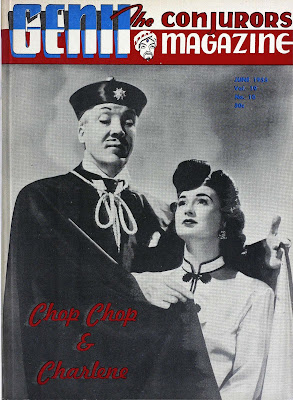
Chop Chop and Charlene were featured on the covers of Genii June 1955 (below) and September 1959


On July 2, 1961, Chop Chop and Charlene appeared on the Ed Sullivan Show (below).  


Wheatley passed away on November 12, 1964, according to a report filed at The Hague.
[Google Translation]
According to an extract from the daily register of the steamship “Statendam” of the limited liability company Dutch-American Steamship Company

“Holland-American Line” in Rotterdam passed away on November twelve, nineteen hundred and sixty-four, at fifteen hours, zero minutes, on board reported bottom, located in Suva, Fiji Islands: Wheatley, Arthur Henry, last domiciled in Hollywood, California in United States of North American, aged sixty-three, married to: Johnson, Charlene June, son of: Wheatley, Samuel and: Johanna, both deceased. Of which deed, on the twenty-first day of December, nineteen hundred and sixty-four. The civil registrar of The Hague.
The Hartford Courant (Connecticut), November 15, 1964, obituary said Wheatley died on Friday, November 13. 
Arthur Wheatley Dies, Former City Magician 
Arthur H. Wheatley, 63, Hollywood, Calif., formerly of Hartford, a magician and night club entertainer, died Friday aboard the SS Stratendam [sic]. A native of Hartford, he moved to Hollywood several years ago and has since appeared in several night clubs. He has appeared on the Ed Sullivan show and in many local magic shows during his career as an entertainer. He leaves his wife, Mrs. Charlene Wheatley; a daughter, Mrs. Joseph Sasso of Chicago, Ill.; a sister, Miss Gladys M. Wheatley of Hartford, and five grandchildren. 

* Ching Ling Fu was a variation on the name of Chinese magician, Ching Ling Foo, who was impersonated by Sigmund Neuberger. Another similar name was Chung Ling Soo who was William E. Robinson


Further Reading and Viewing
Photographs here and here 
Magic Tricks, Science Facts (1990), pages 67–71: Chop Chop’s Cup 
Magicpedia, The Chop Cup


 (Next post on Friday: Ching-chih Yee, Artist and Teacher)